Department of Physiology, Autism Research and Treatment Center, Al-Amodi Autism Research Chair, Faculty of Medicine, King Saud University, Riyadh, Saudi Arabia.
J Neuroinflammation. 2012 Jul 2;9:158. doi: 10.1186/1742-2094-9-158.
The T-helper (Th)1/Th2 dichotomy dominated the field of immune regulation until interleukin (IL)-17-expressing T cells (Th17) were proposed to be a third lineage of helper T cells, the key players in the pathogenesis of autoimmune disorders. Autoimmunity to brain tissue may play a pathogenic role in autism. IL-17A is a pro-inflammatory cytokine that has been shown to play an important role in various autoimmune neuroinflammatory diseases. The aim of this study was to measure serum levels of IL-17A in relation to the degree of the severity of autism.
Serum IL-17A levels were measured by ELISA in 45 children with autism and 40 matched healthy controls.
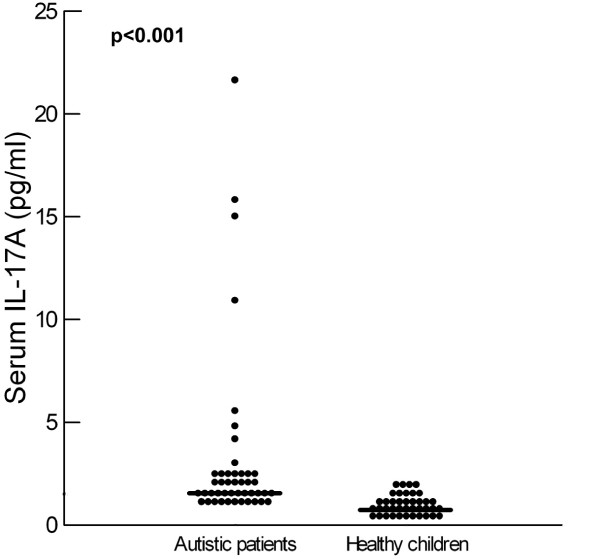
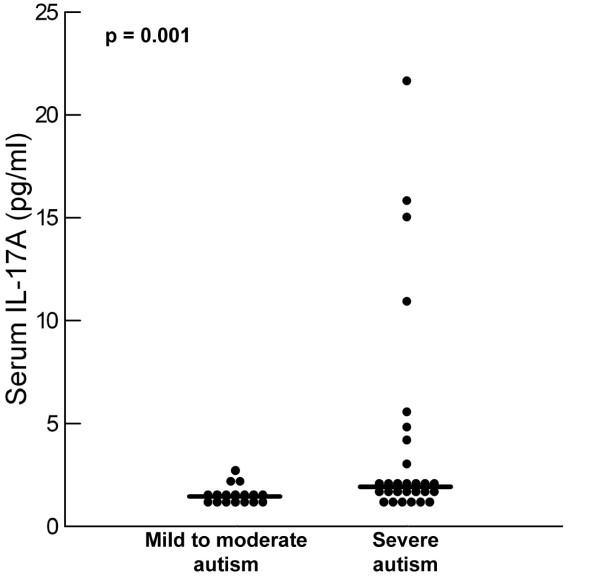
Children with autism had significantly higher serum IL-17A levels than healthy controls (P <0.001), with increased serum levels of IL-17A found in 48.9% of the autism group. Patients with severe autism had significantly higher serum IL-17A levels than those with mild to moderate autism (P=0.01), and raised serum IL-17A levels were significantly more common in children with severe autism (67.9%) than in those with mild to moderate autism (17.6%), P=0.001.
Serum IL-17A levels were raised in the group with autism, and the levels correlated significantly with the severity of autism. This is the first study to measure levels of IL-17A in relation to the severity of autism, to our knowledge. Further research, with a larger subject population, is warranted to determine whether the increase of serum IL-17A levels plasma has a pathogenic role in autism, and whether anti- IL-17A therapy could be useful.
直到白细胞介素(IL)-17 表达 T 细胞(Th17)被提出是辅助 T 细胞的第三谱系,成为自身免疫性疾病发病机制的关键因素,Th1/Th2 二分法主导了免疫调节领域。脑组织自身免疫可能在自闭症中起致病作用。白细胞介素-17A(IL-17A)是一种促炎细胞因子,已被证明在各种自身免疫性神经炎症性疾病中发挥重要作用。本研究旨在测量与自闭症严重程度相关的血清 IL-17A 水平。
通过 ELISA 法测量 45 名自闭症儿童和 40 名匹配健康对照者的血清 IL-17A 水平。
自闭症儿童的血清 IL-17A 水平明显高于健康对照组(P<0.001),自闭症组中 48.9%的患者发现血清 IL-17A 水平升高。严重自闭症患者的血清 IL-17A 水平明显高于轻度至中度自闭症患者(P=0.01),严重自闭症患儿的血清 IL-17A 水平升高更为常见(67.9%),而轻度至中度自闭症患儿则较低(17.6%),P=0.001。
自闭症组血清 IL-17A 水平升高,且与自闭症严重程度显著相关。据我们所知,这是第一项测量自闭症严重程度与 IL-17A 水平相关的研究。需要进一步研究,纳入更大的研究人群,以确定血清 IL-17A 水平升高是否在自闭症中具有致病性作用,以及抗 IL-17A 治疗是否有用。