Department of Chemistry, Yale University, New Haven, Connecticut 06520, United States.
ACS Chem Biol. 2012 Jul 20;7(7):1139-51. doi: 10.1021/cb300119g. Epub 2012 Jul 3.
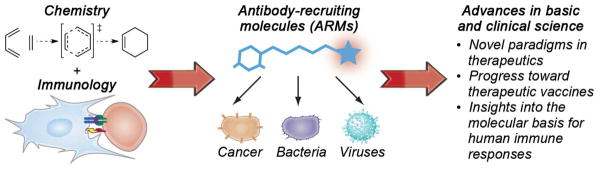
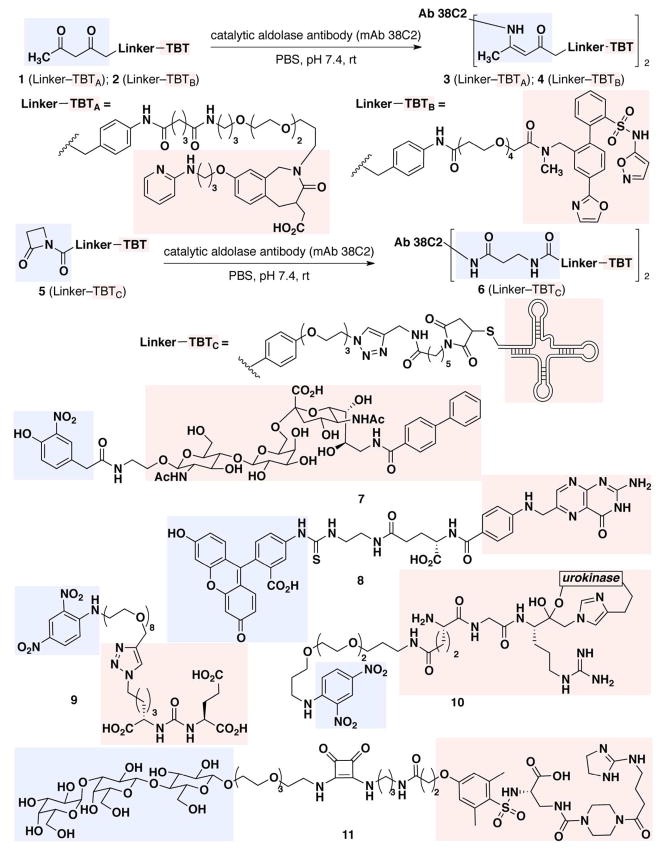
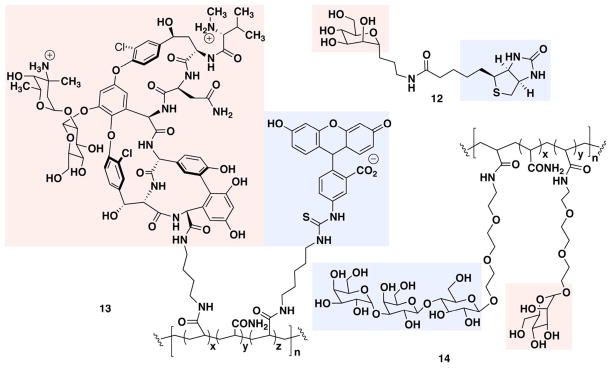
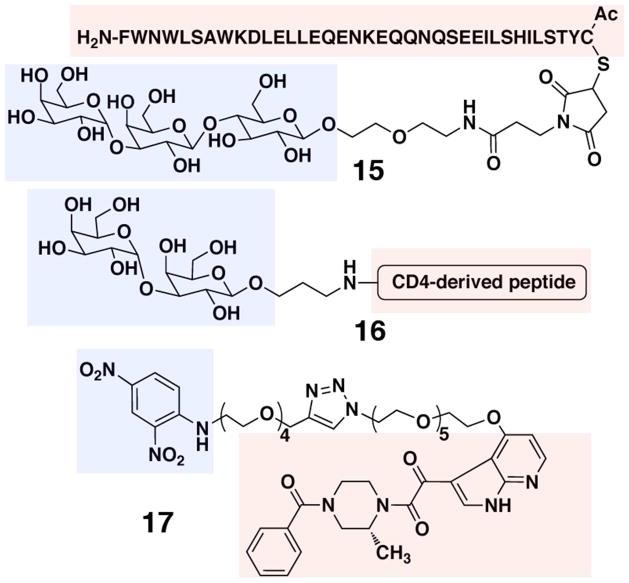
Synthetic immunology, the development of synthetic systems capable of modulating and/or manipulating immunological functions, represents an emerging field of research with manifold possibilities. One focus of this area has been to create low molecular weight synthetic species, called antibody-recruiting molecules (ARMs), which are capable of enhancing antibody binding to disease-relevant cells or viruses, thus leading to their immune-mediated clearance. This article provides a thorough discussion of contributions in this area, beginning with the history of small-molecule-based technologies for modulating antibody recognition, followed by a systematic review of the various applications of ARM-based strategies. Thus, we describe ARMs capable of targeting cancer, bacteria, and viral pathogens, along with some of the scientific discoveries that have resulted from their development. Research in this area underscores the many exciting possibilities at the interface of organic chemistry and immunobiology and is positioned to advance both basic and clinical science in the years to come.
合成免疫学,即开发能够调节和/或操纵免疫功能的合成系统,是一个具有多种可能性的新兴研究领域。该领域的一个重点是创造能够增强抗体与疾病相关细胞或病毒结合的低分子量合成物质,称为抗体募集分子(ARM),从而导致其免疫介导的清除。本文全面讨论了这一领域的贡献,首先介绍了基于小分子的调节抗体识别的技术历史,然后系统地综述了基于 ARM 的策略的各种应用。因此,我们描述了能够靶向癌症、细菌和病毒病原体的 ARM,以及由此产生的一些科学发现。该领域的研究强调了有机化学和免疫生物学界面的许多令人兴奋的可能性,并有望在未来几年推动基础科学和临床科学的发展。