
基于模型的贝叶斯估计结核分枝杆菌 VNTR 位点的进化率。
A model-based Bayesian estimation of the rate of evolution of VNTR loci in Mycobacterium tuberculosis.
机构信息
School of Mathematics and Statistics, University of New South Wales, Sydney, New South Wales, Australia.
出版信息
PLoS Comput Biol. 2012;8(6):e1002573. doi: 10.1371/journal.pcbi.1002573. Epub 2012 Jun 28.
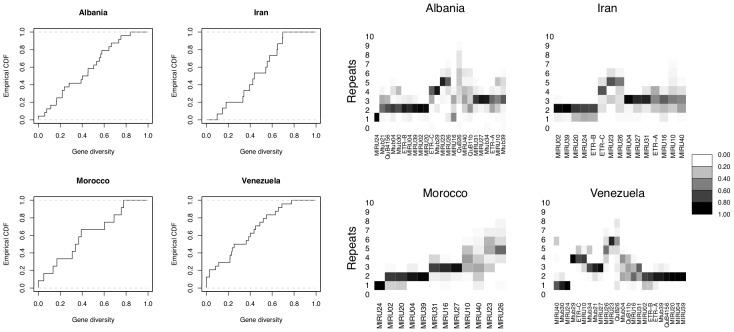
Variable numbers of tandem repeats (VNTR) typing is widely used for studying the bacterial cause of tuberculosis. Knowledge of the rate of mutation of VNTR loci facilitates the study of the evolution and epidemiology of Mycobacterium tuberculosis. Previous studies have applied population genetic models to estimate the mutation rate, leading to estimates varying widely from around 10⁻⁵ to 10⁻² per locus per year. Resolving this issue using more detailed models and statistical methods would lead to improved inference in the molecular epidemiology of tuberculosis. Here, we use a model-based approach that incorporates two alternative forms of a stepwise mutation process for VNTR evolution within an epidemiological model of disease transmission. Using this model in a Bayesian framework we estimate the mutation rate of VNTR in M. tuberculosis from four published data sets of VNTR profiles from Albania, Iran, Morocco and Venezuela. In the first variant, the mutation rate increases linearly with respect to repeat numbers (linear model); in the second, the mutation rate is constant across repeat numbers (constant model). We find that under the constant model, the mean mutation rate per locus is 10⁻²·⁰⁶ (95% CI: 10⁻²·⁶¹,10⁻¹·⁵⁸)and under the linear model, the mean mutation rate per locus per repeat unit is 10⁻²·⁴⁵ (95% CI: 10⁻³·⁰⁷,10⁻¹·⁹⁴). These new estimates represent a high rate of mutation at VNTR loci compared to previous estimates. To compare the two models we use posterior predictive checks to ascertain which of the two models is better able to reproduce the observed data. From this procedure we find that the linear model performs better than the constant model. The general framework we use allows the possibility of extending the analysis to more complex models in the future.
可变数目串联重复(VNTR)分型广泛用于研究结核病的细菌病因。VNTR 基因座突变率的知识有助于研究结核分枝杆菌的进化和流行病学。先前的研究应用群体遗传学模型来估计突变率,导致估计值从每年每个基因座约 10⁻⁵到 10⁻²变化很大。使用更详细的模型和统计方法解决这个问题将导致在结核病分子流行病学中的推断得到改善。在这里,我们使用一种基于模型的方法,该方法在疾病传播的流行病学模型中包含了 VNTR 进化的两种逐步突变过程的替代形式。我们使用这种模型在贝叶斯框架中,从来自阿尔巴尼亚、伊朗、摩洛哥和委内瑞拉的四个 VNTR 图谱发表数据集估计结核分枝杆菌中 VNTR 的突变率。在第一个变体中,突变率随重复数线性增加(线性模型);在第二个变体中,突变率在重复数之间保持不变(常数模型)。我们发现,在常数模型下,每个基因座的平均突变率为 10⁻²·⁰⁶(95%置信区间:10⁻²·61,10⁻¹·58),在线性模型下,每个重复单位的每个基因座的平均突变率为 10⁻²·⁴⁵(95%置信区间:10⁻³·07,10⁻¹·94)。与以前的估计相比,这些新的估计代表了 VNTR 基因座的高突变率。为了比较这两种模型,我们使用后验预测检查来确定哪一种模型能够更好地再现观察数据。从这个过程中,我们发现线性模型的表现优于常数模型。我们使用的一般框架允许将来将分析扩展到更复杂的模型。




 Zotero 插件