Swiss Center for Affective Sciences, and the Laboratory for the Study of Emotion Elicitation and Expression, Department of Psychology, University of Geneva, Geneva, Switzerland.
PLoS One. 2012;7(6):e37857. doi: 10.1371/journal.pone.0037857. Epub 2012 Jun 21.
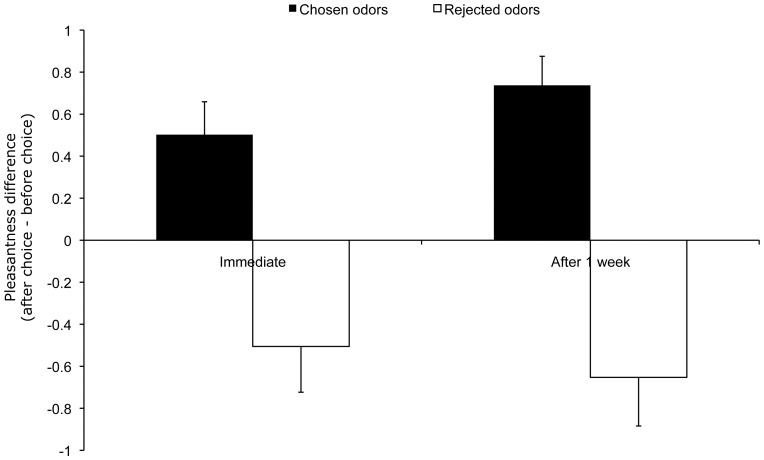
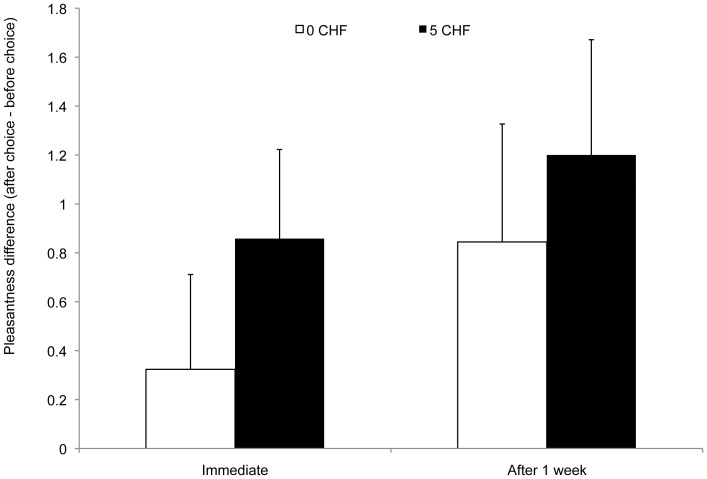
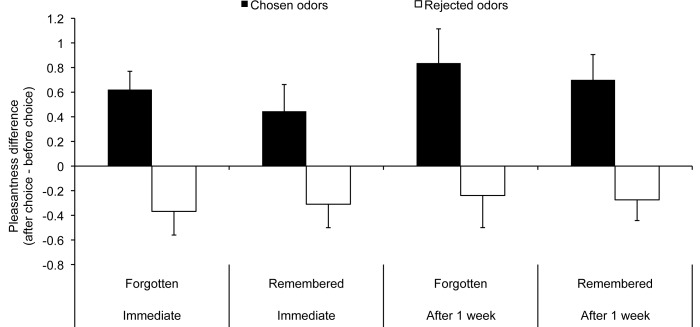
Preferences are traditionally assumed to be stable. However, empirical evidence such as preference modulation following choices calls this assumption into question. The evolution of such postchoice preference over long time spans, even when choices have been explicitly forgotten, has so far not been studied. In two experiments, we investigated this question by using a variant of the free choice paradigm: In a first session, participants evaluated the pleasantness of a number of odors. We then formed pairs of similarly rated odors, and asked participants to choose their favorite, for each pair. Participants were then presented with all odors again, and asked for another pleasantness rating. In a second session 1 week later, a third pleasantness rating was obtained, and participants were again asked to choose between the same options. Results suggested postchoice preference modulation immediately and 1 week after choice for both chosen and rejected options, even when choices were not explicitly remembered. A third experiment, using another paradigm, confirmed that choice can have a modulatory impact on preferences, and that this modulation can be long-lasting. Taken together, these findings suggest that although preferences appear to be flexible because they are modulated by choices, this modulation also appears to be stable over time and even without explicit recollection of the choice. These results bring a new argument to the idea that postchoice preference modulation could rely on implicit mechanisms, and are consistent with the recent proposal that cognitive dissonance reduction could to some extent be implicit.
偏好传统上被认为是稳定的。然而,实证证据表明,如选择后的偏好调节,对这一假设提出了质疑。在很长一段时间内,甚至在选择被明确遗忘后,这种选择后的偏好是否会进化,目前还没有研究。在两项实验中,我们通过使用自由选择范式的变体来研究这个问题:在第一个阶段,参与者评估了一系列气味的愉悦度。然后,我们将相似评分的气味配对,并要求参与者为每对选择他们最喜欢的气味。然后,再次向参与者展示所有气味,并要求他们再次进行愉悦度评分。在一周后的第二个阶段,再次获得了第三个愉悦度评分,参与者再次被要求在相同的选项之间进行选择。结果表明,即使选择没有被明确记住,参与者在选择后立即和一周后对选择和拒绝的选项都表现出了偏好调节。第三个实验使用另一种范式,证实了选择可以对偏好产生调节作用,并且这种调节作用可以持久存在。总的来说,这些发现表明,尽管偏好似乎是灵活的,因为它们受到选择的调节,但这种调节也似乎随着时间的推移而稳定,即使没有对选择的明确回忆。这些结果为选择后偏好调节可能依赖于内隐机制的观点提供了新的论据,并且与最近的一种观点一致,即认知失调的减少在某种程度上可能是内隐的。