CNRS USR 3413 SANPSY, Sleep, Attention and NeuroPSYchiatrie, Université de Bordeaux, Bordeaux, France.
PLoS One. 2012;7(6):e39410. doi: 10.1371/journal.pone.0039410. Epub 2012 Jun 25.
The contribution of circadian system and sleep pressure influences on executive performance as a function of age has never been studied. The aim of our study was to determine the age-related evolution of inhibitory motor control (i.e., ability to suppress a prepotent motor response) and sustained attention under controlled high or low sleep pressure conditions.
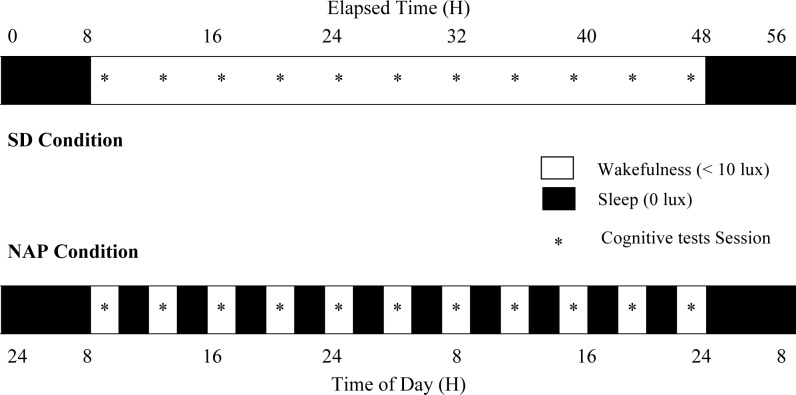
14 healthy young males (mean age = 23 ± 2.7; 20-29 years) and 11 healthy older males (mean age = 68 ± 1.4; 66-70 years) were recruited. The volunteers were placed for 40 hours in "constant routine". In the "Sleep Deprivation SD" condition, the volunteer was kept awake for 40 hours to obtain a high sleep pressure condition interacting with the circadian process. In the "NAP" condition, the volunteer adopted a short wake/sleep cycle (150/75 min) resulting in a low sleep pressure condition to counteract the homeostatic pressure and investigate the circadian process. Performances were evaluated by a simple reaction time task and a Go/Nogo task repeated every 3H45.
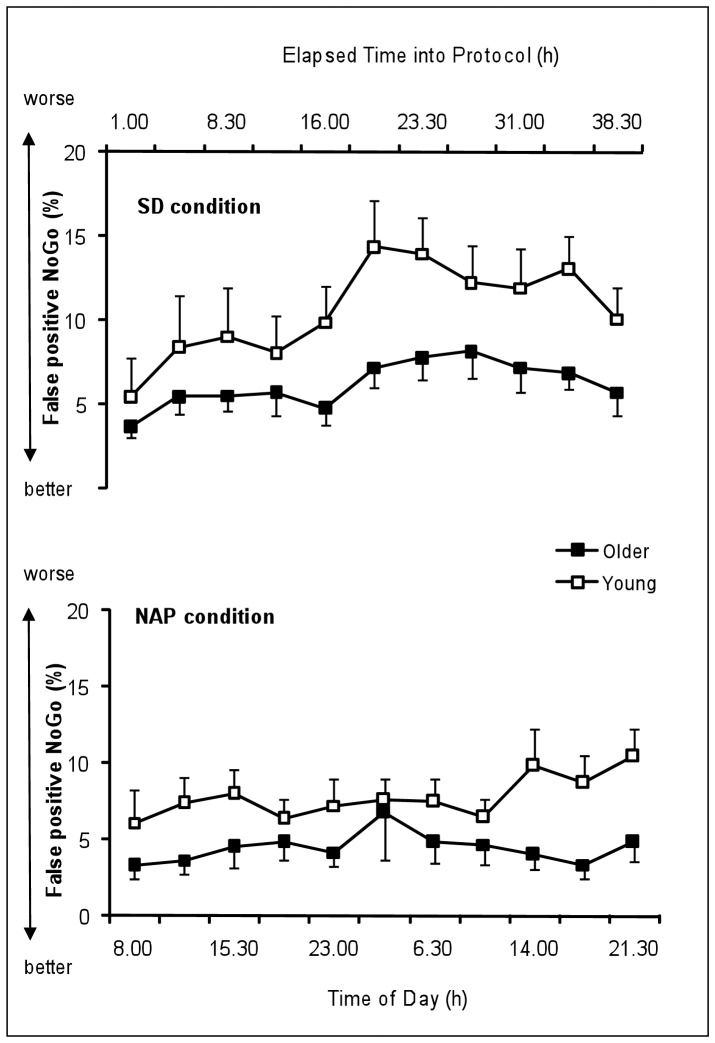
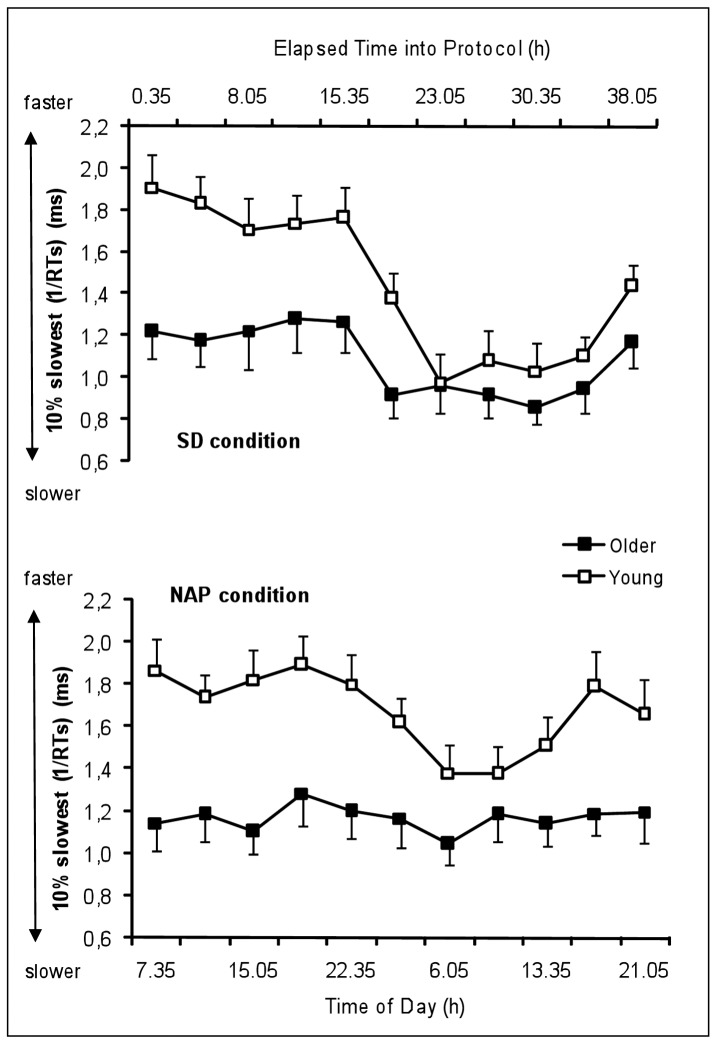
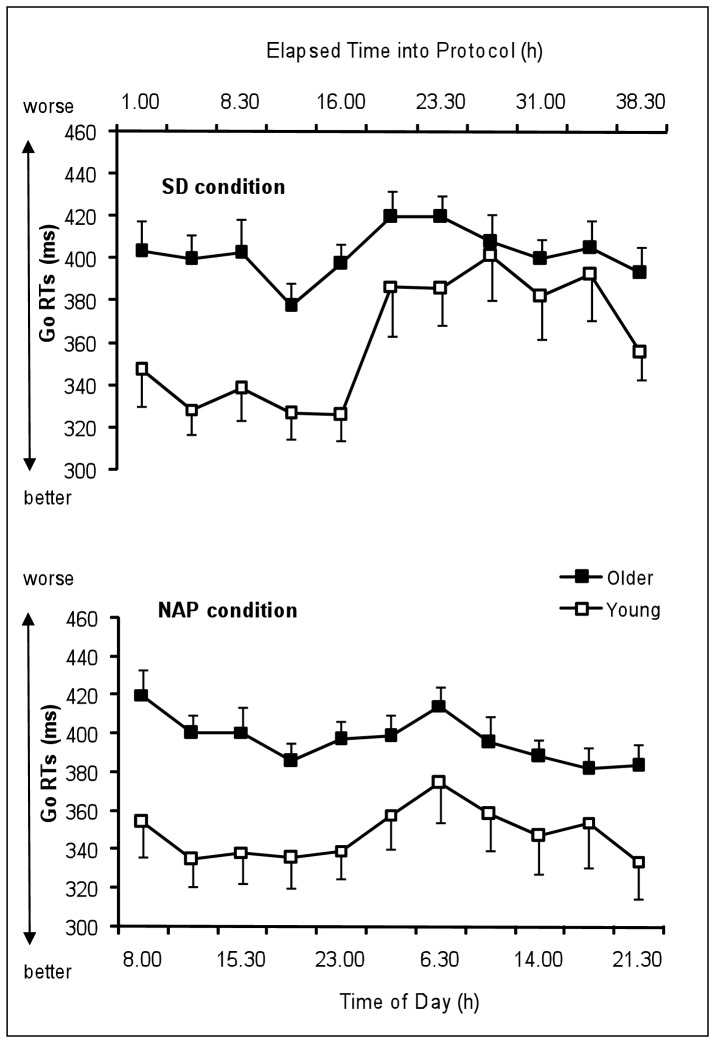
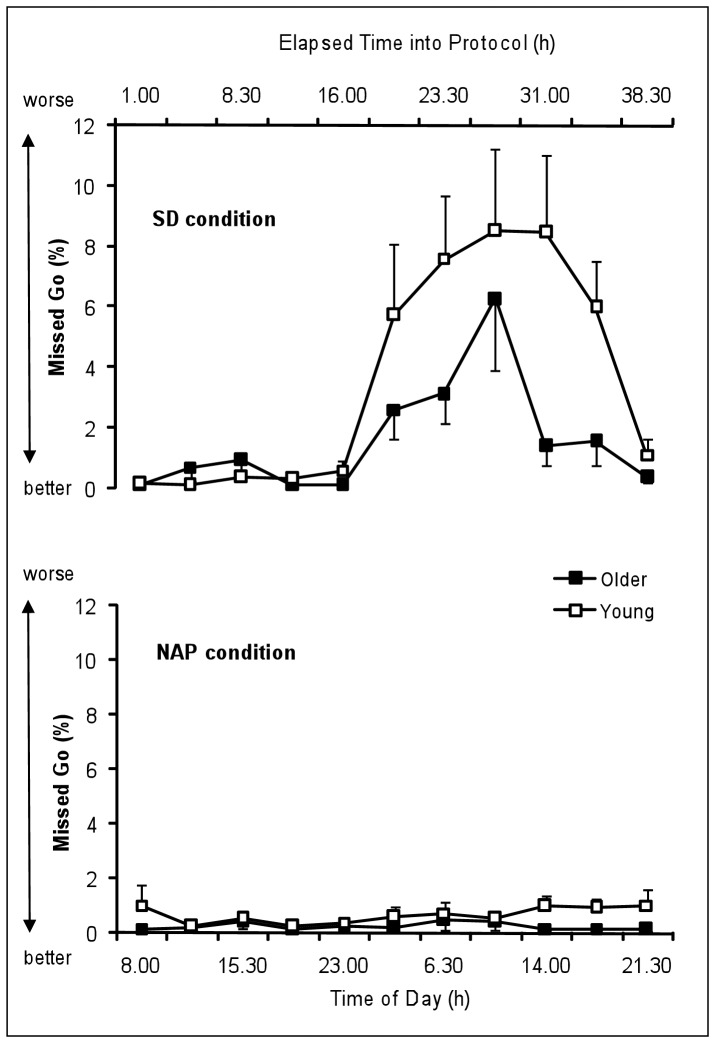
In the SD condition, inhibitory motor control (i.e., ability to inhibit an inappropriate response) was impaired by extended wakefulness equally in both age groups (P<.01). Sustained attention (i.e. ability to respond accurately to appropriate stimuli) on the executive task decreased under sleep deprivation in both groups, and even more in young participants (P<.05). In the NAP condition, age did not influence the time course of inhibitory motor control or sustained attention. In the SD and NAP conditions, older participants had a less fluctuating reaction time performance across time of day than young participants (P<.001).
Aging could be a protective factor against the effects of extended wakefulness especially on sustained attention failures due to an attenuation of sleep pressure with duration of time awake.
昼夜节律系统和睡眠压力对执行表现的影响随年龄的变化尚未被研究过。本研究的目的是确定在受控制的高或低睡眠压力条件下,抑制性运动控制(即抑制优势运动反应的能力)和持续性注意力的年龄相关演变。
招募了 14 名健康的年轻男性(平均年龄=23±2.7;20-29 岁)和 11 名健康的老年男性(平均年龄=68±1.4;66-70 岁)。志愿者被放置在“恒常程序”中 40 小时。在“睡眠剥夺 SD”条件下,志愿者保持清醒 40 小时,以获得高睡眠压力条件,同时与昼夜节律过程相互作用。在“小睡 NAP”条件下,志愿者采用短的清醒/睡眠周期(150/75 分钟),导致低睡眠压力条件,以抵消生理压力并研究昼夜节律过程。通过简单反应时间任务和 Go/Nogo 任务每隔 3 小时 45 分钟重复评估表现。
在 SD 条件下,抑制性运动控制(即抑制不适当反应的能力)在两个年龄组中均因长时间清醒而受损(P<.01)。在两组中,执行任务的持续性注意力(即准确响应适当刺激的能力)在睡眠剥夺下下降,而在年轻参与者中下降更为明显(P<.05)。在 NAP 条件下,年龄不影响抑制性运动控制或持续性注意力的时间进程。在 SD 和 NAP 条件下,与年轻参与者相比,老年参与者在一天中的不同时间点的反应时间表现波动较小(P<.001)。
随着时间的推移,年龄可能是对长时间清醒影响的保护因素,特别是对由于睡眠压力衰减而导致的持续性注意力失败的影响。