Centre for Chronobiology, Psychiatric Hospital of the University of Basel, Basel, Switzerland.
Institute of Primary Health Care (BIHAM), University of Bern, Bern, Switzerland.
Sci Rep. 2018 Jan 17;8(1):970. doi: 10.1038/s41598-017-17022-9.
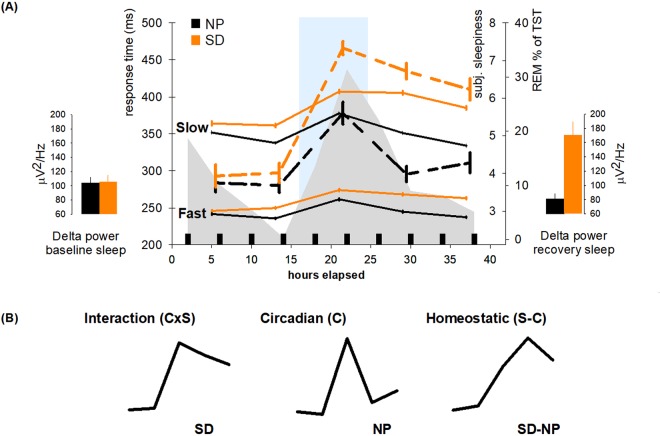
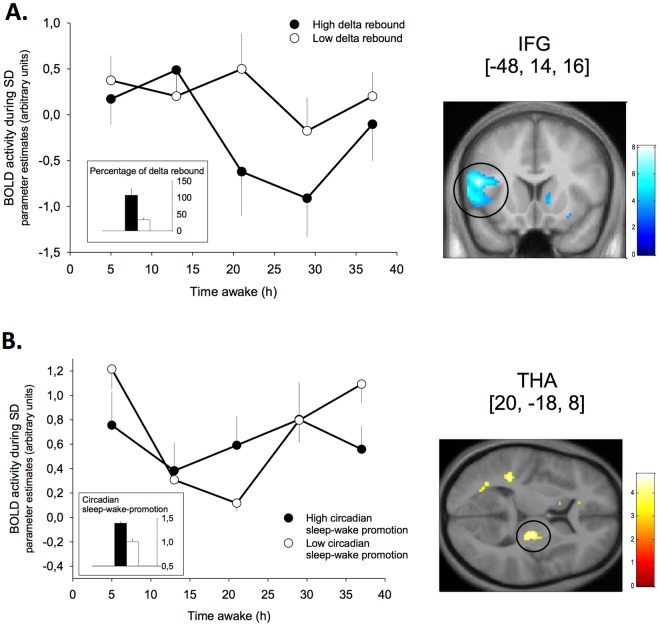
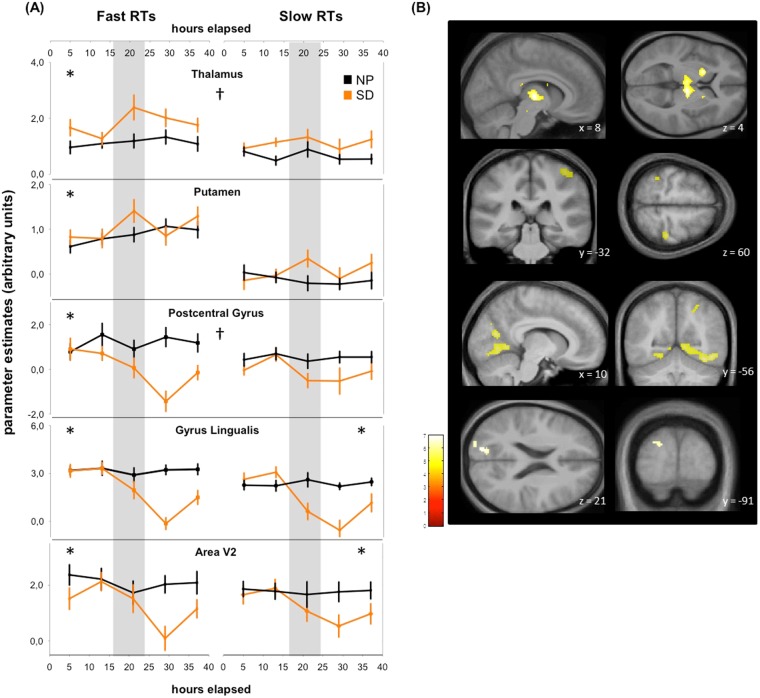
Sleepiness and cognitive function vary over the 24-h day due to circadian and sleep-wake-dependent mechanisms. However, the underlying cerebral hallmarks associated with these variations remain to be fully established. Using functional magnetic resonance imaging (fMRI), we investigated brain responses associated with circadian and homeostatic sleep-wake-driven dynamics of subjective sleepiness throughout day and night. Healthy volunteers regularly performed a psychomotor vigilance task (PVT) in the MR-scanner during a 40-h sleep deprivation (high sleep pressure) and a 40-h multiple nap protocol (low sleep pressure). When sleep deprived, arousal-promoting thalamic activation during optimal PVT performance paralleled the time course of subjective sleepiness with peaks at night and troughs on the subsequent day. Conversely, task-related cortical activation decreased when sleepiness increased as a consequence of higher sleep debt. Under low sleep pressure, we did not observe any significant temporal association between PVT-related brain activation and subjective sleepiness. Thus, a circadian modulation in brain correlates of vigilant attention was only detectable under high sleep pressure conditions. Our data indicate that circadian and sleep homeostatic processes impact on vigilant attention via specific mechanisms; mirrored in a decline of cortical resources under high sleep pressure, opposed by a subcortical "rescuing" at adverse circadian times.
由于昼夜节律和睡眠-觉醒依赖机制的作用,睡眠和认知功能在 24 小时内会发生变化。然而,与这些变化相关的大脑特征仍有待充分确定。使用功能磁共振成像 (fMRI),我们研究了与主观嗜睡的昼夜节律和稳态睡眠-觉醒驱动动态相关的大脑反应。健康志愿者在 40 小时的睡眠剥夺(高睡眠压力)和 40 小时的多次小睡方案(低睡眠压力)期间,定期在磁共振扫描仪中进行精神运动警觉任务 (PVT)。在睡眠剥夺期间,最佳 PVT 表现时促进觉醒的丘脑激活与主观嗜睡的时间进程平行,峰值出现在晚上,低谷出现在随后的一天。相反,随着睡眠债务的增加,当嗜睡增加时,与任务相关的皮质激活减少。在低睡眠压力下,我们没有观察到 PVT 相关大脑激活与主观嗜睡之间存在任何显著的时间关联。因此,只有在高睡眠压力条件下,才能检测到警觉注意力的昼夜节律调节的大脑相关性。我们的数据表明,昼夜节律和睡眠稳态过程通过特定的机制影响警觉注意力;在高睡眠压力下,皮质资源下降反映了这一点,而在不利的昼夜时间,皮质下“挽救”则相反。