ENT Audiology Phoniatrics Unit, Department of Neurosciences, University of Pisa, Italy.
Acta Otorhinolaryngol Ital. 2012 Apr;32(2):115-21.
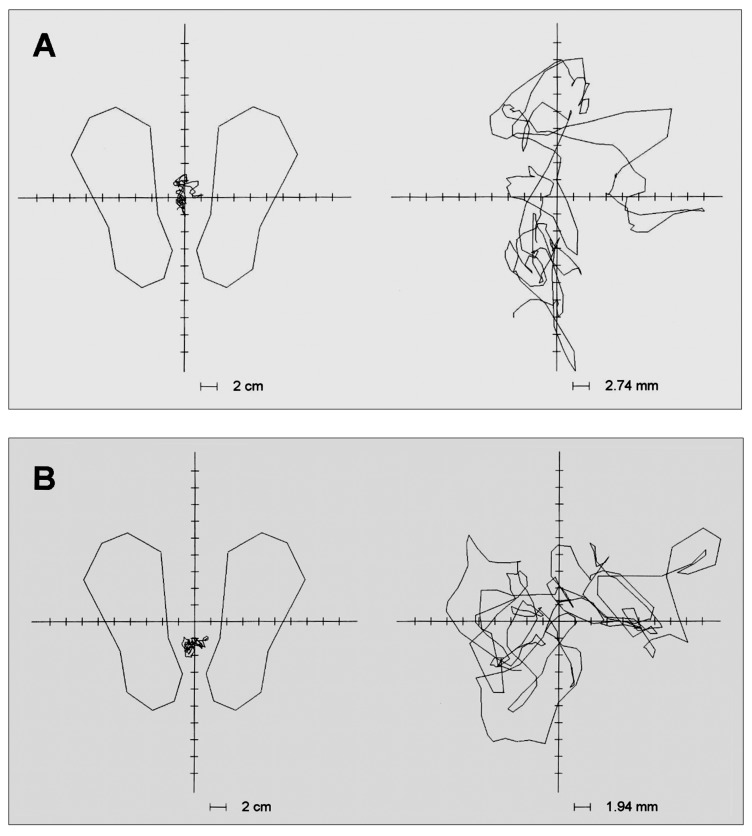
The relationship between voice and posture has been previously investigated. The aim of this study was to evaluate postural alterations in subjects with dysfunctional dysphonia and to analyse their variations after rehabilitation. Forty subjects with hypokinetic dysfunctional dysphonia were submitted to posturographic analysis with alternatively open and closed eyes; subjects were invited to stand upright and breath normally so that the vestibular-spinal reflex could be assessed. The following variables were considered: pressure centre coordinates on frontal and sagittal planes and standard deviations (SD), length and surface of the tract, mean velocity of the oscillations and SD, spectral frequency analysis of oscillations, statokinesigram and stabilogram. At baseline, the parameters showing the highest alterations were surface and velocity SD. All parameters improved after rehabilitation, particularly SD(X) and SD(Y), surface, velocity and relative SD; the centre of pressure shifted backwards in all patients. These results confirm that in subjects with dysfunctional dysphonia, the greater proprioceptive awareness acquired through speech therapy permits improvement in postural performance. Static stabilometry is a fundamental test for demonstrating basal postural alterations and for evaluating improvement after rehabilitation.
声音与姿势的关系此前已被研究过。本研究旨在评估功能性发音障碍患者的姿势变化,并分析其康复后的变化。40 名运动障碍性功能性发音障碍患者接受了姿势描记法分析,分析时患者的眼睛分别处于睁开和闭合两种状态;让患者站直并正常呼吸,以评估前庭-脊髓反射。考虑了以下变量:额状面和矢状面压力中心坐标及其标准差(SD)、轨迹长度和面积、摆动的平均速度及其 SD、摆动的频谱频率分析、姿势描记图和平衡描记图。在基线时,显示最高变化的参数是表面和速度 SD。所有参数在康复后均得到改善,尤其是 SD(X)和 SD(Y)、表面、速度和相对 SD;所有患者的压力中心均向后移位。这些结果证实,在功能性发音障碍患者中,通过言语治疗获得的更高本体感觉意识可以改善姿势表现。静态稳定描记法是一项基本测试,可用于证明基础姿势变化,并评估康复后的改善情况。