Section of Nuclear Medicine & PET, Department of Radiology, Oncology and Radiation Sciences. Uppsala University, SE-75185, Uppsala, Sweden.
Theranostics. 2012;2(5):427-36. doi: 10.7150/thno.3794. Epub 2012 May 4.
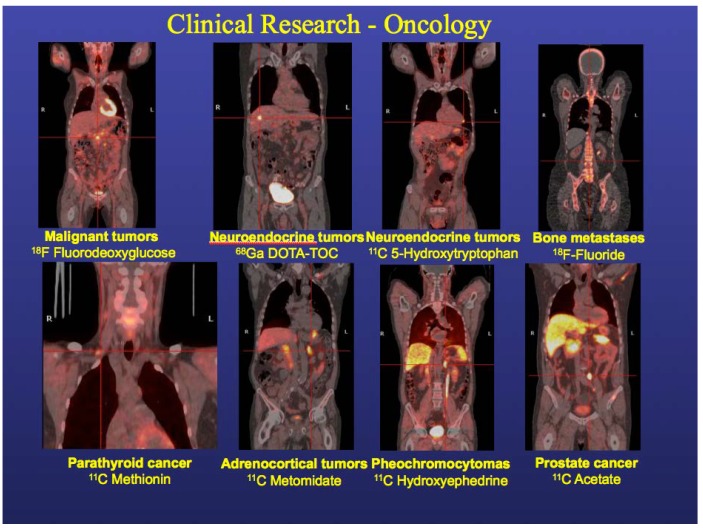
Clinical molecular imaging by use of PET and PET/CT is increasingly important in routine oncological practice worldwide. A vast majority of clinical PET investigations are performed with [(18)F]-fluorodeoxyglucose (FDG), but there is a growing interest in novel molecular probes among scientists and clinicians. Beyond FDG, a small number of different tracers have been shown to be of clinical value. With a growing commercial interest in tracer development, many more are under investigation. This review provides some examples of clinical situations where tracers other than FDG have been found useful and an outlook towards technical and regulatory development needed to allow the full impact of clinical PET to benefit the individual patient.
临床正电子发射断层扫描(PET)和正电子发射断层扫描计算机断层成像(PET/CT)的分子影像学在全球范围内的肿瘤学常规实践中变得越来越重要。绝大多数临床 PET 研究都是使用 [(18)F]-氟脱氧葡萄糖(FDG)进行的,但科学家和临床医生对新型分子探针的兴趣日益浓厚。除了 FDG 之外,还有少数不同的示踪剂已被证明具有临床价值。随着人们对示踪剂开发的商业兴趣不断增加,有更多的示踪剂正在被研究。这篇综述提供了一些临床情况的例子,这些情况下除了 FDG 以外的示踪剂被证明是有用的,并展望了技术和监管方面的发展,以使临床 PET 的全部影响惠及个体患者。