UESC, Centro de Biotecnologia e Genética, Ilhéus, Bahia, Brasil.
PLoS One. 2012;7(6):e37969. doi: 10.1371/journal.pone.0037969. Epub 2012 Jun 29.
The pathogenesis related protein PR10 (TcPR-10), obtained from the Theobroma cacao-Moniliophthora perniciosa interaction library, presents antifungal activity against M. perniciosa and acts in vitro as a ribonuclease. However, despite its biotechnological potential, the TcPR-10 has the P-loop motif similar to those of some allergenic proteins such as Bet v 1 (Betula verrucosa) and Pru av 1 (Prunus avium). The insertion of mutations in this motif can produce proteins with reduced allergenic power. The objective of the present work was to evaluate the allergenic potential of the wild type and mutant recombinant TcPR-10 using bioinformatics tools and immunological assays.
METHODOLOGY/PRINCIPAL FINDINGS: Mutant substitutions (T10P, I30V, H45S) were inserted in the TcPR-10 gene by site-directed mutagenesis, cloned into pET28a and expressed in Escherichia coli BL21(DE3) cells. Changes in molecular surface caused by the mutant substitutions was evaluated by comparative protein modeling using the three-dimensional structure of the major cherry allergen, Pru av 1 as a template. The immunological assays were carried out in 8-12 week old female BALB/c mice. The mice were sensitized with the proteins (wild type and mutants) via subcutaneous and challenged intranasal for induction of allergic airway inflammation.
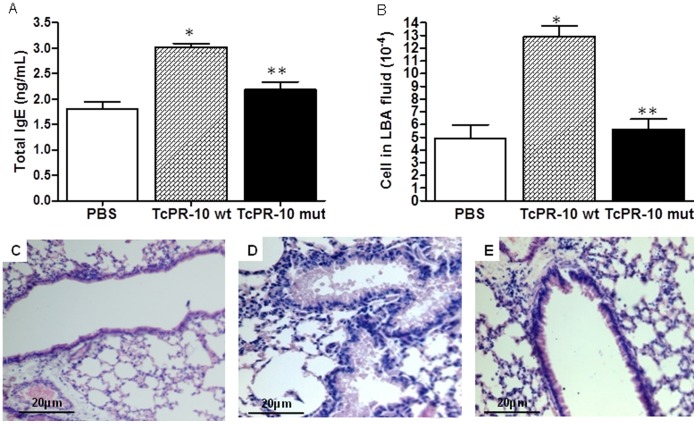
CONCLUSIONS/SIGNIFICANCE: We showed that the wild TcPR-10 protein has allergenic potential, whereas the insertion of mutations produced proteins with reduced capacity of IgE production and cellular infiltration in the lungs. On the other hand, in vitro assays show that the TcPR-10 mutants still present antifungal and ribonuclease activity against M. perniciosa RNA. In conclusion, the mutant proteins present less allergenic potential than the wild TcPR-10, without the loss of interesting biotechnological properties.
从可可-Moniliophthora perniciosa 互作文库中获得的与发病机制相关的蛋白 PR10(TcPR-10)对 M. perniciosa 具有抗真菌活性,并在体外作为核糖核酸酶发挥作用。然而,尽管具有生物技术潜力,但 TcPR-10 具有与某些过敏原蛋白(如 Bet v 1(桦木)和 Pru av 1(樱桃))相似的 P 环基序。在该基序中插入突变可以产生致敏性降低的蛋白。本工作的目的是使用生物信息学工具和免疫测定法评估野生型和突变重组 TcPR-10 的致敏潜能。
方法/主要发现:通过定点诱变在 TcPR-10 基因中插入突变(T10P、I30V、H45S),克隆到 pET28a 中,并在大肠杆菌 BL21(DE3)细胞中表达。使用三维结构作为模板,通过比较蛋白质建模评估突变取代引起的分子表面变化主要樱桃过敏原 Pru av 1。免疫测定在 8-12 周龄雌性 BALB/c 小鼠中进行。通过皮下致敏和鼻内挑战诱导过敏气道炎症来敏化蛋白(野生型和突变体)。
结论/意义:我们表明,野生 TcPR-10 蛋白具有致敏潜能,而插入突变产生的蛋白 IgE 产生能力和细胞浸润肺部减少。另一方面,体外试验表明,TcPR-10 突变体仍对 M. perniciosa RNA 具有抗真菌和核糖核酸酶活性。总之,突变蛋白的致敏潜能低于野生 TcPR-10,而不失有趣的生物技术特性。