Department of Radiological Technology, University of Tokyo Hospital, Tokyo 113-8655, Japan.
Korean J Radiol. 2012 Jul-Aug;13(4):391-402. doi: 10.3348/kjr.2012.13.4.391. Epub 2012 Jun 18.
Many studies have reported pre-processing effects for brain volumetry; however, no study has investigated whether non-parametric non-uniform intensity normalization (N3) correction processing results in reduced system dependency when using an atlas-based method. To address this shortcoming, the present study assessed whether N3 correction processing provides reduced system dependency in atlas-based volumetry.
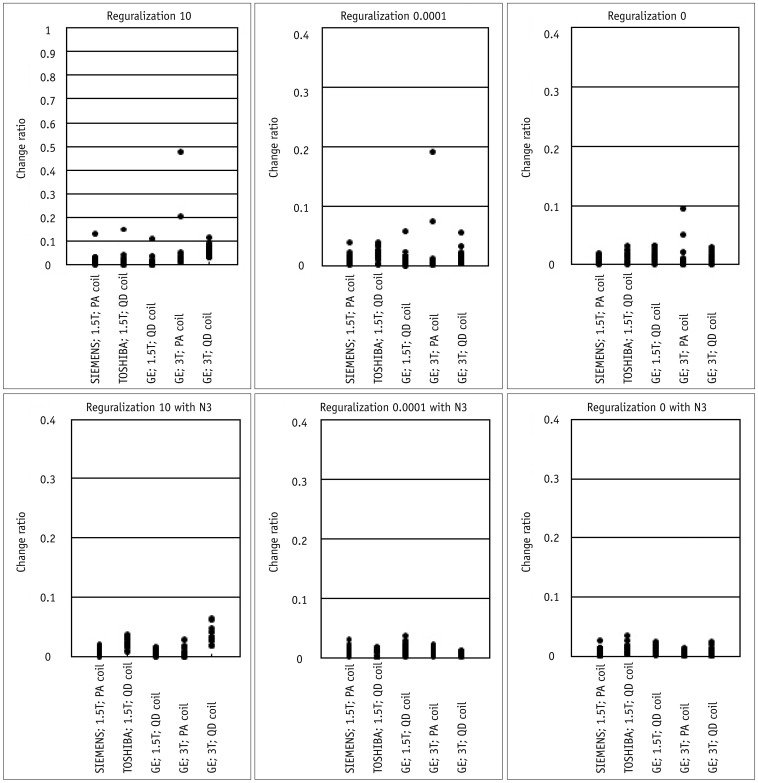
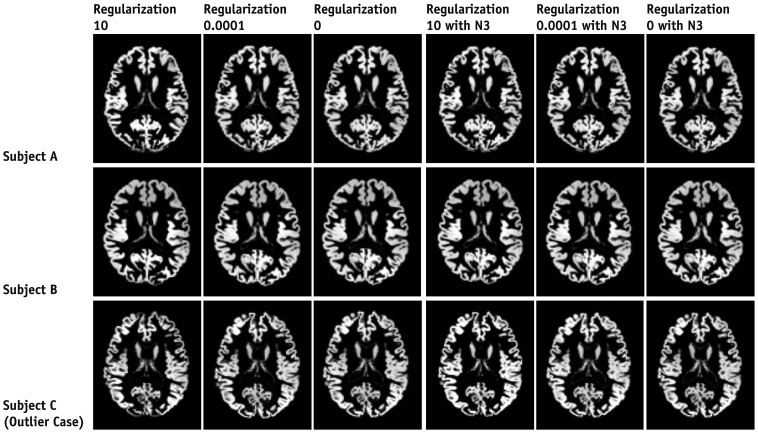
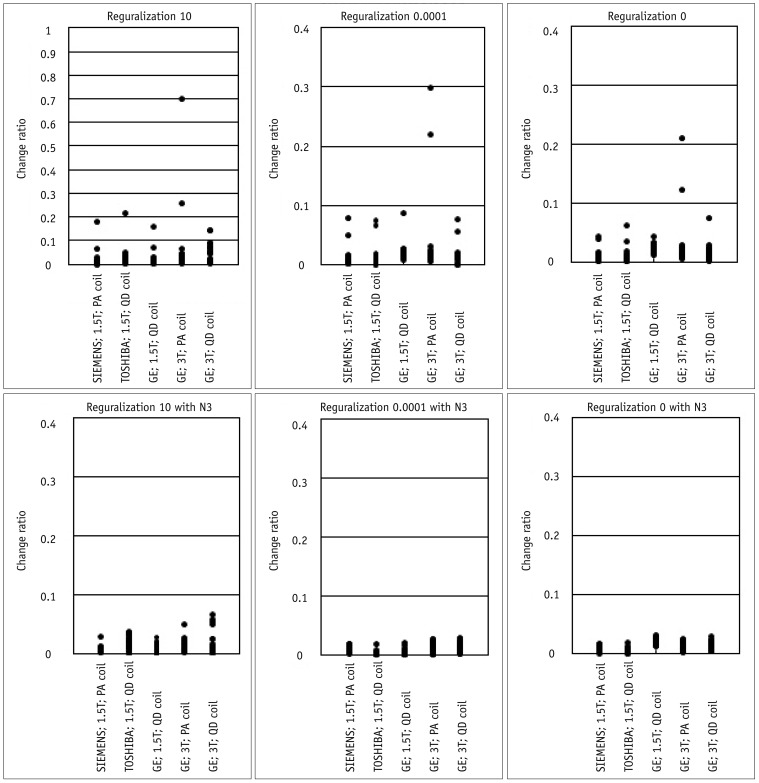
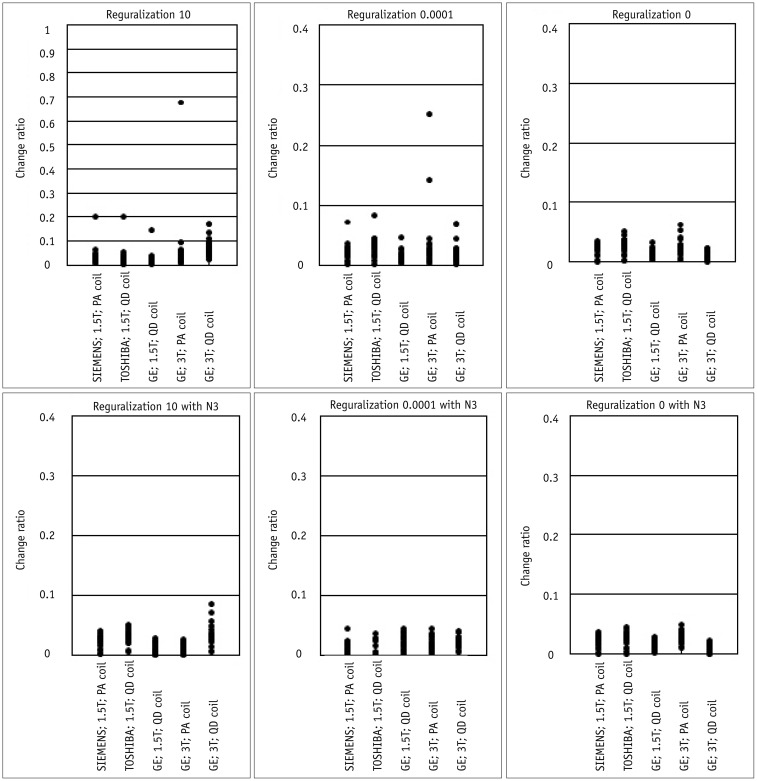
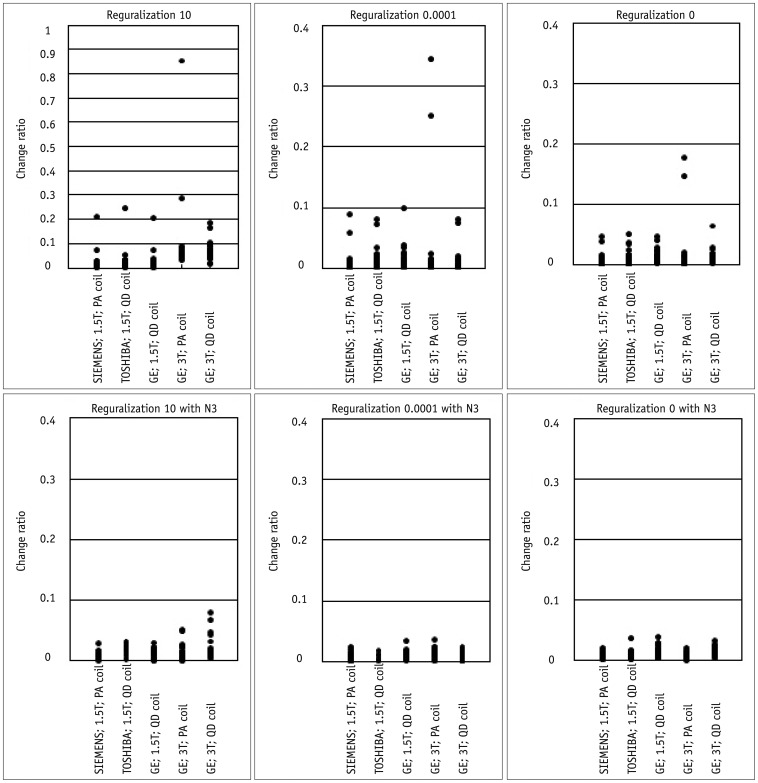
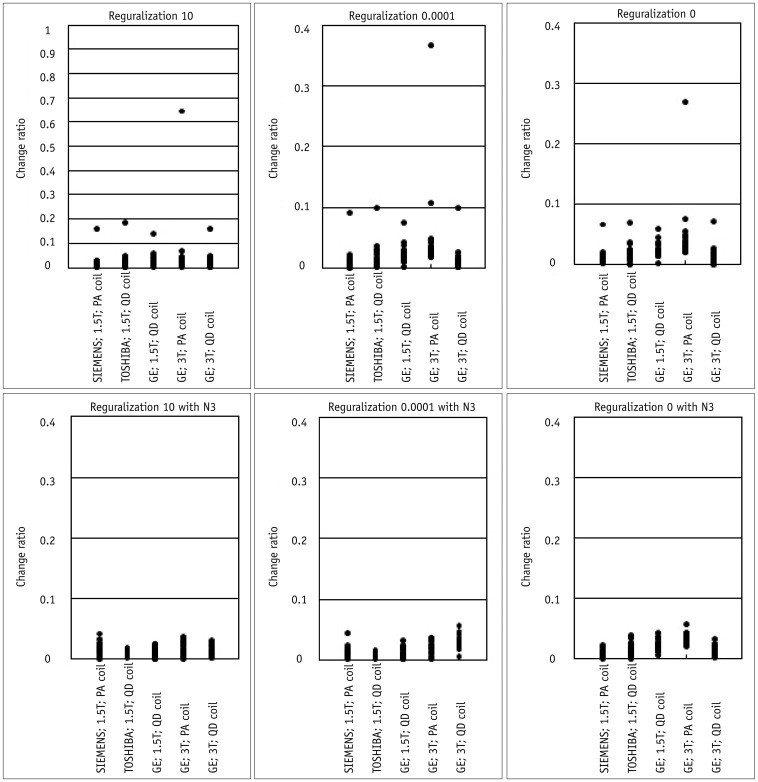
Contiguous sagittal T1-weighted images of the brain were obtained from 21 healthy participants, by using five magnetic resonance protocols. After image preprocessing using the Statistical Parametric Mapping 5 software, we measured the structural volume of the segmented images with the WFU-PickAtlas software. We applied six different bias-correction levels (Regularization 10, Regularization 0.0001, Regularization 0, Regularization 10 with N3, Regularization 0.0001 with N3, and Regularization 0 with N3) to each set of images. The structural volume change ratio (%) was defined as the change ratio (%) = (100 × [measured volume - mean volume of five magnetic resonance protocols] / mean volume of five magnetic resonance protocols) for each bias-correction level.
A low change ratio was synonymous with lower system dependency. The results showed that the images with the N3 correction had a lower change ratio compared with those without the N3 correction.
The present study is the first atlas-based volumetry study to show that the precision of atlas-based volumetry improves when using N3-corrected images. Therefore, correction for signal intensity non-uniformity is strongly advised for multi-scanner or multi-site imaging trials.
许多研究报告了脑容积成像的预处理效应;然而,尚无研究探讨基于图谱的方法是否会因采用非参数非均匀强度归一化(N3)校正处理而降低系统依赖性。为解决这一不足,本研究评估了 N3 校正处理是否会降低基于图谱的容积成像中的系统依赖性。
本研究纳入了 21 名健康参与者,使用五种磁共振协议获取了连续矢状位 T1 加权脑图像。在使用统计参数映射 5 软件进行图像预处理后,我们使用 WF U-PickAtlas 软件测量了分割图像的结构体积。我们对每组图像应用了六种不同的偏置校正水平(正则化 10、正则化 0.0001、正则化 0、带 N3 的正则化 10、带 N3 的正则化 0.0001 和带 N3 的正则化 0)。结构体积变化率(%)定义为变化率(%)=(100×[测量体积-五种磁共振协议的平均体积]/五种磁共振协议的平均体积),用于每个偏置校正水平。
低变化率表示系统依赖性较低。结果表明,带 N3 校正的图像与不带 N3 校正的图像相比,变化率较低。
本研究是首次基于图谱的容积成像研究,表明使用 N3 校正图像可提高基于图谱的容积成像的精度。因此,强烈建议对多扫描仪或多站点成像试验进行信号强度非均匀性校正。