Département de Biochimie, Université de Lausanne, 1066 Epalinges, Switzerland.
Mol Biol Cell. 2012 Sep;23(17):3438-49. doi: 10.1091/mbc.E12-05-0347. Epub 2012 Jul 11.
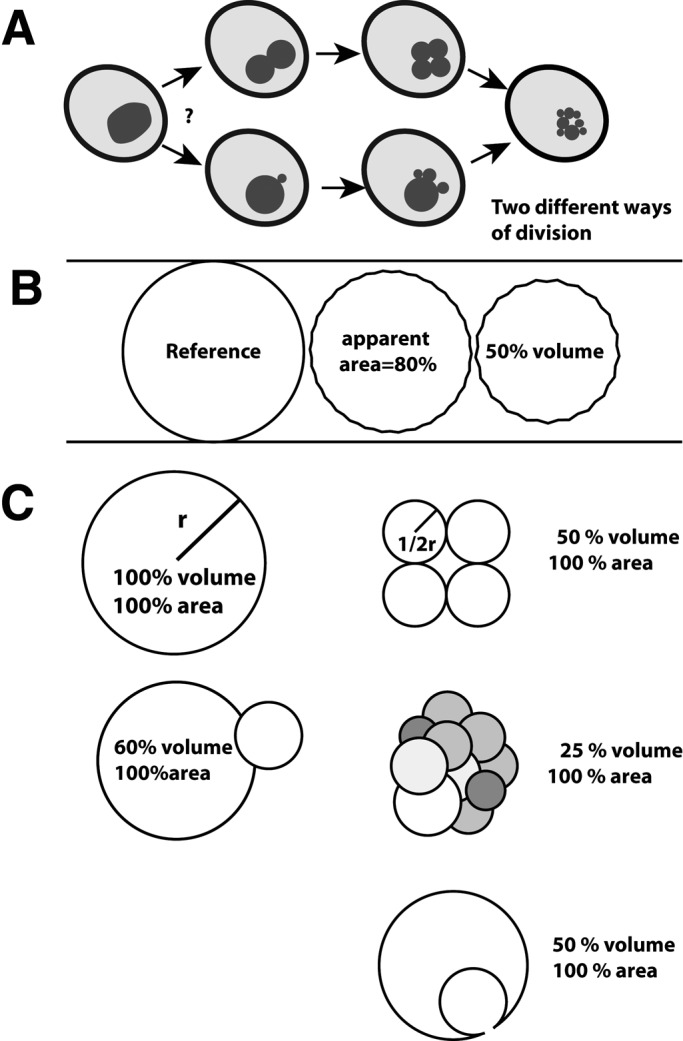
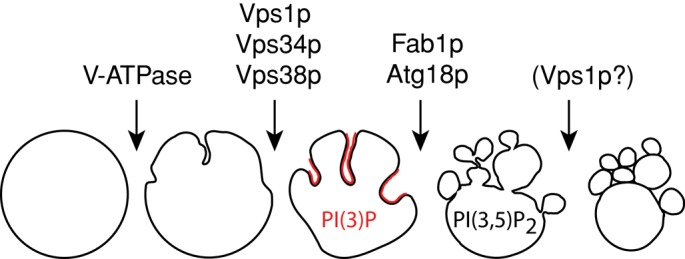
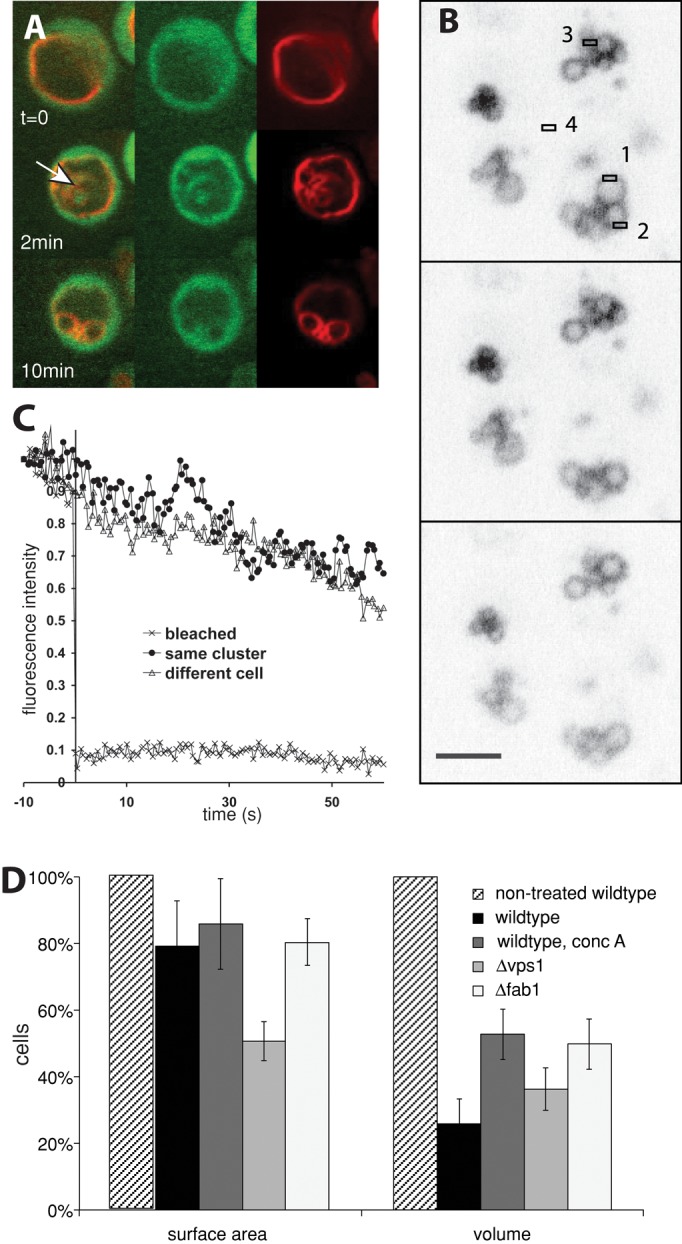
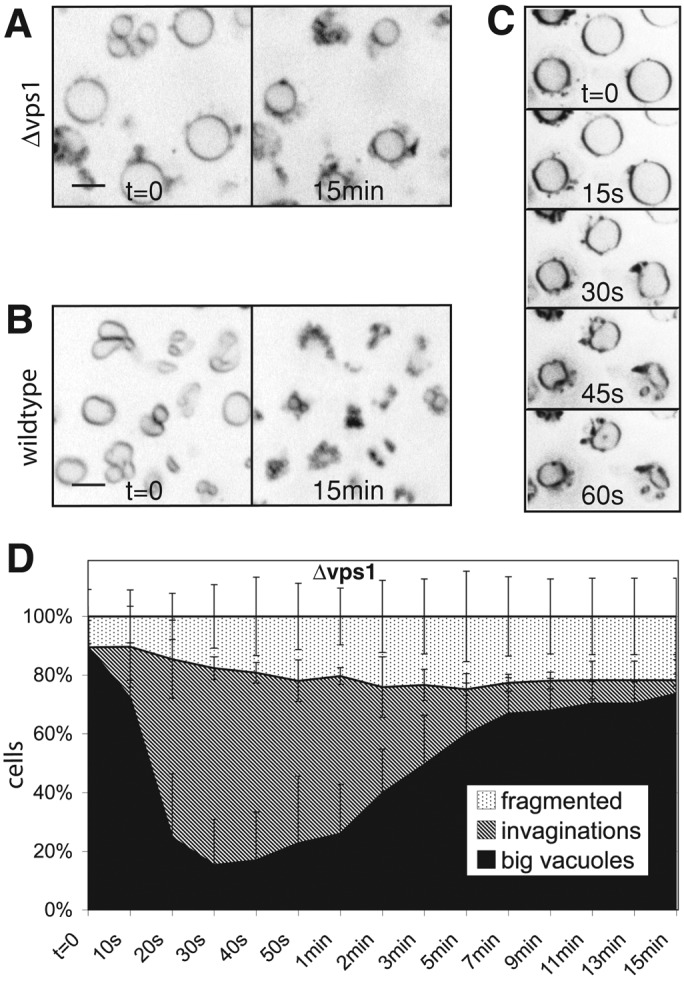
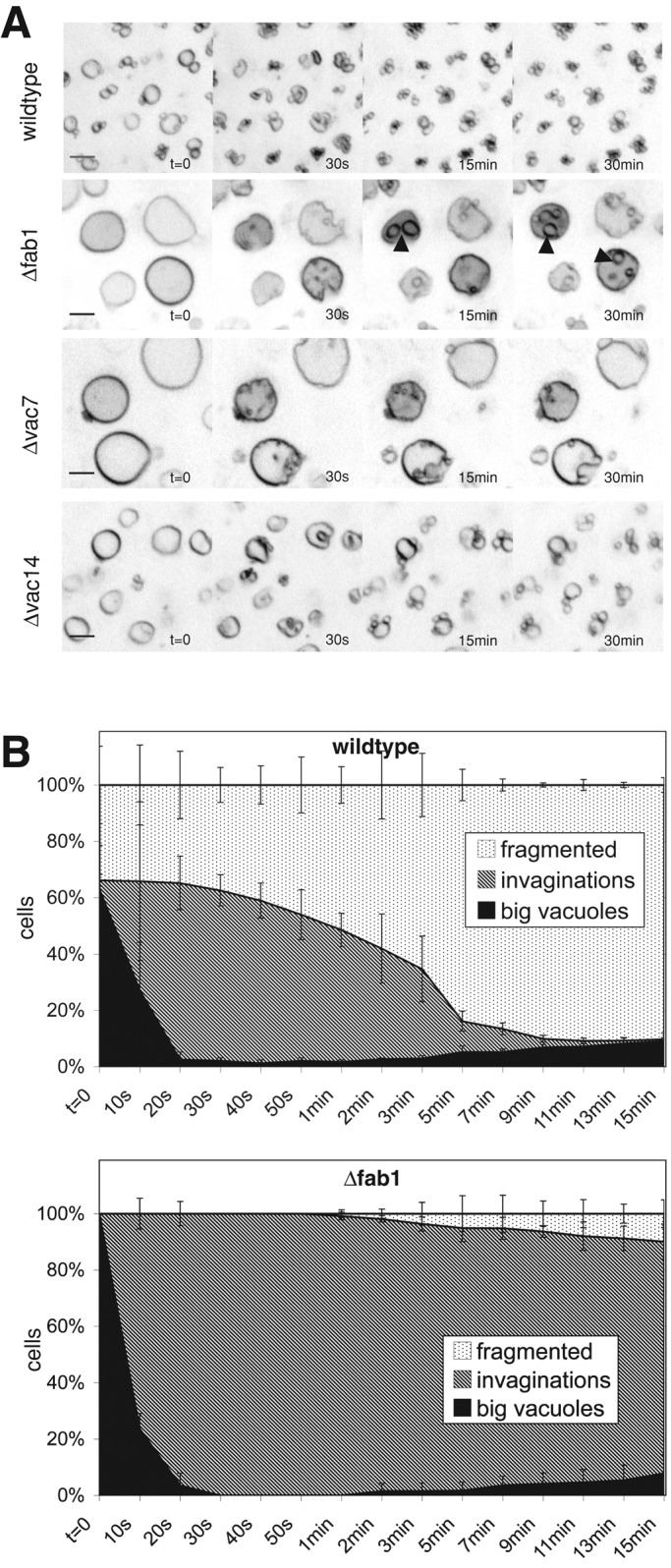
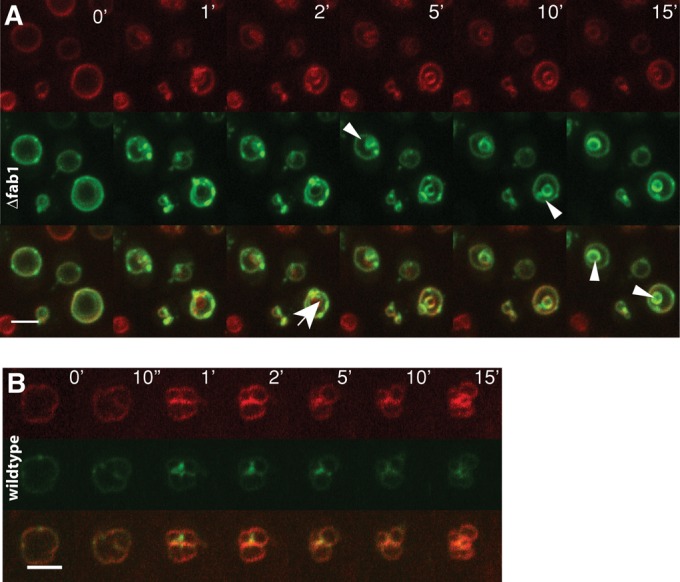
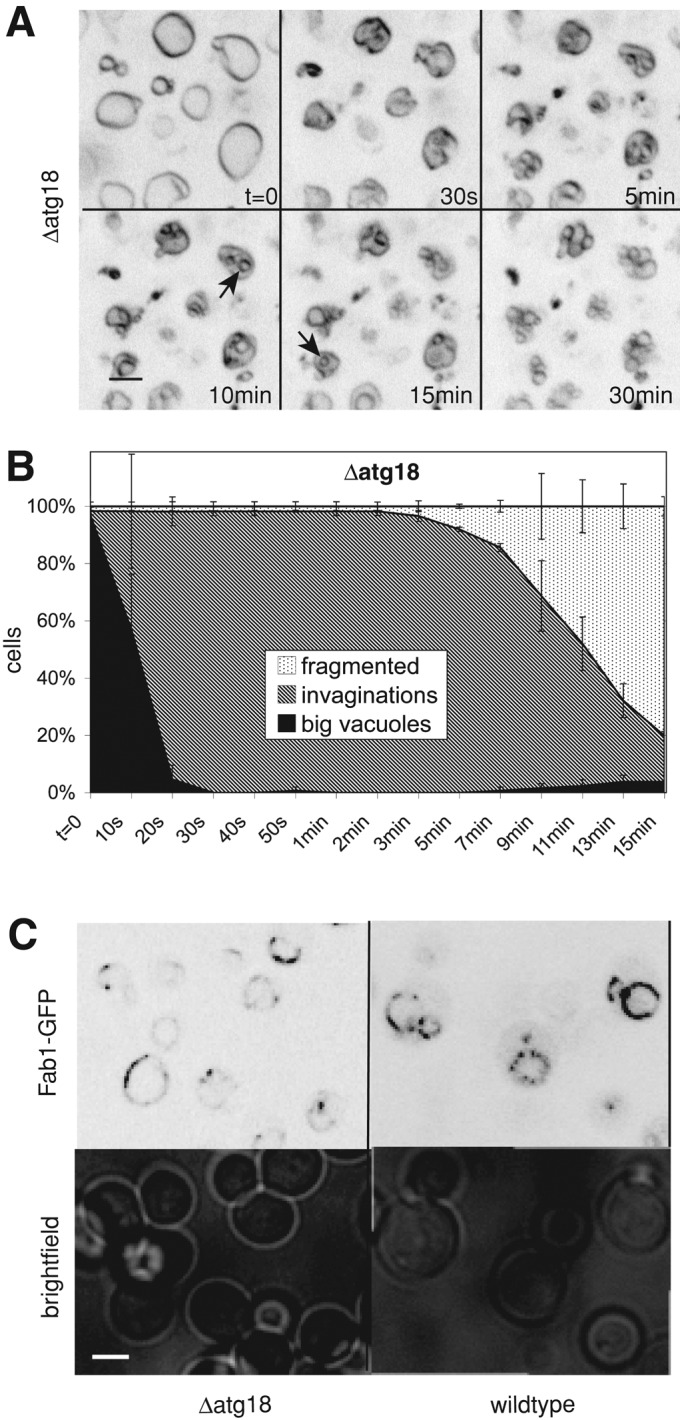
Yeast vacuoles fragment and fuse in response to environmental conditions, such as changes in osmotic conditions or nutrient availability. Here we analyze osmotically induced vacuole fragmentation by time-lapse microscopy. Small fragmentation products originate directly from the large central vacuole. This happens by asymmetrical scission rather than by consecutive equal divisions. Fragmentation occurs in two distinct phases. Initially, vacuoles shrink and generate deep invaginations that leave behind tubular structures in their vicinity. Already this invagination requires the dynamin-like GTPase Vps1p and the vacuolar proton gradient. Invaginations are stabilized by phosphatidylinositol 3-phosphate (PI(3)P) produced by the phosphoinositide 3-kinase complex II. Subsequently, vesicles pinch off from the tips of the tubular structures in a polarized manner, directly generating fragmentation products of the final size. This phase depends on the production of phosphatidylinositol-3,5-bisphosphate and the Fab1 complex. It is accelerated by the PI(3)P- and phosphatidylinositol 3,5-bisphosphate-binding protein Atg18p. Thus vacuoles fragment in two steps with distinct protein and lipid requirements.
酵母液泡会响应环境条件(如渗透压变化或营养可用性)而发生片段化和融合。在这里,我们通过延时显微镜分析渗透压诱导的液泡片段化。小的片段化产物直接来源于大的中央液泡。这是通过不对称分裂而不是连续均等分裂发生的。片段化发生在两个不同的阶段。最初,液泡收缩并产生深的内陷,在其附近留下管状结构。这种内陷已经需要类似于动力蛋白的 GTP 酶 Vps1p 和液泡质子梯度。内陷由磷酸肌醇 3-激酶复合物 II 产生的磷脂酰肌醇 3-磷酸 (PI(3)P) 稳定。随后,小泡从管状结构的尖端以极化的方式缢缩,直接产生最终大小的片段化产物。这一阶段依赖于磷脂酰肌醇-3,5-二磷酸的产生和 Fab1 复合物。PI(3)P 和磷脂酰肌醇 3,5-二磷酸结合蛋白 Atg18p 的加速作用。因此,液泡通过具有不同蛋白质和脂质需求的两个步骤进行片段化。