Lee Hyun Hye, Park Hyun Ah, Kang Jae Heon, Cho Young Gyu, Park Jin Kyun, Lee Ran, Yoon Ji Ye, Kim Ok Hyun
Department of Family Medicine, Inje University College of Medicine, Seoul, Korea.
Korean J Fam Med. 2012 May;33(3):134-43. doi: 10.4082/kjfm.2012.33.3.134. Epub 2012 May 24.
This preliminary study is to assess risk factors associated with children's body mass index (BMI) and their changes over a 2-year period based on the analysis of the Obesity and Metabolic Disorders Cohort in Childhood registry.
A total of 1,504 children comprised of 474 1st graders and 1,030 4th graders were included in the study. Data on physical activity, dietary intake, and socioeconomic status were obtained through self-administered questionnaires, and height and weight were measured annually for 2 years.
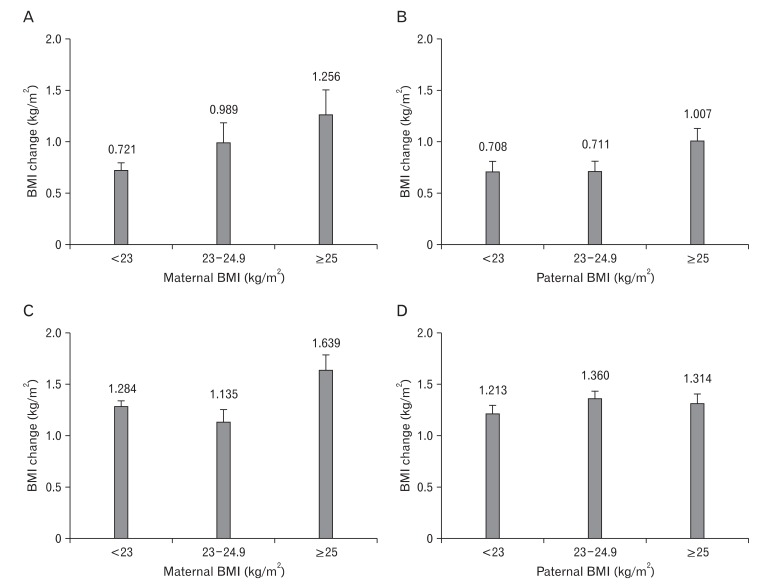
In a cross-sectional analysis, BMI of 1st graders was associated with higher parental BMI (both P < 0.001) and frequent snack consumption (P = 0.049). BMI of 4th graders was additionally associated with shorter sleep duration (P = 0.001), lower household income (P = 0.016), higher fat intake (P = 0.017), and frequent meal skipping (P = 0.020). During a 2-year follow-up, BMI increased by 0.8 ± 1.4 kg/m(2) in 1st graders and by 1.3 ± 1.4 kg/m(2) in 4th graders. In a longitudinal analysis, higher exercise frequency (P = 0.007), shorter sleep duration (P = 0.027), lower household income (P = 0.002), and higher paternal BMI (P = 0.002, 0.043) were significant predictors of BMI changes in the 1st graders whereas only higher maternal BMI (P=0.035), and frequent snack consumption (P = 0.010) were predictors for the 4th graders BMI changes.
Our findings indicate that parental obesity, short sleep duration, low socioeconomic status, and frequent snacking are associated with BMI and BMI changes.
本初步研究旨在基于对儿童肥胖与代谢紊乱队列登记处的分析,评估与儿童体重指数(BMI)及其在2年期间变化相关的风险因素。
本研究共纳入1504名儿童,其中包括474名一年级学生和1030名四年级学生。通过自行填写问卷获取身体活动、饮食摄入和社会经济状况的数据,并在2年中每年测量身高和体重。
在横断面分析中,一年级学生的BMI与较高的父母BMI(均P<0.001)和频繁吃零食(P=0.049)相关。四年级学生的BMI还与较短的睡眠时间(P=0.001)、较低的家庭收入(P=0.016)、较高的脂肪摄入量(P=0.017)和频繁不吃正餐(P=0.020)相关。在2年的随访期间,一年级学生的BMI增加了0.8±1.4kg/m²,四年级学生增加了1.3±1.4kg/m²。在纵向分析中,较高的运动频率(P=0.007)、较短的睡眠时间(P=0.027)、较低的家庭收入(P=0.002)和较高的父亲BMI(P=0.002,0.043)是一年级学生BMI变化的显著预测因素,而只有较高的母亲BMI(P=0.035)和频繁吃零食(P=0.010)是四年级学生BMI变化的预测因素。
我们的研究结果表明,父母肥胖、睡眠时间短、社会经济地位低和频繁吃零食与BMI及其变化有关。