Ogbuehi Kelechi C
Cornea Research Chair, Department of Optometry and Vision Sciences, College of Applied Medical Sciences, King Saud University, Riyadh, Saudi Arabia.
Clin Ophthalmol. 2012;6:871-8. doi: 10.2147/OPTH.S32322. Epub 2012 Jun 15.
The intraocular pressures and biomechanical parameters measured by the ocular response analyzer make the analyzer a useful tool for the diagnosis and management of anterior segment disease. This observational study was designed to investigate the effect of topical anesthesia on the parameters measured by the ocular response analyzer: corneal hysteresis, corneal resistance factor, Goldmann-correlated intraocular pressure (IOPg), and corneal-compensated intraocular pressure (IOPcc).
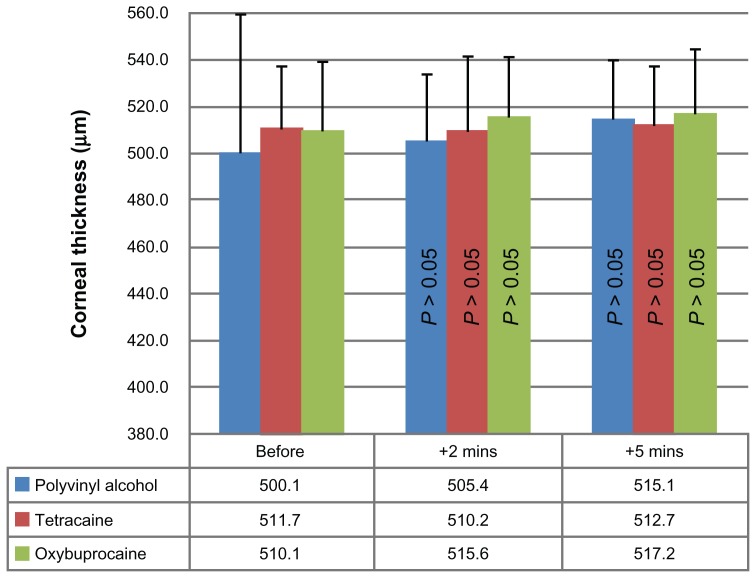
Two sets of measurements were made for 78 eyes of 39 subjects, approximately 1 week apart. In session 1, each eye of each subject was randomized into one of three groups: polyvinyl alcohol (0.5%), tetracaine hydrochloride (0.5%), or oxybuprocaine hydrochloride (0.4%). In session 2, eyes that were in the polyvinyl alcohol group in session 1 were assigned to the tetracaine group, those in the tetracaine group in session 1 were assigned to oxybuprocaine group, and those in the oxybuprocaine group in session 1 were assigned to the polyvinyl alcohol group. For both sessions, each subject first had his or her central corneal thickness assessed with a specular microscope, followed by measurements of intraocular pressure and corneal biomechanical parameters with the Ocular Response Analyzer. All measurements were repeated for 2 minutes and 5 minutes following the instillation of either polyvinyl alcohol, tetracaine, or oxybuprocaine. The level of statistical significance was 0.05.
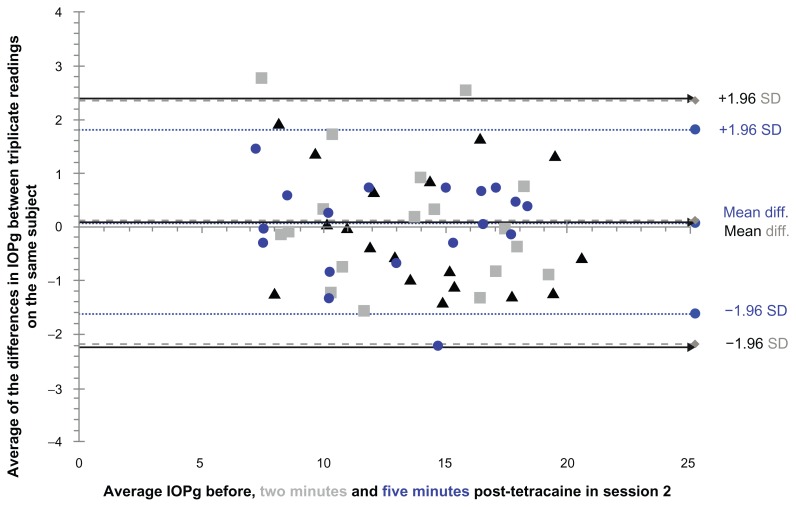
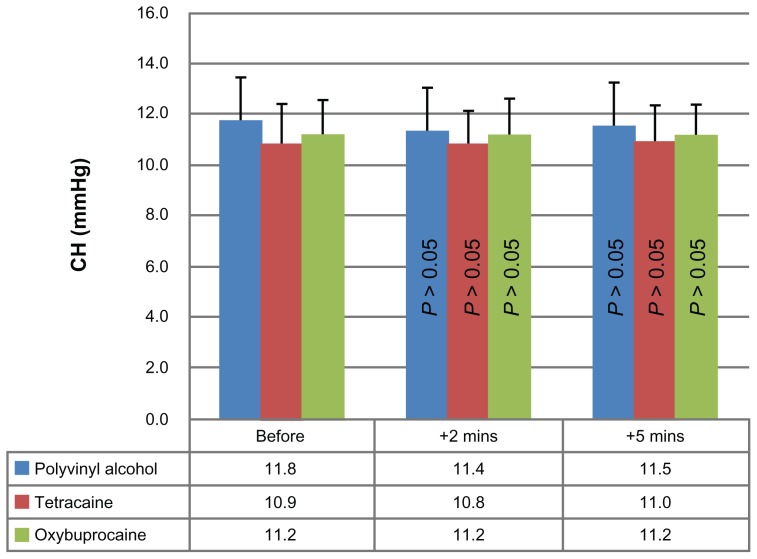
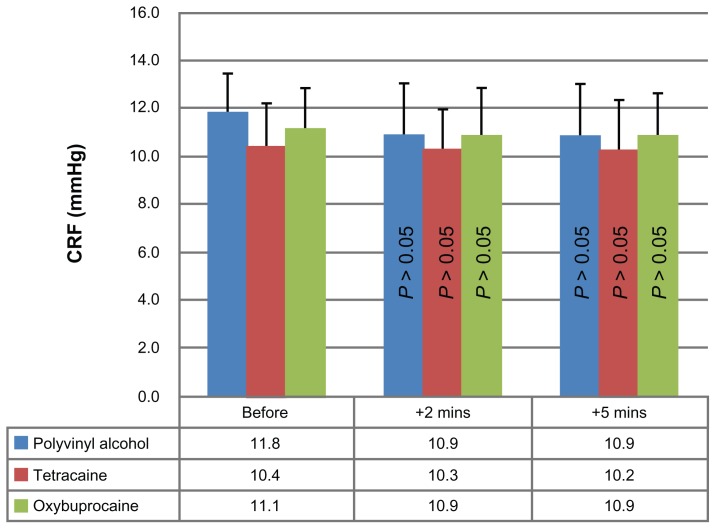
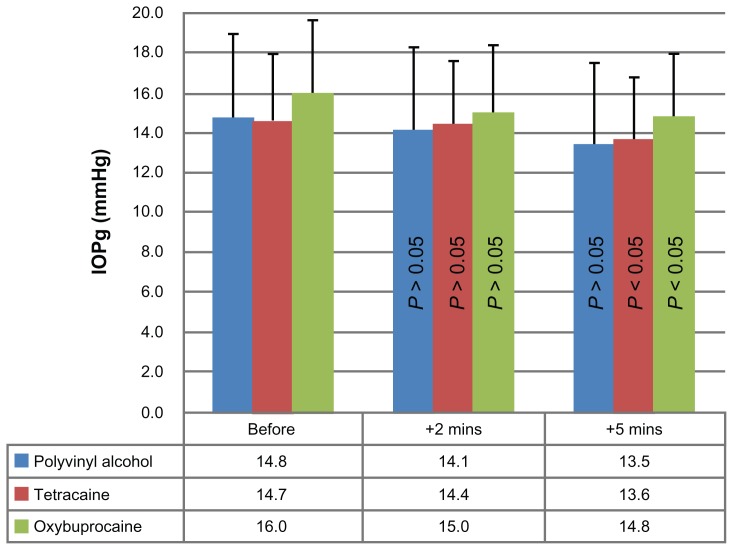
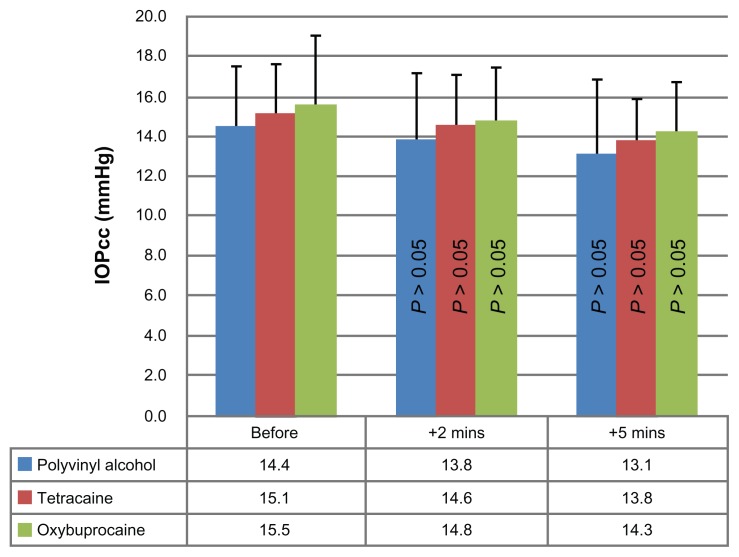
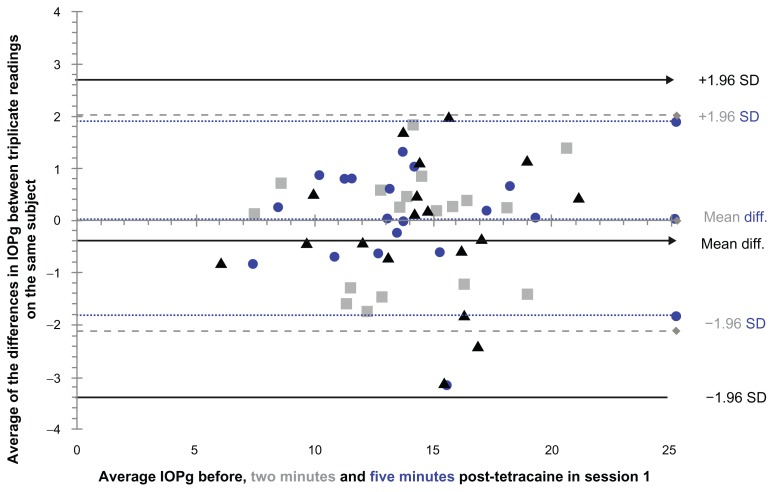
Polyvinyl alcohol, tetracaine hydrochloride, and oxybuprocaine hydrochloride had no statistically significant (P > 0.05) effect on any of the biomechanical parameters of the cornea. There was no statistically significant effect on either IOPg (P > 0.05) or IOPcc (P > 0.05) 2 minutes after the eye drops were instilled in either session. Five minutes after the eye drops were instilled, polyvinyl alcohol showed no statistically significant effect on either IOPg (P > 0.05) or IOPcc (P > 0.05) in either session. Oxybuprocaine and tetracaine caused statistically significant (P < 0.05) reductions in IOPg in session 1, but only tetracaine had a significant (P < 0.05) effect in session 2. Tetracaine also caused a statistically significant (P < 0.05) reduction in IOPcc in session 1.
The statistically significant effect of topical anesthesia on IOPg varies with the anesthetic used, and while this effect was statistically significant in this study, the small effect is probably not clinically relevant. There was no effect on any of the biomechanical parameters of the cornea.
眼反应分析仪所测量的眼内压和生物力学参数使该分析仪成为眼前节疾病诊断和管理的有用工具。本观察性研究旨在探讨表面麻醉对眼反应分析仪所测量参数的影响:角膜滞后、角膜阻力因子、Goldmann相关眼内压(IOPg)和角膜补偿眼内压(IOPcc)。
对39名受试者的78只眼睛进行了两组测量,间隔约1周。在第1阶段,将每个受试者的每只眼睛随机分为三组之一:聚乙烯醇(0.5%)、盐酸丁卡因(0.5%)或盐酸奥布卡因(0.4%)。在第2阶段,第1阶段在聚乙烯醇组的眼睛被分配到丁卡因组,第1阶段在丁卡因组的眼睛被分配到奥布卡因组,第1阶段在奥布卡因组的眼睛被分配到聚乙烯醇组。对于两个阶段,每个受试者首先用镜面显微镜评估其中央角膜厚度,然后用眼反应分析仪测量眼内压和角膜生物力学参数。在滴入聚乙烯醇、丁卡因或奥布卡因后2分钟和5分钟重复所有测量。统计学显著性水平为0.05。
聚乙烯醇、盐酸丁卡因和盐酸奥布卡因对角膜的任何生物力学参数均无统计学显著影响(P>0.05)。在任何一个阶段滴入眼药水后2分钟,对IOPg(P>0.05)或IOPcc(P>0.05)均无统计学显著影响。滴入眼药水5分钟后,聚乙烯醇在任何一个阶段对IOPg(P>0.05)或IOPcc(P>0.05)均无统计学显著影响。奥布卡因和丁卡因在第1阶段导致IOPg有统计学显著降低(P<0.05),但在第2阶段只有丁卡因有显著影响(P<0.05)。丁卡因在第1阶段也导致IOPcc有统计学显著降低(P<0.05)。
表面麻醉对IOPg的统计学显著影响因所用麻醉剂而异,虽然在本研究中这种影响具有统计学显著性,但这种微小影响可能在临床上并不相关。对角膜的任何生物力学参数均无影响。