• 文献检索
  • 文档翻译
  • 深度研究
  • 学术资讯
  • Suppr Zotero 插件Zotero 插件
  • 邀请有礼
  • 套餐&价格
  • 历史记录
应用&插件
Suppr Zotero 插件Zotero 插件浏览器插件Mac 客户端Windows 客户端微信小程序
定价
高级版会员购买积分包购买API积分包
服务
文献检索文档翻译深度研究API 文档MCP 服务
关于我们
关于 Suppr公司介绍联系我们用户协议隐私条款
关注我们

Suppr 超能文献

核心技术专利:CN118964589B侵权必究
粤ICP备2023148730 号-1Suppr @ 2026

文献检索

告别复杂PubMed语法,用中文像聊天一样搜索,搜遍4000万医学文献。AI智能推荐,让科研检索更轻松。

立即免费搜索

文件翻译

保留排版,准确专业,支持PDF/Word/PPT等文件格式,支持 12+语言互译。

免费翻译文档

深度研究

AI帮你快速写综述,25分钟生成高质量综述,智能提取关键信息,辅助科研写作。

立即免费体验

化学生物学、分子机制与 γ-分泌酶调节剂在阿尔茨海默病中的临床研究进展。

Chemical Biology, Molecular Mechanism and Clinical Perspective of γ-Secretase Modulators in Alzheimer's Disease.

机构信息

Research Group Chemical Biology of Neurodegenerative Diseases, Center of Advanced European Studies and Research, D-53175 Bonn, Germany.

出版信息

Curr Neuropharmacol. 2011 Dec;9(4):598-622. doi: 10.2174/157015911798376352.

DOI:10.2174/157015911798376352
PMID:22798753
原文链接:https://pmc.ncbi.nlm.nih.gov/articles/PMC3391656/
Abstract

Comprehensive evidence supports that oligomerization and accumulation of amyloidogenic Aβ42 peptides in brain is crucial in the pathogenesis of both familial and sporadic forms of Alzheimer's disease. Imaging studies indicate that the buildup of Aβ begins many years before the onset of clinical symptoms, and that subsequent neurodegeneration and cognitive decline may proceed independently of Aβ. This implies the necessity for early intervention in cognitively normal individuals with therapeutic strategies that prioritize safety. The aspartyl protease γ-secretase catalyses the last step in the cellular generation of Aβ42 peptides, and is a principal target for anti-amyloidogenic intervention strategies. Due to the essential role of γ-secretase in the NOTCH signaling pathway, overt mechanism-based toxicity has been observed with the first generation of γ-secretase inhibitors, and safety of this approach has been questioned. However, two new classes of small molecules, γ-secretase modulators (GSMs) and NOTCH-sparing γ-secretase inhibitors, have revitalized γ-secretase as a drug target in AD. GSMs are small molecules that cause a product shift from Aβ42 towards shorter and less toxic Ab peptides. Importantly, GSMs spare other physiologically important substrates of the γ-secretase complex like NOTCH. Recently, GSMs with nanomolar potency and favorable in vivo properties have been described. In this review, we summarize the knowledge about the unusual proteolytic activity of γ-secretase, and the chemical biology, molecular mechanisms and clinical perspective of compounds that target the γ-secretase complex, with a particular focus on GSMs.

摘要

有充分的证据表明,淀粉样蛋白 Aβ42 肽的寡聚化和积累在家族性和散发性阿尔茨海默病的发病机制中至关重要。影像学研究表明,Aβ 的积累在临床症状出现前多年就开始了,随后的神经退行性变和认知能力下降可能与 Aβ 无关。这意味着需要在认知正常的个体中进行早期干预,采用以安全性为优先的治疗策略。天冬氨酸蛋白酶 γ-分泌酶催化 Aβ42 肽在细胞内生成的最后一步,是抗淀粉样蛋白形成干预策略的主要靶点。由于 γ-分泌酶在 NOTCH 信号通路中的重要作用,第一代 γ-分泌酶抑制剂已经观察到明显的基于机制的毒性,因此该方法的安全性受到质疑。然而,两种新的小分子类别,γ-分泌酶调节剂(GSM)和 NOTCH 节约型 γ-分泌酶抑制剂,使 γ-分泌酶重新成为 AD 的药物靶点。GSM 是一种小分子,可使产物从 Aβ42 向较短且毒性较小的 Ab 肽转移。重要的是,GSM 可使 NOTCH 等 γ-分泌酶复合物的其他生理上重要的底物免受影响。最近,已经描述了具有纳摩尔效力和良好体内特性的 GSM。在这篇综述中,我们总结了关于 γ-分泌酶异常蛋白水解活性的知识,以及靶向 γ-分泌酶复合物的化合物的化学生物学、分子机制和临床观点,特别关注 GSM。
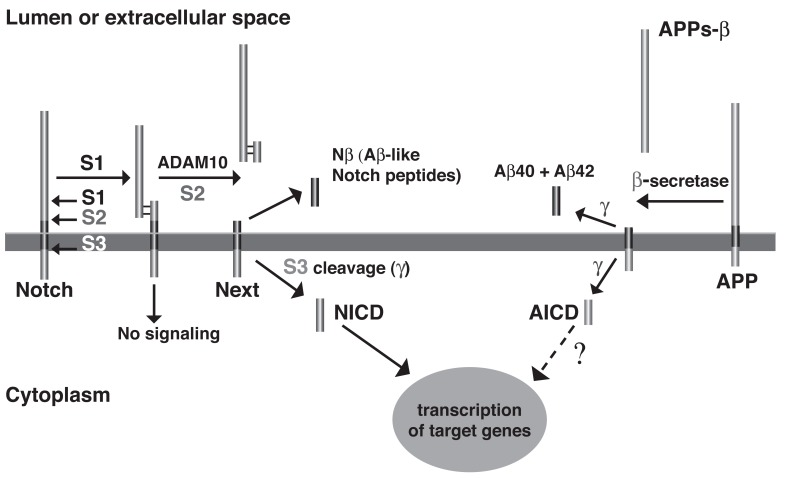
https://cdn.ncbi.nlm.nih.gov/pmc/blobs/ef02/3391656/4bf3815328e1/CN-9-598_F16.jpg
https://cdn.ncbi.nlm.nih.gov/pmc/blobs/ef02/3391656/05aa978392a4/CN-9-598_F1.jpg
https://cdn.ncbi.nlm.nih.gov/pmc/blobs/ef02/3391656/add00135e6d3/CN-9-598_F2.jpg
https://cdn.ncbi.nlm.nih.gov/pmc/blobs/ef02/3391656/a9cc9df6c296/CN-9-598_F3.jpg
https://cdn.ncbi.nlm.nih.gov/pmc/blobs/ef02/3391656/336c6fd3c715/CN-9-598_F4.jpg
https://cdn.ncbi.nlm.nih.gov/pmc/blobs/ef02/3391656/6de867c42a53/CN-9-598_F5.jpg
https://cdn.ncbi.nlm.nih.gov/pmc/blobs/ef02/3391656/d105dcaf4039/CN-9-598_F6.jpg
https://cdn.ncbi.nlm.nih.gov/pmc/blobs/ef02/3391656/032d8a3f922c/CN-9-598_F7.jpg
https://cdn.ncbi.nlm.nih.gov/pmc/blobs/ef02/3391656/8c05c1d24aae/CN-9-598_F8.jpg
https://cdn.ncbi.nlm.nih.gov/pmc/blobs/ef02/3391656/9b177daba648/CN-9-598_F9.jpg
https://cdn.ncbi.nlm.nih.gov/pmc/blobs/ef02/3391656/b5ea3560b788/CN-9-598_F10.jpg
https://cdn.ncbi.nlm.nih.gov/pmc/blobs/ef02/3391656/76cddf5861c3/CN-9-598_F11.jpg
https://cdn.ncbi.nlm.nih.gov/pmc/blobs/ef02/3391656/9b8695f41dbf/CN-9-598_F12.jpg
https://cdn.ncbi.nlm.nih.gov/pmc/blobs/ef02/3391656/27864dd51fbf/CN-9-598_F13.jpg
https://cdn.ncbi.nlm.nih.gov/pmc/blobs/ef02/3391656/a1945983f334/CN-9-598_F14.jpg
https://cdn.ncbi.nlm.nih.gov/pmc/blobs/ef02/3391656/867fa7611447/CN-9-598_F15.jpg
https://cdn.ncbi.nlm.nih.gov/pmc/blobs/ef02/3391656/4bf3815328e1/CN-9-598_F16.jpg
https://cdn.ncbi.nlm.nih.gov/pmc/blobs/ef02/3391656/05aa978392a4/CN-9-598_F1.jpg
https://cdn.ncbi.nlm.nih.gov/pmc/blobs/ef02/3391656/add00135e6d3/CN-9-598_F2.jpg
https://cdn.ncbi.nlm.nih.gov/pmc/blobs/ef02/3391656/a9cc9df6c296/CN-9-598_F3.jpg
https://cdn.ncbi.nlm.nih.gov/pmc/blobs/ef02/3391656/336c6fd3c715/CN-9-598_F4.jpg
https://cdn.ncbi.nlm.nih.gov/pmc/blobs/ef02/3391656/6de867c42a53/CN-9-598_F5.jpg
https://cdn.ncbi.nlm.nih.gov/pmc/blobs/ef02/3391656/d105dcaf4039/CN-9-598_F6.jpg
https://cdn.ncbi.nlm.nih.gov/pmc/blobs/ef02/3391656/032d8a3f922c/CN-9-598_F7.jpg
https://cdn.ncbi.nlm.nih.gov/pmc/blobs/ef02/3391656/8c05c1d24aae/CN-9-598_F8.jpg
https://cdn.ncbi.nlm.nih.gov/pmc/blobs/ef02/3391656/9b177daba648/CN-9-598_F9.jpg
https://cdn.ncbi.nlm.nih.gov/pmc/blobs/ef02/3391656/b5ea3560b788/CN-9-598_F10.jpg
https://cdn.ncbi.nlm.nih.gov/pmc/blobs/ef02/3391656/76cddf5861c3/CN-9-598_F11.jpg
https://cdn.ncbi.nlm.nih.gov/pmc/blobs/ef02/3391656/9b8695f41dbf/CN-9-598_F12.jpg
https://cdn.ncbi.nlm.nih.gov/pmc/blobs/ef02/3391656/27864dd51fbf/CN-9-598_F13.jpg
https://cdn.ncbi.nlm.nih.gov/pmc/blobs/ef02/3391656/a1945983f334/CN-9-598_F14.jpg
https://cdn.ncbi.nlm.nih.gov/pmc/blobs/ef02/3391656/867fa7611447/CN-9-598_F15.jpg
https://cdn.ncbi.nlm.nih.gov/pmc/blobs/ef02/3391656/4bf3815328e1/CN-9-598_F16.jpg

相似文献

1
Chemical Biology, Molecular Mechanism and Clinical Perspective of γ-Secretase Modulators in Alzheimer's Disease.化学生物学、分子机制与 γ-分泌酶调节剂在阿尔茨海默病中的临床研究进展。
Curr Neuropharmacol. 2011 Dec;9(4):598-622. doi: 10.2174/157015911798376352.
2
Presenilin is the molecular target of acidic γ-secretase modulators in living cells.早老素是活细胞中酸性 γ-分泌酶调节剂的分子靶标。
PLoS One. 2012;7(1):e30484. doi: 10.1371/journal.pone.0030484. Epub 2012 Jan 6.
3
Development and mechanism of γ-secretase modulators for Alzheimer's disease.γ-分泌酶调节剂治疗阿尔茨海默病的研发与作用机制。
Biochemistry. 2013 May 14;52(19):3197-216. doi: 10.1021/bi400377p. Epub 2013 May 2.
4
Second generation γ-secretase modulators exhibit different modulation of Notch β and Aβ production.第二代 γ-分泌酶调节剂对 Notch β 和 Aβ 产生的调节作用不同。
J Biol Chem. 2012 Sep 21;287(39):32640-50. doi: 10.1074/jbc.M112.376541. Epub 2012 Jul 31.
5
Characterization of FRM-36143 as a new γ-secretase modulator for the potential treatment of familial Alzheimer's disease.FRM-36143作为一种新型γ-分泌酶调节剂用于家族性阿尔茨海默病潜在治疗的特性研究
Alzheimers Res Ther. 2016 Aug 30;8(1):34. doi: 10.1186/s13195-016-0199-5.
6
Recent developments of small molecule γ-secretase modulators for Alzheimer's disease.用于阿尔茨海默病的小分子γ-分泌酶调节剂的最新进展
RSC Med Chem. 2020 Aug 27;11(9):1003-1022. doi: 10.1039/d0md00196a. eCollection 2020 Sep 1.
7
γ-Secretase modulators exhibit selectivity for modulation of APP cleavage but inverse γ-secretase modulators do not.γ-分泌酶调节剂对 APP 切割的调节具有选择性,但反向 γ-分泌酶调节剂则没有。
Alzheimers Res Ther. 2020 May 19;12(1):61. doi: 10.1186/s13195-020-00622-5.
8
γ-Secretase Modulators: Can We Combine Potency with Safety?γ-分泌酶调节剂:我们能否将效力与安全性相结合?
Int J Alzheimers Dis. 2012;2012:295207. doi: 10.1155/2012/295207. Epub 2012 Dec 17.
9
γ-Secretase modulator in Alzheimer's disease: shifting the end.阿尔茨海默病中的 γ-分泌酶调节剂:改变终点。
J Alzheimers Dis. 2012;31(4):685-96. doi: 10.3233/JAD-2012-120751.
10
Gamma-secretase modulation with Abeta42-lowering nonsteroidal anti-inflammatory drugs and derived compounds.使用降低β淀粉样蛋白42水平的非甾体抗炎药及其衍生化合物对γ-分泌酶进行调节。
Neurodegener Dis. 2006;3(4-5):298-304. doi: 10.1159/000095270.

引用本文的文献

1
The manipulator behind "Scissors": γ -secretase and its modulators in Alzheimer's disease.“剪刀”背后的操纵者:γ-分泌酶及其在阿尔茨海默病中的调节剂
Front Aging Neurosci. 2025 Aug 25;17:1637671. doi: 10.3389/fnagi.2025.1637671. eCollection 2025.
2
Novel Anti-Alzheimer's Therapeutic Molecules Targeting Amyloid Precursor Protein Processing.新型靶向淀粉样前体蛋白加工的抗阿尔茨海默病治疗分子。
Oxid Med Cell Longev. 2020 Apr 29;2020:7039138. doi: 10.1155/2020/7039138. eCollection 2020.
3
Identification and Preclinical Evaluation of the Bicyclic Pyrimidine γ-Secretase Modulator BMS-932481.

本文引用的文献

1
Presenilin-1 but not amyloid precursor protein mutations present in mouse models of Alzheimer's disease attenuate the response of cultured cells to γ-secretase modulators regardless of their potency and structure.阿尔茨海默病小鼠模型中存在的早老素-1 突变而不是淀粉样前体蛋白突变,无论其效力和结构如何,都会减弱培养细胞对 γ-分泌酶调节剂的反应。
J Neurochem. 2011 Feb;116(3):385-95. doi: 10.1111/j.1471-4159.2010.07118.x. Epub 2010 Dec 13.
2
Modulation of gamma-secretase reduces beta-amyloid deposition in a transgenic mouse model of Alzheimer's disease.γ-分泌酶的调制可减少阿尔茨海默病转基因小鼠模型中的β-淀粉样蛋白沉积。
Neuron. 2010 Sep 9;67(5):769-80. doi: 10.1016/j.neuron.2010.08.018.
3
双环嘧啶γ-分泌酶调节剂BMS-932481的鉴定与临床前评估
ACS Med Chem Lett. 2019 Feb 17;10(3):312-317. doi: 10.1021/acsmedchemlett.8b00541. eCollection 2019 Mar 14.
4
Precision pharmacology for Alzheimer's disease.阿尔茨海默病的精准药理学。
Pharmacol Res. 2018 Apr;130:331-365. doi: 10.1016/j.phrs.2018.02.014. Epub 2018 Feb 16.
5
Drug candidates in clinical trials for Alzheimer's disease.治疗阿尔茨海默病的临床试验药物候选物。
J Biomed Sci. 2017 Jul 19;24(1):47. doi: 10.1186/s12929-017-0355-7.
6
Modulation of Aβ42 in vivo by γ-secretase modulator in primates and humans.γ-分泌酶调节剂在灵长类动物和人类体内对Aβ42的调节作用。
Alzheimers Res Ther. 2015 Aug 5;7(1):55. doi: 10.1186/s13195-015-0137-y. eCollection 2015.
7
Development of nanoparticles incorporating a novel liposomal membrane destabilization peptide for efficient release of cargos into cancer cells.包含新型脂质体膜去稳定肽的纳米颗粒的开发,用于将货物有效释放到癌细胞中。
PLoS One. 2014 Oct 24;9(10):e111181. doi: 10.1371/journal.pone.0111181. eCollection 2014.
8
Smoking and increased Alzheimer's disease risk: a review of potential mechanisms.吸烟与阿尔茨海默病风险增加:潜在机制综述
Alzheimers Dement. 2014 Jun;10(3 Suppl):S122-45. doi: 10.1016/j.jalz.2014.04.009.
9
Nanoparticulate flurbiprofen reduces amyloid-β42 generation in an in vitro blood-brain barrier model.纳米颗粒氟比洛芬可减少体外血脑屏障模型中淀粉样蛋白-β42 的生成。
Alzheimers Res Ther. 2013 Nov 27;5(6):51. doi: 10.1186/alzrt225. eCollection 2013.
10
R-flurbiprofen improves tau, but not Aß pathology in a triple transgenic model of Alzheimer's disease.R-氟比洛芬改善了阿尔茨海默病三转基因模型中的 tau 蛋白,而非 Aβ 病理学。
Brain Res. 2013 Dec 6;1541:115-27. doi: 10.1016/j.brainres.2013.10.025. Epub 2013 Oct 22.
Neurotoxicity of Alzheimer's disease Aβ peptides is induced by small changes in the Aβ42 to Aβ40 ratio.
阿尔茨海默病 Aβ 肽的神经毒性是由 Aβ42 与 Aβ40 比值的微小变化引起的。
EMBO J. 2010 Oct 6;29(19):3408-20. doi: 10.1038/emboj.2010.211. Epub 2010 Sep 3.
4
Iminoheterocycles as gamma-secretase modulators.亚氨基杂环作为γ-分泌酶调节剂。
Bioorg Med Chem Lett. 2010 Sep 15;20(18):5380-4. doi: 10.1016/j.bmcl.2010.07.121. Epub 2010 Aug 1.
5
Amyloid beta 42 peptide (Abeta42)-lowering compounds directly bind to Abeta and interfere with amyloid precursor protein (APP) transmembrane dimerization.β淀粉样蛋白 42 肽(Abeta42)降低化合物直接与 Abeta 结合,并干扰淀粉样前体蛋白(APP)跨膜二聚化。
Proc Natl Acad Sci U S A. 2010 Aug 17;107(33):14597-602. doi: 10.1073/pnas.1003026107. Epub 2010 Aug 2.
6
Design, synthesis, and biological evaluation of a novel class of gamma-secretase modulators with PPARgamma activity.新型具有 PPARγ 活性γ-分泌酶调节剂的设计、合成与生物评价。
J Med Chem. 2010 Jun 24;53(12):4691-700. doi: 10.1021/jm1003073.
7
Alzheimer's disease: strategies for disease modification.阿尔茨海默病:疾病修饰策略。
Nat Rev Drug Discov. 2010 May;9(5):387-98. doi: 10.1038/nrd2896.
8
Beta-amyloid precursor protein mutants respond to gamma-secretase modulators.β-淀粉样前体蛋白突变体对 γ-分泌酶调节剂有反应。
J Biol Chem. 2010 Jun 4;285(23):17798-810. doi: 10.1074/jbc.M110.103283. Epub 2010 Mar 26.
9
Novel gamma-secretase inhibitors uncover a common nucleotide-binding site in JAK3, SIRT2, and PS1.新型γ-分泌酶抑制剂揭示 JAK3、SIRT2 和 PS1 中的共同核苷酸结合位点。
FASEB J. 2010 Jul;24(7):2464-74. doi: 10.1096/fj.09-148031. Epub 2010 Mar 17.
10
Design and synthesis of tricyclic sulfones as gamma-secretase inhibitors with greatly reduced Notch toxicity.作为具有显著降低Notch毒性的γ-分泌酶抑制剂的三环砜的设计与合成。
Bioorg Med Chem Lett. 2010 Apr 15;20(8):2591-6. doi: 10.1016/j.bmcl.2010.02.080. Epub 2010 Feb 23.