Howard Hughes Medical Institute and Department of Biology, Massachusetts Institute of Technology, Cambridge, Massachusetts 02139, USA.
Nature. 2012 Aug 9;488(7410):226-30. doi: 10.1038/nature11240.
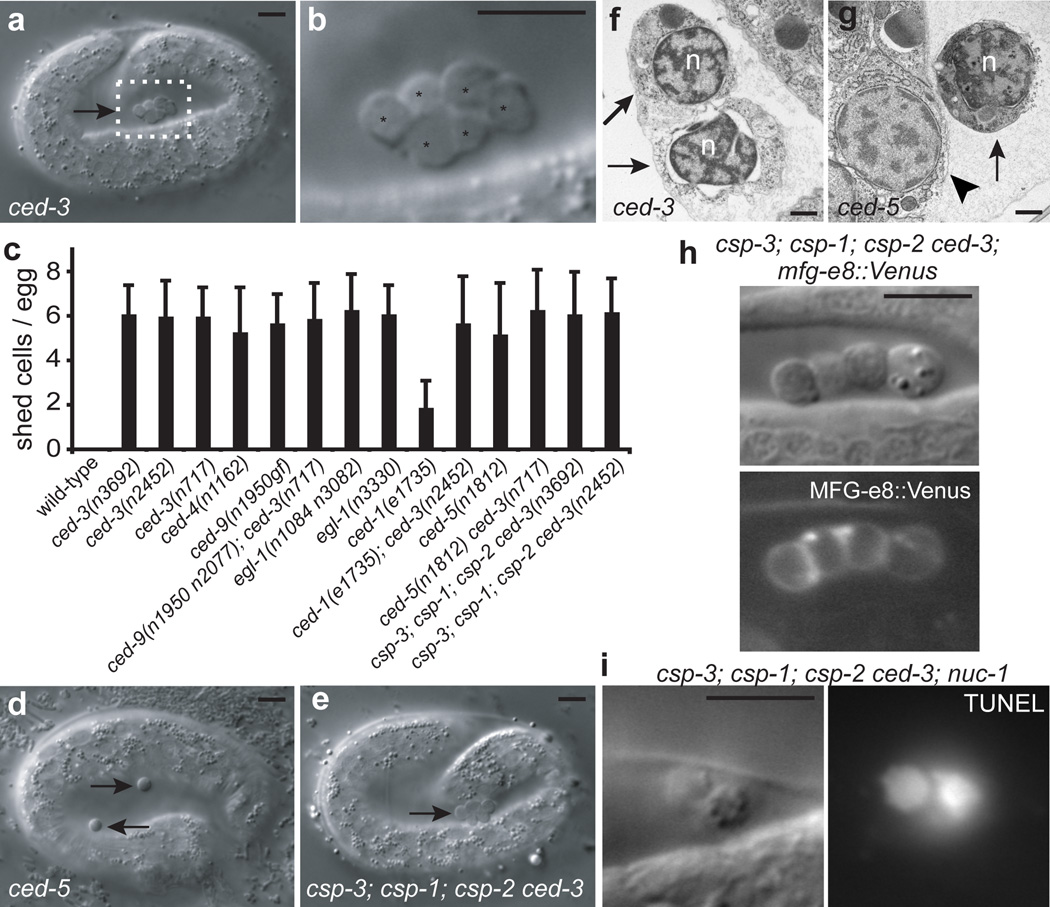
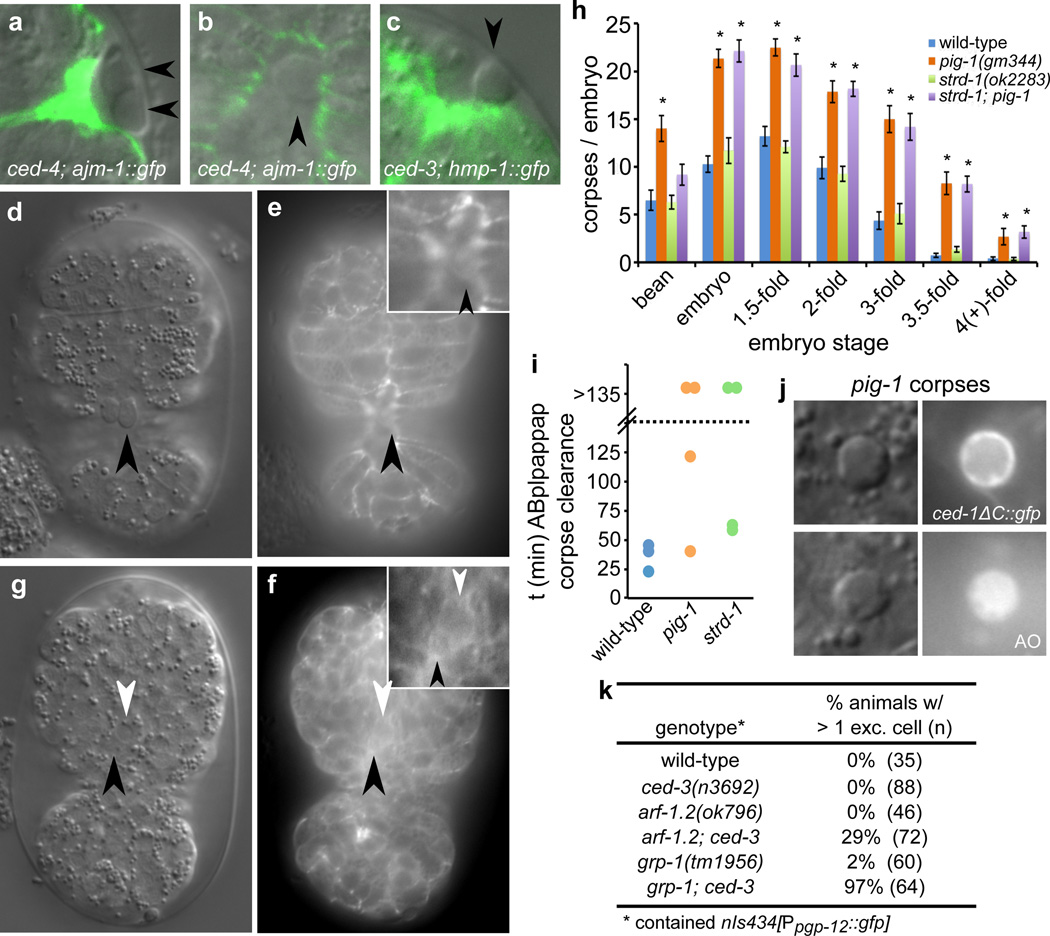
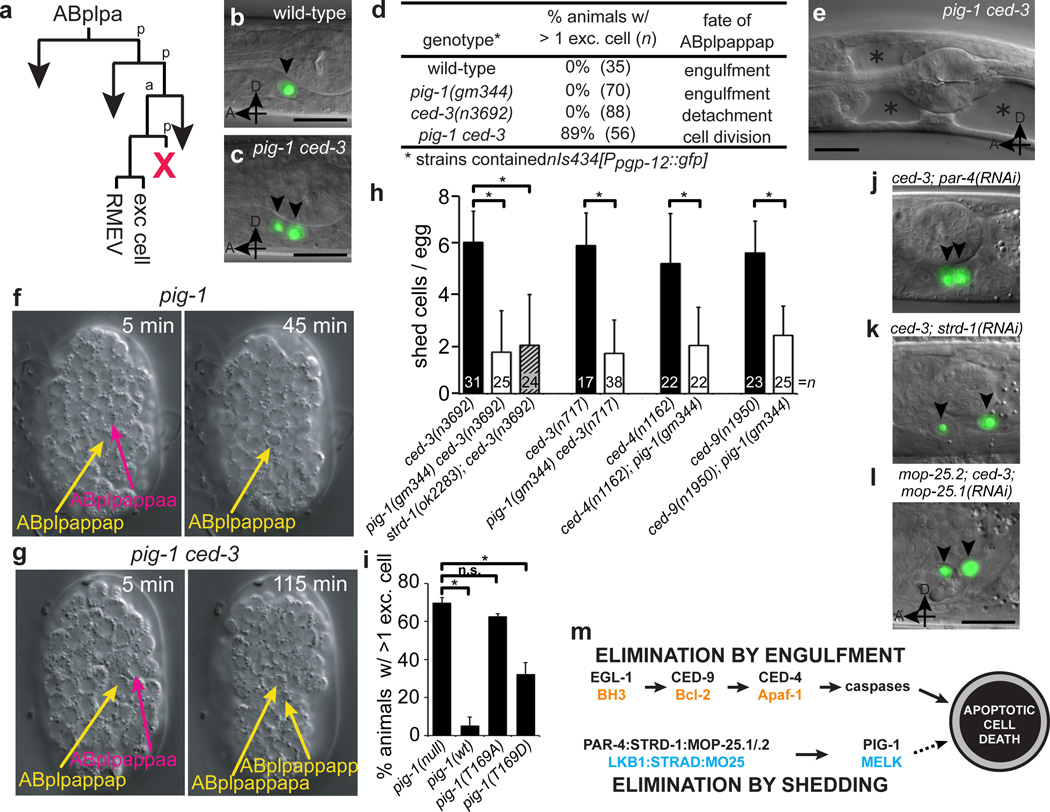
The elimination of unnecessary or defective cells from metazoans occurs during normal development and tissue homeostasis, as well as in response to infection or cellular damage. Although many cells are removed through caspase-mediated apoptosis followed by phagocytosis by engulfing cells, other mechanisms of cell elimination occur, including the extrusion of cells from epithelia through a poorly understood, possibly caspase-independent, process. Here we identify a mechanism of cell extrusion that is caspase independent and that can eliminate a subset of the Caenorhabditis elegans cells programmed to die during embryonic development. In wild-type animals, these cells die soon after their generation through caspase-mediated apoptosis. However, in mutants lacking all four C. elegans caspase genes, these cells are eliminated by being extruded from the developing embryo into the extra-embryonic space of the egg. The shed cells show apoptosis-like cytological and morphological characteristics, indicating that apoptosis can occur in the absence of caspases in C. elegans. We describe a kinase pathway required for cell extrusion involving PAR-4, STRD-1 and MOP-25.1/-25.2, the C. elegans homologues of the mammalian tumour-suppressor kinase LKB1 and its binding partners STRADα and MO25α. The AMPK-related kinase PIG-1, a possible target of the PAR-4–STRD-1–MOP-25 kinase complex, is also required for cell shedding. PIG-1 promotes shed-cell detachment by preventing the cell-surface expression of cell-adhesion molecules. Our findings reveal a mechanism for apoptotic cell elimination that is fundamentally distinct from that of canonical programmed cell death.
多细胞生物中,多余或有缺陷的细胞会在正常发育和组织稳态过程中被清除,同时也会在受到感染或细胞损伤时被清除。虽然许多细胞是通过半胱天冬酶介导的凋亡并被吞噬细胞吞噬而被清除的,但也存在其他的细胞清除机制,包括通过一种尚未完全了解的、可能不依赖半胱天冬酶的过程,将细胞从上皮细胞中挤出。在这里,我们鉴定了一种不依赖半胱天冬酶的细胞挤出机制,该机制可以清除一组在胚胎发育过程中被编程死亡的秀丽隐杆线虫细胞。在野生型动物中,这些细胞在通过半胱天冬酶介导的凋亡产生后不久就会死亡。然而,在缺乏所有四个秀丽隐杆线虫半胱天冬酶基因的突变体中,这些细胞通过从发育中的胚胎中挤出到卵的胚胎外空间而被清除。脱落的细胞表现出类似凋亡的细胞学和形态学特征,表明在秀丽隐杆线虫中,凋亡可以在没有半胱天冬酶的情况下发生。我们描述了一种涉及 PAR-4、STRD-1 和 MOP-25.1/-25.2 的细胞挤出所必需的激酶途径,PAR-4、STRD-1 和 MOP-25.1/-25.2 是哺乳动物肿瘤抑制激酶 LKB1 及其结合伴侣 STRADα 和 MO25α 的秀丽隐杆线虫同源物。与 AMPK 相关的激酶 PIG-1 也是细胞脱落所必需的,它可能是 PAR-4-STRD-1-MOP-25 激酶复合物的靶标。PIG-1 通过防止细胞表面表达细胞黏附分子来促进脱落细胞的脱离。我们的发现揭示了一种与经典程序性细胞死亡截然不同的凋亡细胞清除机制。