Department of Medical Microbiology, University Medical Center Utrecht, Utrecht, The Netherlands.
mBio. 2012 Jul 17;3(4):e00151-12. doi: 10.1128/mBio.00151-12. Print 2012.
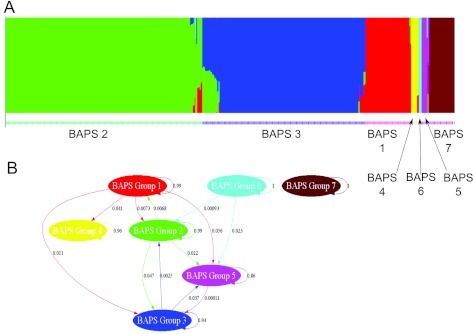
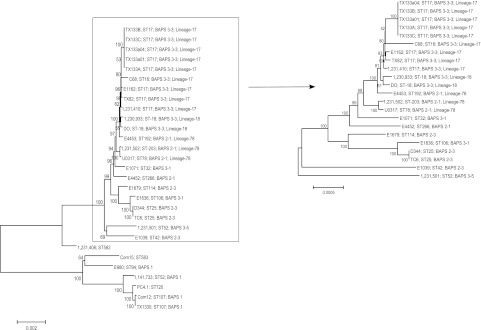
Enterococcus faecium has recently emerged as an important multiresistant nosocomial pathogen. Defining population structure in this species is required to provide insight into the existence, distribution, and dynamics of specific multiresistant or pathogenic lineages in particular environments, like the hospital. Here, we probe the population structure of E. faecium using Bayesian-based population genetic modeling implemented in Bayesian Analysis of Population Structure (BAPS) software. The analysis involved 1,720 isolates belonging to 519 sequence types (STs) (491 for E. faecium and 28 for Enterococcus faecalis). E. faecium isolates grouped into 13 BAPS (sub)groups, but the large majority (80%) of nosocomial isolates clustered in two subgroups (2-1 and 3-3). Phylogenetic and eBURST analysis of BAPS groups 2 and 3 confirmed the existence of three separate hospital lineages (17, 18, and 78), highlighting different evolutionary trajectories for BAPS 2-1 (lineage 78) and 3-3 (lineage 17 and lineage 18) isolates. Phylogenomic analysis of 29 E. faecium isolates showed agreement between BAPS assignment of STs and their relative positions in the phylogenetic tree. Odds ratio calculation confirmed the significant association between hospital isolates with BAPS 3-3 and lineages 17, 18, and 78. Admixture analysis showed a scarce number of recombination events between the different BAPS groups. For the E. faecium hospital population, we propose an evolutionary model in which strains with a high propensity to colonize and infect hospitalized patients arise through horizontal gene transfer. Once adapted to the distinct hospital niche, this subpopulation becomes isolated, and recombination with other populations declines.
Multiresistant Enterococcus faecium has become one of the most important nosocomial pathogens, causing increasing numbers of nosocomial infections worldwide. Here, we used Bayesian population genetic analysis to identify groups of related E. faecium strains and show a significant association of hospital and farm animal isolates to different genetic groups. We also found that hospital isolates could be divided into three lineages originating from sequence types (STs) 17, 18, and 78. We propose that, driven by the selective pressure in hospitals, the three hospital lineages have arisen through horizontal gene transfer, but once adapted to the distinct pathogenic niche, this population has become isolated and recombination with other populations declines. Elucidation of the population structure is a prerequisite for effective control of multiresistant E. faecium since it provides insight into the processes that have led to the progressive change of E. faecium from an innocent commensal to a multiresistant hospital-adapted pathogen.
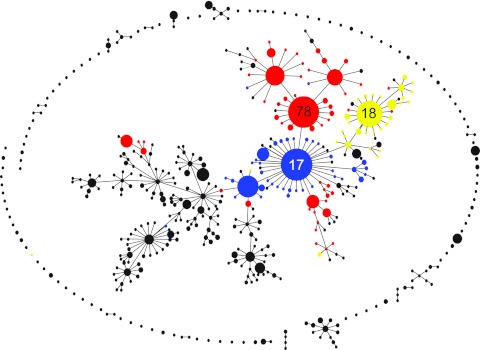
屎肠球菌最近已成为一种重要的多药耐药医院病原体。在该物种中定义种群结构,以了解特定的多药耐药或致病谱系在特定环境(如医院)中的存在、分布和动态。在这里,我们使用贝叶斯分析种群结构(BAPS)软件中的基于贝叶斯的种群遗传建模来探测屎肠球菌的种群结构。该分析涉及属于 519 个序列型(ST)的 1720 个分离株(491 个属于屎肠球菌,28 个属于粪肠球菌)。屎肠球菌分离株分为 13 个 BAPS(亚)组,但绝大多数(80%)医院分离株聚集在两个亚组(2-1 和 3-3)中。BAPS 组 2 和 3 的系统发育和 eBURST 分析证实了三个独立的医院谱系(17、18 和 78)的存在,突出了 BAPS 2-1(谱系 78)和 3-3(谱系 17 和谱系 18)分离株的不同进化轨迹。对 29 个屎肠球菌分离株的基因组分析表明,ST 的 BAPS 分配与其在系统发育树中的相对位置一致。比值比计算证实了医院分离株与 BAPS 3-3 和谱系 17、18 和 78 之间的显著关联。混合分析表明,不同 BAPS 组之间发生的重组事件很少。对于屎肠球菌医院人群,我们提出了一种进化模型,其中具有定植和感染住院患者高倾向的菌株通过水平基因转移产生。一旦适应了独特的医院小生境,这个亚群就会被隔离,与其他群体的重组减少。
多药耐药屎肠球菌已成为最重要的医院病原体之一,导致全球越来越多的医院感染。在这里,我们使用贝叶斯种群遗传分析来识别相关屎肠球菌菌株的群体,并显示医院和农场动物分离株与不同遗传群体之间存在显著关联。我们还发现,医院分离株可分为源自 ST 17、18 和 78 的三个谱系。我们提出,在医院的选择压力驱动下,三个医院谱系通过水平基因转移产生,但一旦适应了独特的致病小生境,这个种群就会被隔离,与其他种群的重组减少。阐明种群结构是有效控制多药耐药屎肠球菌的前提,因为它可以深入了解导致屎肠球菌从无辜的共生菌逐渐演变为多药耐药的医院适应病原体的过程。