Betancur Juan G, Yoda Mayuko, Tomari Yukihide
Institute of Molecular and Cellular Biosciences, The University of Tokyo, Tokyo, Japan.
Front Genet. 2012 Jul 12;3:127. doi: 10.3389/fgene.2012.00127. eCollection 2012.
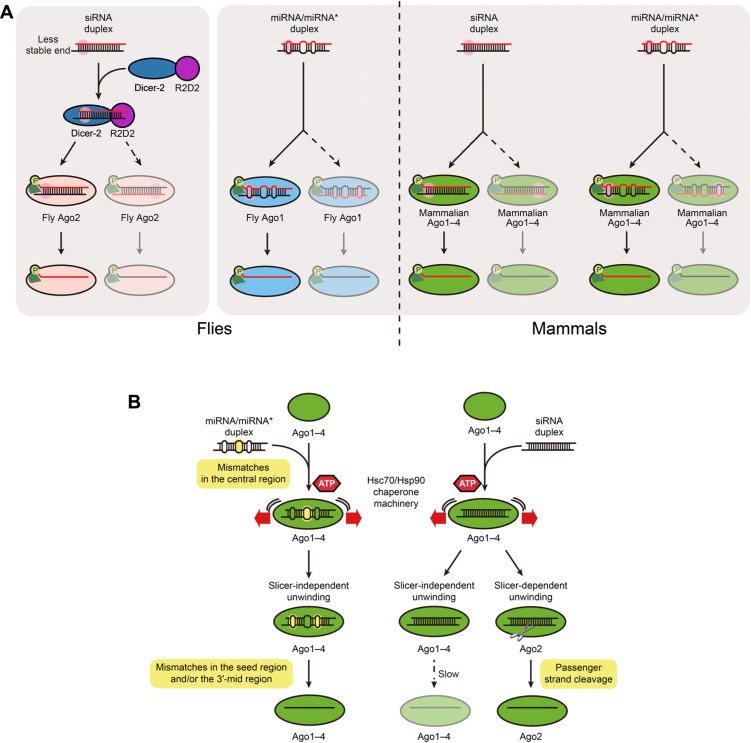
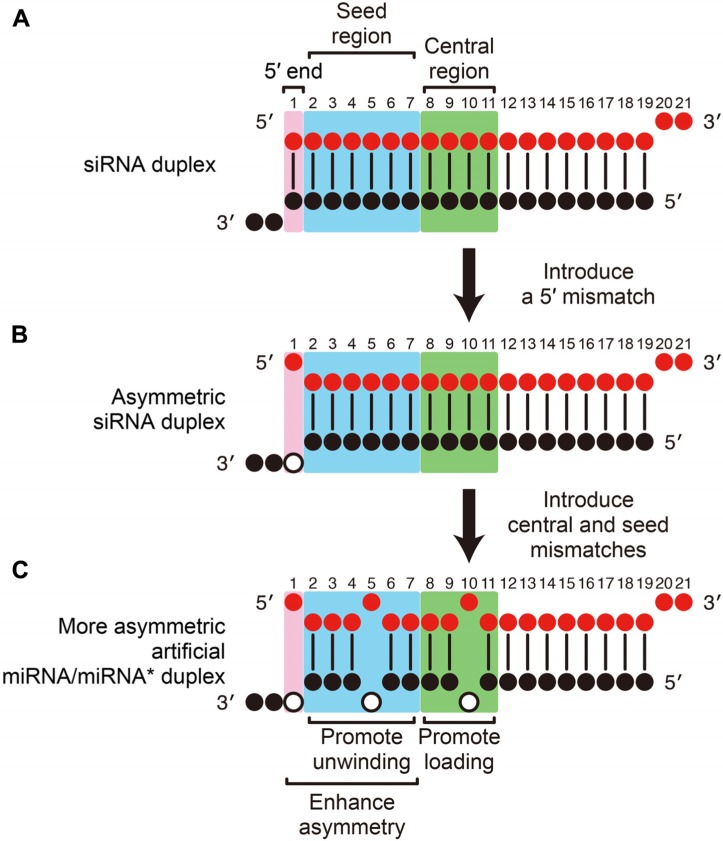
siRNA duplexes, the most common triggers of RNA interference, are first loaded into an Argonaute (Ago) protein and then undergo unwinding via passenger strand cleavage, which requires the slicer activity of the Ago protein. In mammals, only Ago2 out of the four Ago proteins possesses such slicer activity. In contrast, miRNA/miRNA* duplexes often contain central mismatches that prevent slicer-dependent unwinding. Instead, mismatches in specific regions (seed and 3'-mid regions) promote efficient slicer-independent unwinding by any of the four mammalian Ago proteins. Both slicer-dependent and slicer-independent unwinding mechanisms produce guide-containing RNA-induced silencing complex (RISC), which silences target mRNAs by cleavage, translational repression, and/or deadenylation that leads to mRNA decay. In this review, we summarize our current knowledge of the RISC assembly pathways, and describe a simple method to rationally design artificial miRNA/miRNA*-like duplexes and highlight its benefits to reduce the unwanted "off-target" effects without compromising the specific target silencing activity.
小干扰RNA双链体是RNA干扰最常见的触发因素,首先被装载到AGO蛋白中,然后通过乘客链切割进行解旋,这需要AGO蛋白的切割活性。在哺乳动物中,四种AGO蛋白中只有AGO2具有这种切割活性。相比之下,微小RNA/微小RNA双链体通常含有中央错配,可阻止依赖切割的解旋。相反,特定区域(种子区和3' - 中间区)的错配可促进四种哺乳动物AGO蛋白中的任何一种进行高效的非依赖切割解旋。依赖切割和解旋的解旋机制都会产生含向导链的RNA诱导沉默复合体(RISC),该复合体通过切割、翻译抑制和/或去腺苷酸化使靶标信使核糖核酸沉默,从而导致信使核糖核酸降解。在本综述中,我们总结了目前对RISC组装途径的认识,并描述了一种合理设计人工微小RNA/微小RNA样双链体的简单方法,并强调了其在不影响特异性靶标沉默活性的情况下减少不必要的“脱靶”效应的益处。