Department of Electrical Engineering and Computer Sciences, Case Western Reserve University, Cleveland, Ohio, United States of America.
PLoS One. 2012;7(7):e38275. doi: 10.1371/journal.pone.0038275. Epub 2012 Jul 12.
Cytometry of asynchronous proliferating cell populations produces data with an extractable time-based feature embedded in the frequency of clustered, correlated events. Here, we present a specific case of general methodology for calculating dynamic expression profiles of epitopes that oscillate during the cell cycle and conversion of these values to the same scale.
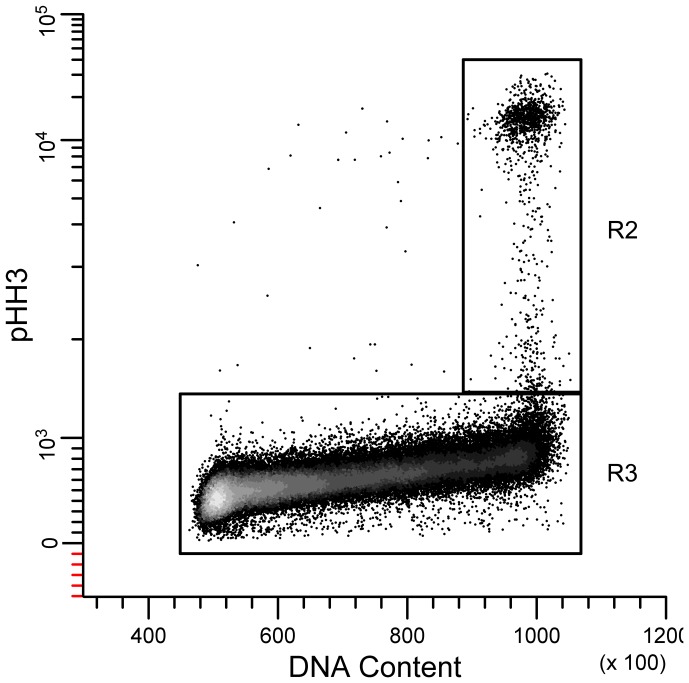
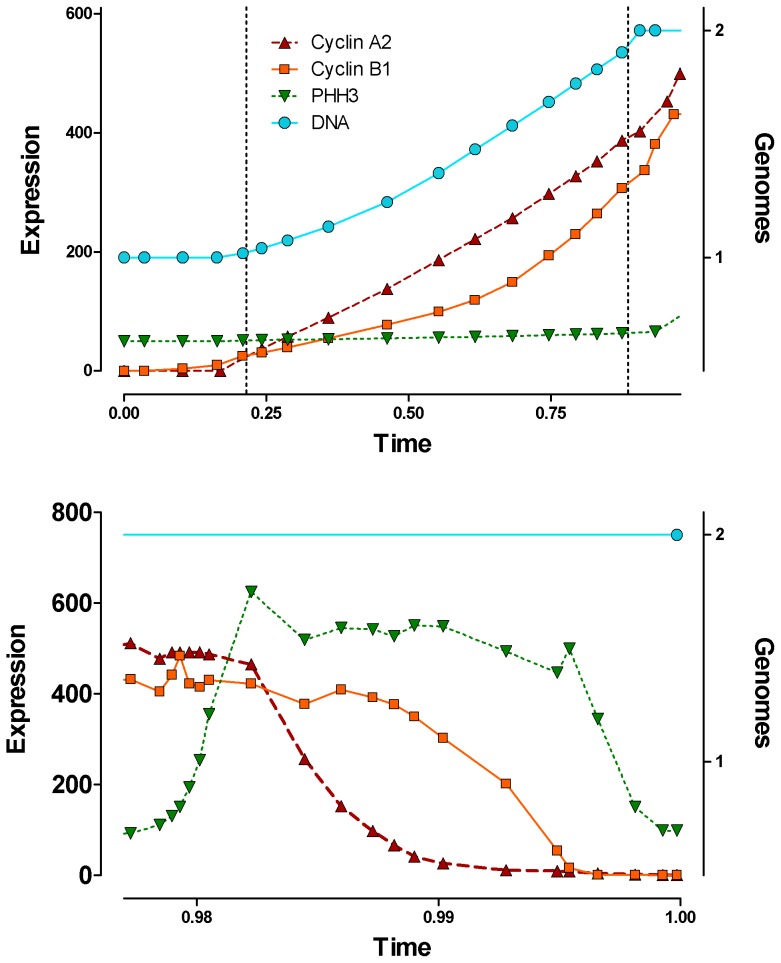
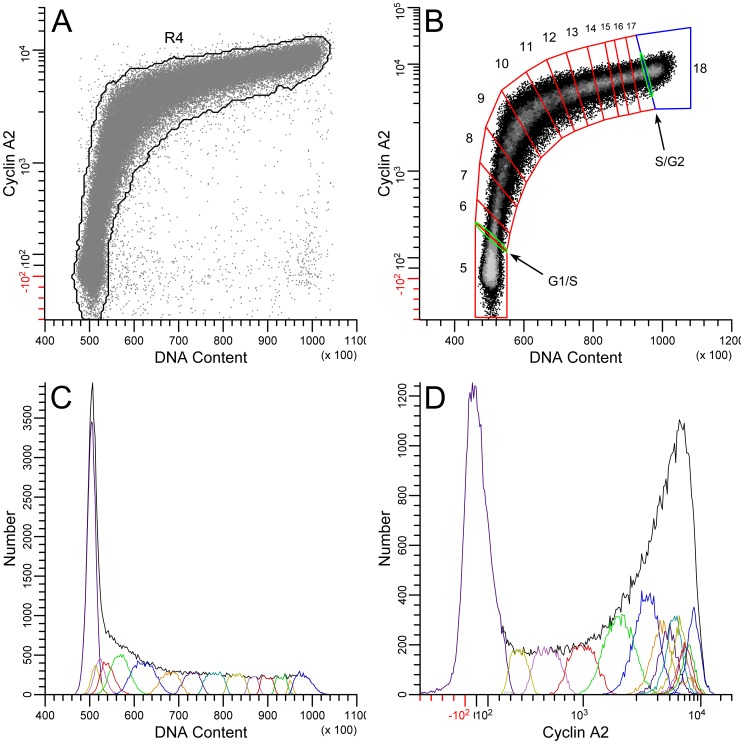
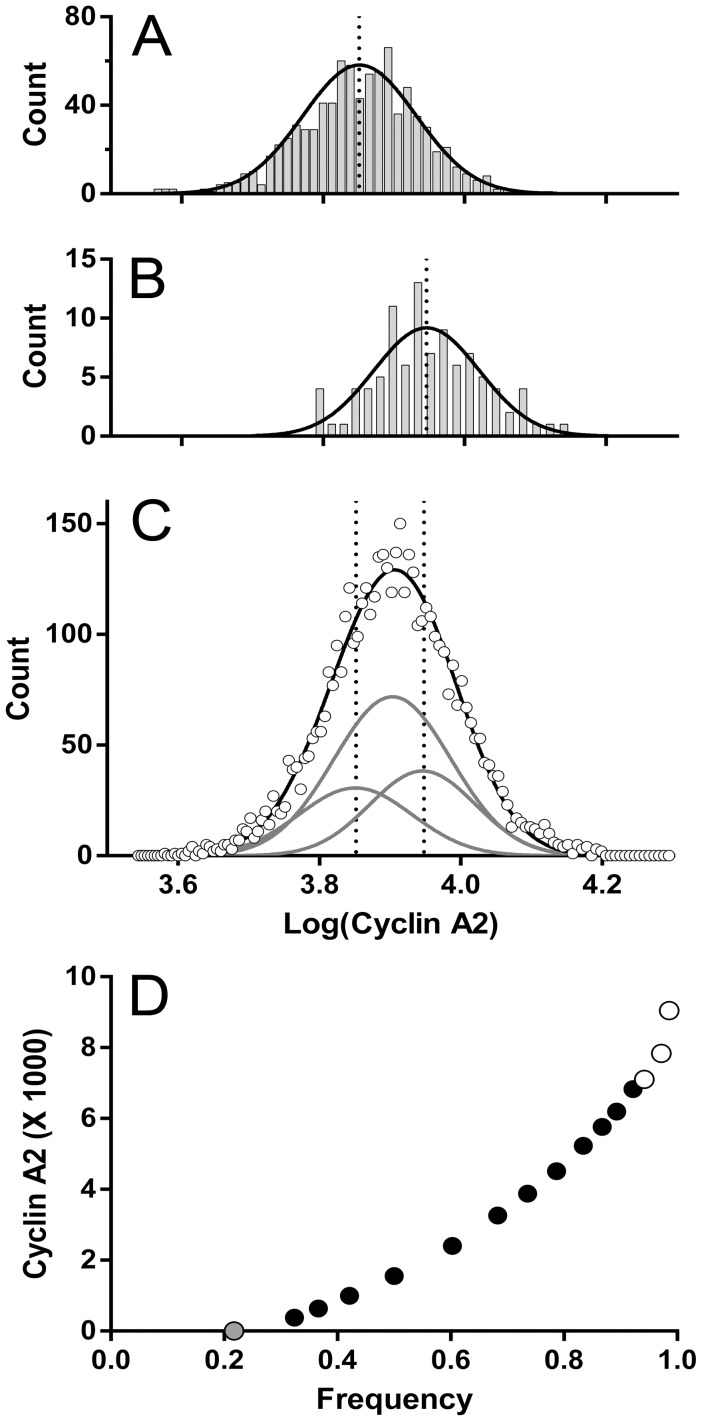
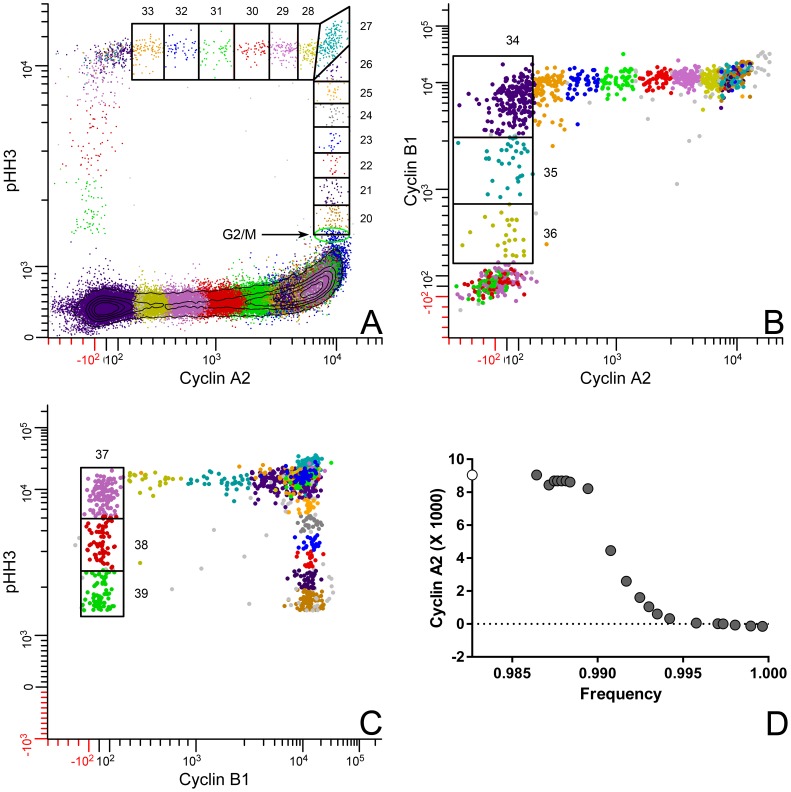
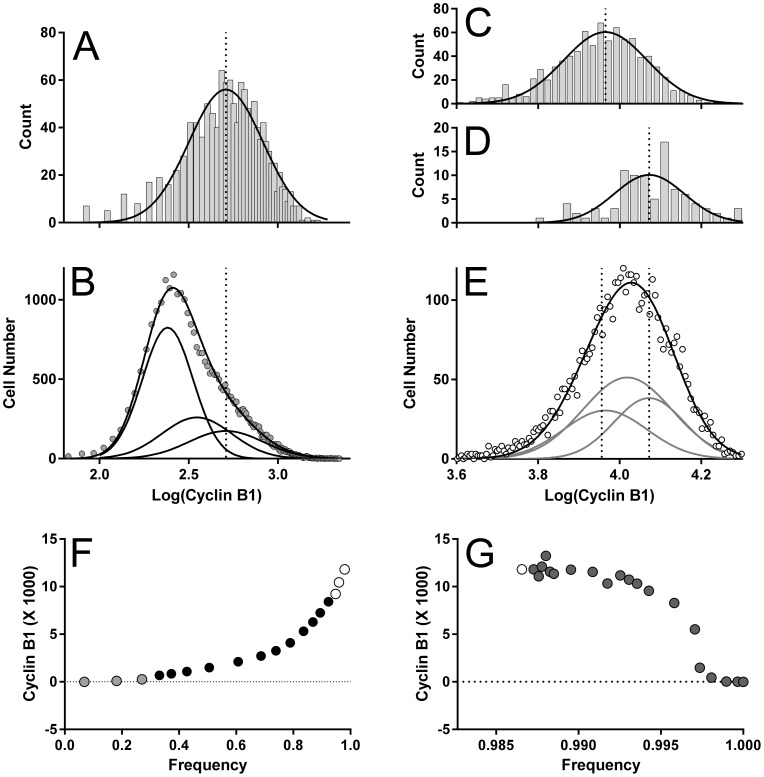
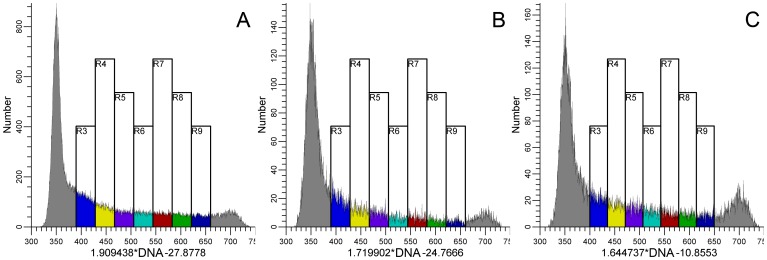
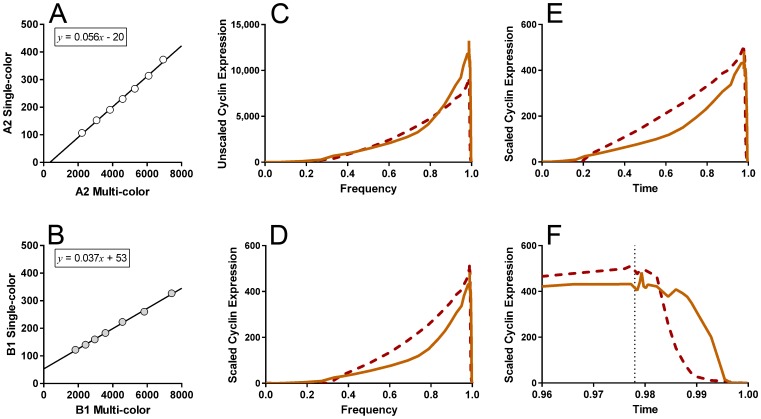
Samples of K562 cells from one population were labeled by direct and indirect antibody methods for cyclins A2 and B1 and phospho-S10-histone H3. The same indirect antibody was used for both cyclins. Directly stained samples were counter-stained with 4'6-diamidino-2-phenylindole and indirectly stained samples with propidium to label DNA. The S phase cyclin expressions from indirect assays were used to scale the expression of the cyclins of the multi-variate direct assay. Boolean gating and two dimensional, sequential regions set on bivariate displays of the directly conjugated sample data were used to untangle and isolate unique, unambiguous expression values of the cyclins along the four-dimensional data path through the cell cycle. The median values of cyclins A2 and B1 from each region were correlated with the frequency of events within each region.
The sequential runs of data were plotted as continuous multi-line linear equations of the form y = [(y(i+1)-y(i))/(x(i+1)-x(i))]x + y(i)-[(y(i+1)-y(i))/(x(i+1)-x(i))]x(i) (line between points (x(i),y(i)) and (x(i+1), y(i+1))) to capture the dynamic expression profile of the two cyclins.
This specific approach demonstrates the general methodology and provides a rule set from which the cell cycle expression of any other epitopes could be measured and calculated. These expression profiles are the "state variable" outputs, useful for calibrating mathematical cell cycle models.
对异步增殖细胞群体进行流式细胞术分析会产生具有时间特征的数据,这些数据嵌入在聚类相关事件的频率中。在此,我们提出了一种特定的一般方法,用于计算在细胞周期中振荡的表位的动态表达谱,并将这些值转换为相同的标度。
从一个群体的 K562 细胞样本中,通过直接和间接抗体方法对细胞周期蛋白 A2 和 B1 以及磷酸化 S10-组蛋白 H3 进行标记。两种细胞周期蛋白都使用相同的间接抗体进行标记。直接染色的样本用 4'6-二脒基-2-苯基吲哚复染,间接染色的样本用碘化丙啶标记 DNA。间接测定法的 S 期细胞周期蛋白表达被用来对多变量直接测定法的细胞周期蛋白表达进行标度。使用布尔门控和双变量显示的二维、顺序区域来解开和分离细胞周期中沿四维数据路径的细胞周期蛋白的独特、明确的表达值。每个区域的细胞周期蛋白 A2 和 B1 的中位数与每个区域内事件的频率相关。
数据的连续运行被绘制为连续的多线线性方程,形式为 y = [(y(i+1)-y(i))/(x(i+1)-x(i))]x + y(i)-[(y(i+1)-y(i))/(x(i+1)-x(i))]x(i)(点 (x(i),y(i)) 和 (x(i+1), y(i+1)) 之间的线),以捕获两个细胞周期蛋白的动态表达谱。
这种特定的方法展示了一般的方法,并提供了一个规则集,从中可以测量和计算任何其他表位的细胞周期表达。这些表达谱是“状态变量”输出,可用于校准数学细胞周期模型。