CSIRO Information and Communication Technologies Centre, Marsfield, New South Wales, Australia.
PLoS One. 2012;7(7):e40084. doi: 10.1371/journal.pone.0040084. Epub 2012 Jul 12.
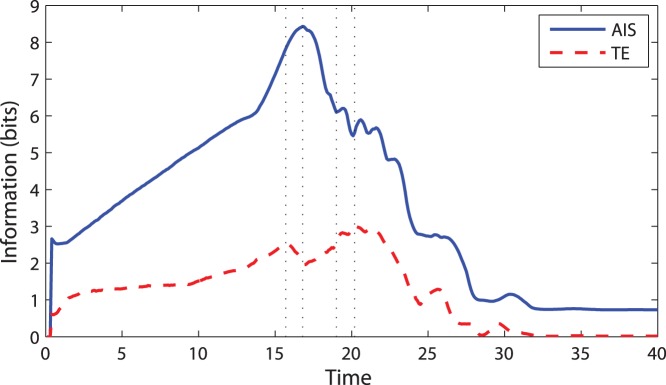
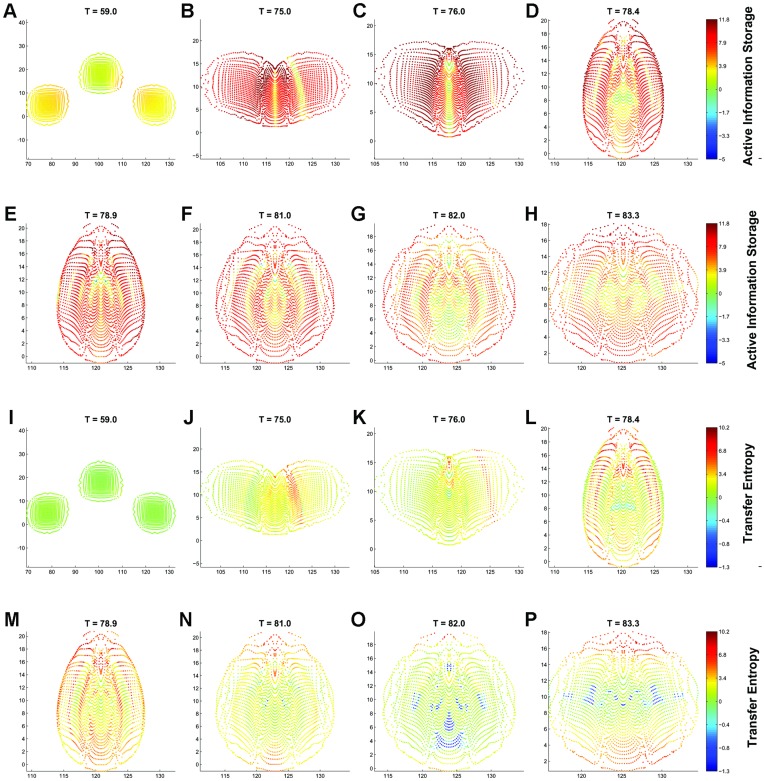
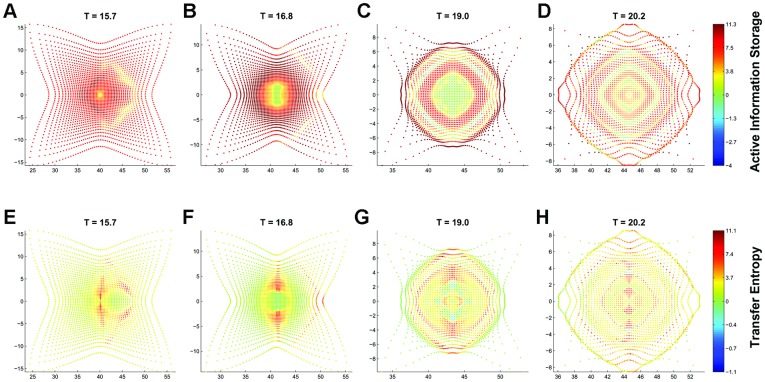
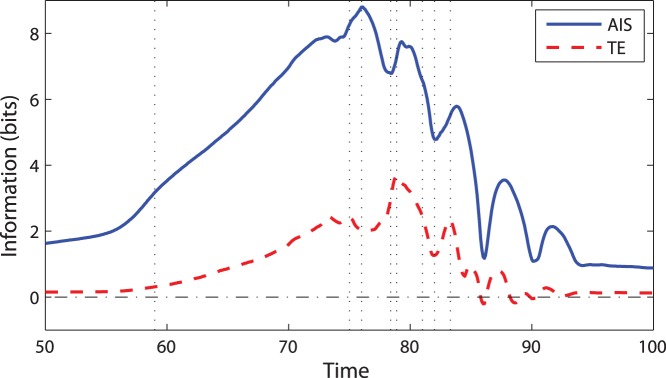
We propose a novel, information-theoretic, characterisation of cascades within the spatiotemporal dynamics of swarms, explicitly measuring the extent of collective communications. This is complemented by dynamic tracing of collective memory, as another element of distributed computation, which represents capacity for swarm coherence. The approach deals with both global and local information dynamics, ultimately discovering diverse ways in which an individual's spatial position is related to its information processing role. It also allows us to contrast cascades that propagate conflicting information with waves of coordinated motion. Most importantly, our simulation experiments provide the first direct information-theoretic evidence (verified in a simulation setting) for the long-held conjecture that the information cascades occur in waves rippling through the swarm. Our experiments also exemplify how features of swarm dynamics, such as cascades' wavefronts, can be filtered and predicted. We observed that maximal information transfer tends to follow the stage with maximal collective memory, and principles like this may be generalised in wider biological and social contexts.
我们提出了一种新颖的、基于信息论的方法来描述群体的时空动态中的级联,明确地测量了集体通信的程度。这一方法还通过动态跟踪集体记忆来补充,作为分布式计算的另一个要素,代表了群体一致性的能力。该方法处理全局和局部信息动态,最终发现了个体的空间位置与其信息处理角色之间的多种关系。它还使我们能够对比传播冲突信息的级联与协调运动的波。最重要的是,我们的模拟实验提供了第一个直接的信息论证据(在模拟环境中得到验证),证明了长期以来的推测,即信息级联以波浪的形式在群体中传播。我们的实验还举例说明了群体动态的特征,如级联的波前,可以被过滤和预测。我们观察到最大的信息传输往往遵循具有最大集体记忆的阶段,这样的原则可能在更广泛的生物和社会背景下得到推广。