Research Institute for Environment and Livelihoods, Charles Darwin University, Darwin, Northern Territory, Australia.
PLoS One. 2012;7(7):e40713. doi: 10.1371/journal.pone.0040713. Epub 2012 Jul 12.
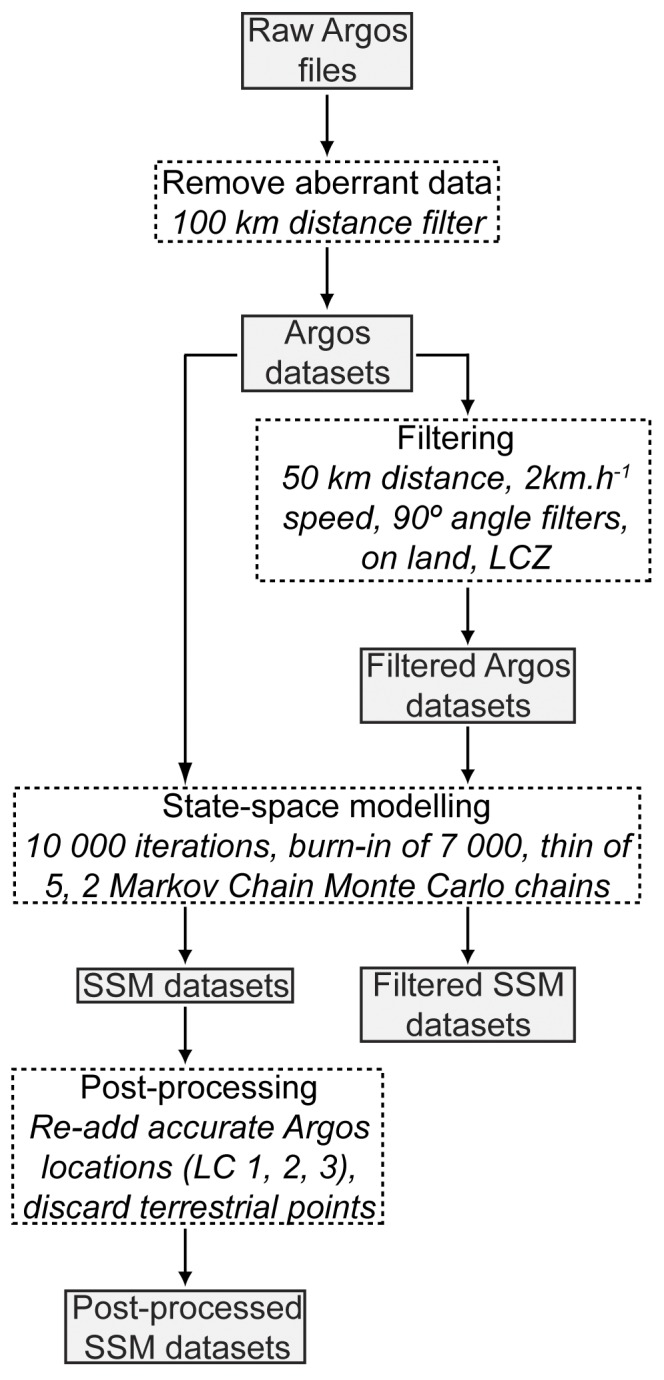
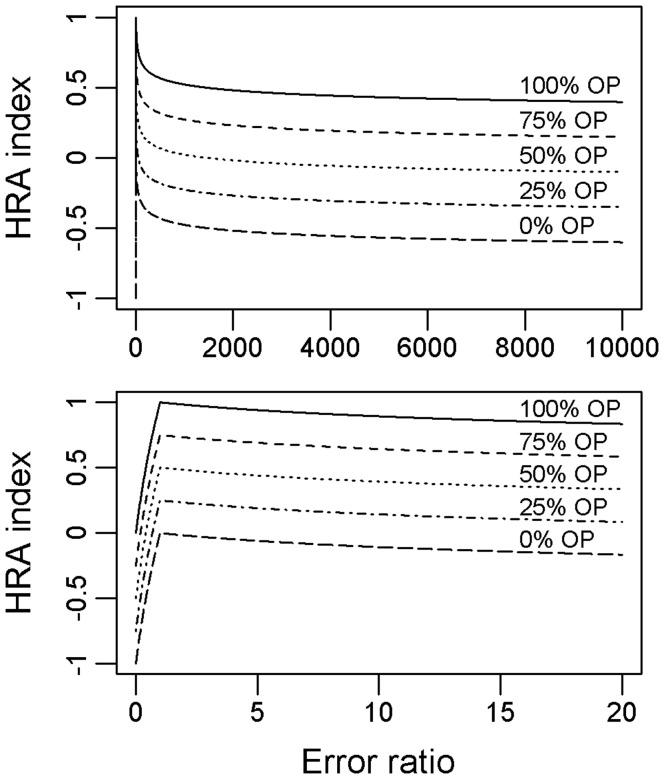
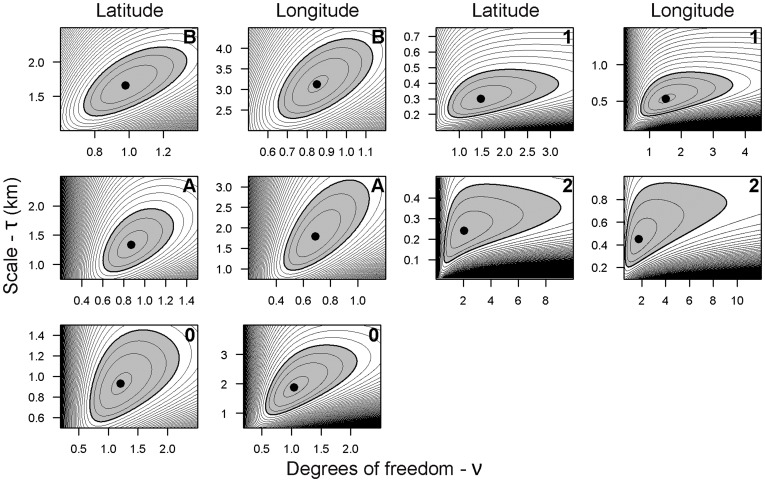
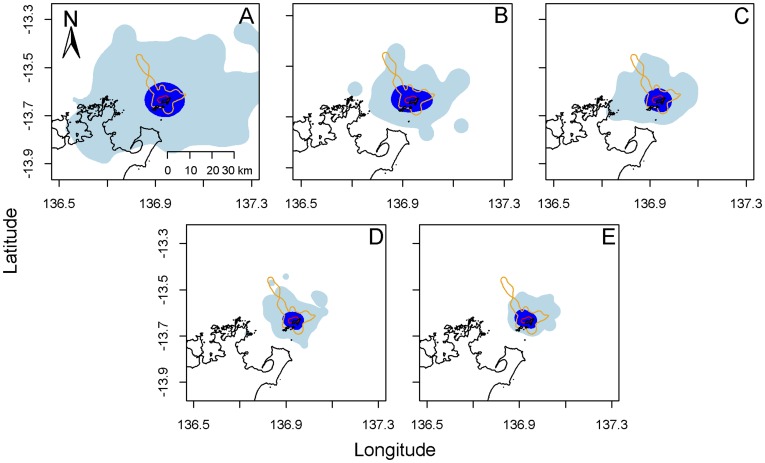
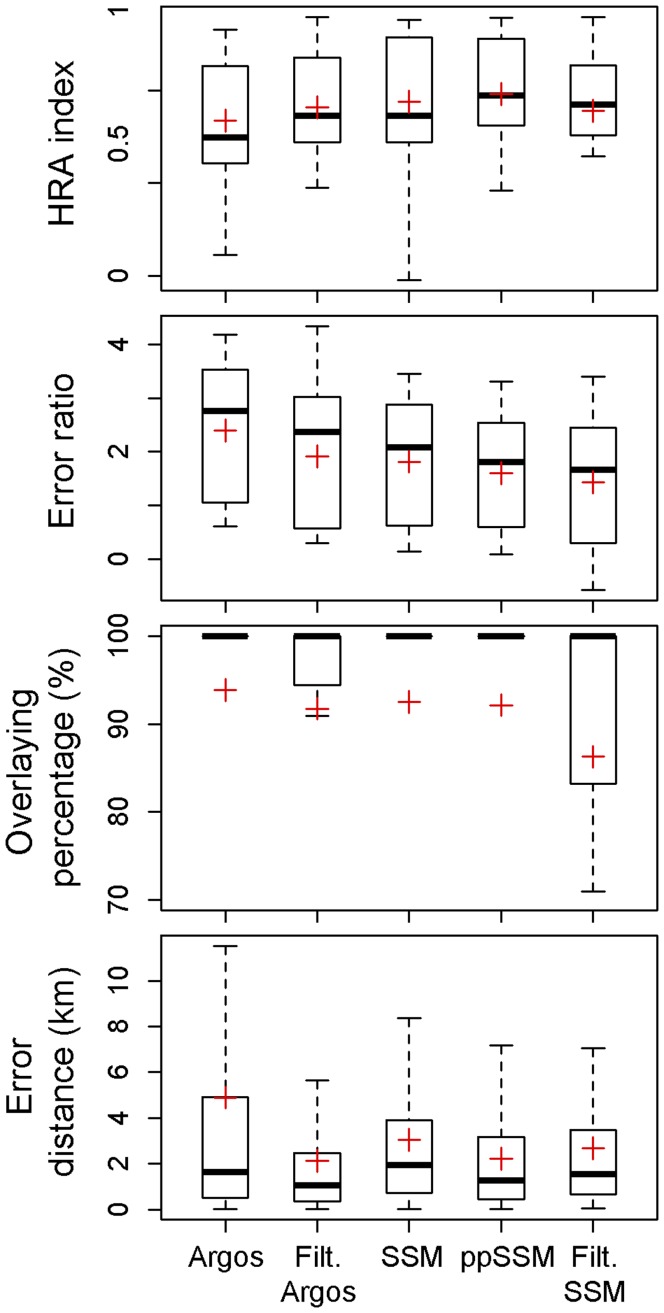
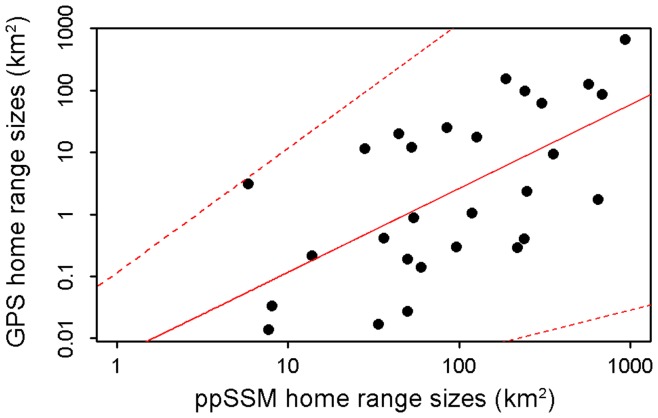
Accurately quantifying animals' spatial utilisation is critical for conservation, but has long remained an elusive goal due to technological impediments. The Argos telemetry system has been extensively used to remotely track marine animals, however location estimates are characterised by substantial spatial error. State-space models (SSM) constitute a robust statistical approach to refine Argos tracking data by accounting for observation errors and stochasticity in animal movement. Despite their wide use in ecology, few studies have thoroughly quantified the error associated with SSM predicted locations and no research has assessed their validity for describing animal movement behaviour. We compared home ranges and migratory pathways of seven hawksbill sea turtles (Eretmochelys imbricata) estimated from (a) highly accurate Fastloc GPS data and (b) locations computed using common Argos data analytical approaches. Argos 68(th) percentile error was <1 km for LC 1, 2, and 3 while markedly less accurate (>4 km) for LC ≤ 0. Argos error structure was highly longitudinally skewed and was, for all LC, adequately modelled by a Student's t distribution. Both habitat use and migration routes were best recreated using SSM locations post-processed by re-adding good Argos positions (LC 1, 2 and 3) and filtering terrestrial points (mean distance to migratory tracks ± SD = 2.2 ± 2.4 km; mean home range overlap and error ratio = 92.2% and 285.6 respectively). This parsimonious and objective statistical procedure however still markedly overestimated true home range sizes, especially for animals exhibiting restricted movements. Post-processing SSM locations nonetheless constitutes the best analytical technique for remotely sensed Argos tracking data and we therefore recommend using this approach to rework historical Argos datasets for better estimation of animal spatial utilisation for research and evidence-based conservation purposes.
准确量化动物的空间利用对于保护至关重要,但由于技术障碍,这一目标长期以来一直难以实现。Argos 遥测系统已被广泛用于远程跟踪海洋动物,但位置估计存在较大的空间误差。状态空间模型(SSM)是一种强大的统计方法,可以通过考虑观测误差和动物运动的随机性来改进 Argos 跟踪数据。尽管它们在生态学中被广泛使用,但很少有研究彻底量化了与 SSM 预测位置相关的误差,也没有研究评估它们在描述动物运动行为方面的有效性。我们比较了从 (a) 高度准确的 Fastloc GPS 数据和 (b) 使用常见 Argos 数据分析方法计算得出的位置估算的 7 只玳瑁(Eretmochelys imbricata)的栖息地范围和洄游路径。Argos 的第 68 百分位误差对于 LC 1、2 和 3 小于 1 公里,而对于 LC ≤ 0 的误差则明显较大(大于 4 公里)。Argos 的误差结构在经度上呈高度偏态分布,对于所有 LC,都可以用学生 t 分布很好地建模。栖息地利用和迁移路线都可以通过重新添加良好的 Argos 位置(LC 1、2 和 3)和过滤陆地点(迁移轨迹的平均距离 ± SD = 2.2 ± 2.4 公里;平均栖息地重叠和误差比分别为 92.2%和 285.6%)来使用经过后处理的 SSM 位置来最佳重现。然而,这种简约和客观的统计程序仍然明显高估了真实的栖息地范围大小,特别是对于运动受限的动物。对 SSM 位置进行后处理仍然是遥测 Argos 跟踪数据的最佳分析技术,因此我们建议使用这种方法来重新处理历史 Argos 数据集,以便更好地估计动物的空间利用情况,用于研究和基于证据的保护目的。