The Parrot Fund, College Station, Texas, United States of America.
PLoS One. 2013 May 17;8(5):e63051. doi: 10.1371/journal.pone.0063051. Print 2013.
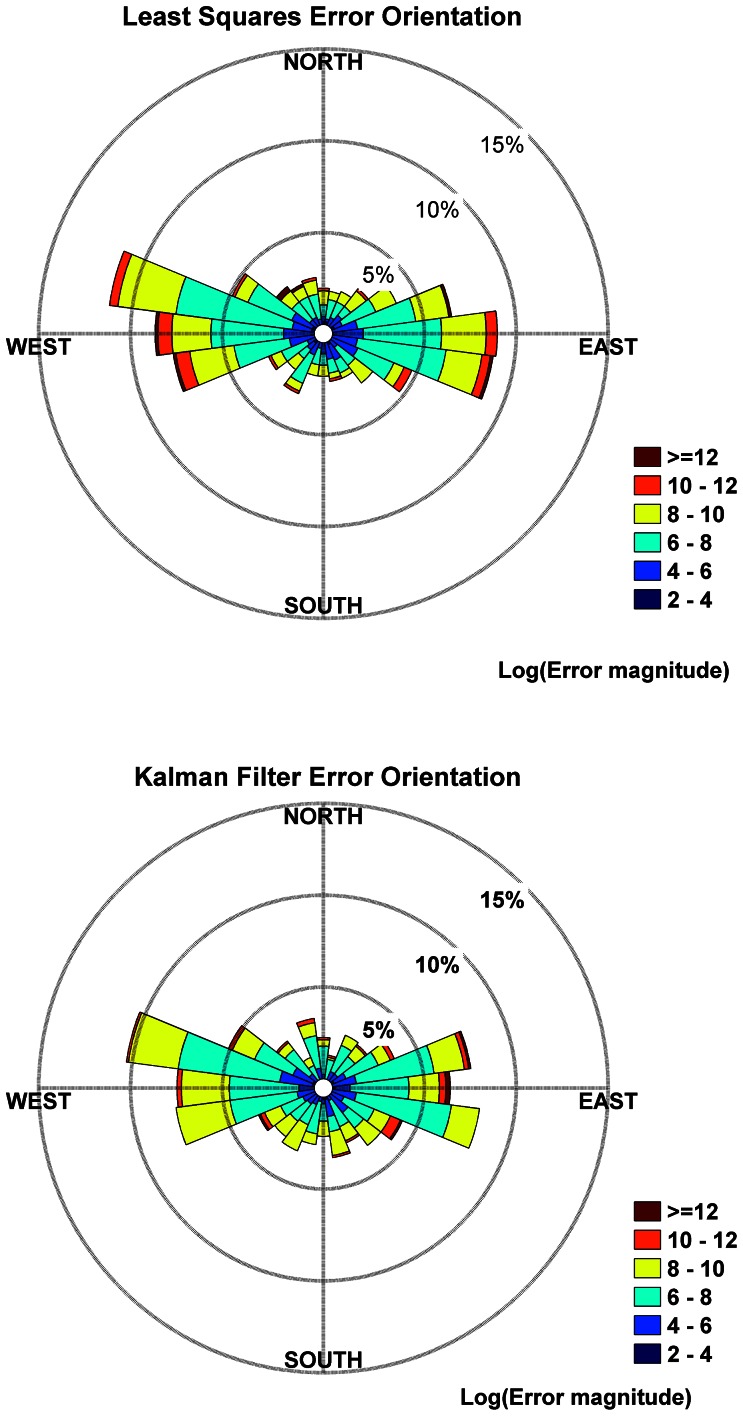
Study of animal movements is key for understanding their ecology and facilitating their conservation. The Argos satellite system is a valuable tool for tracking species which move long distances, inhabit remote areas, and are otherwise difficult to track with traditional VHF telemetry and are not suitable for GPS systems. Previous research has raised doubts about the magnitude of position errors quoted by the satellite service provider CLS. In addition, no peer-reviewed publications have evaluated the usefulness of the CLS supplied error ellipses nor the accuracy of the new Kalman filtering (KF) processing method. Using transmitters hung from towers and trees in southeastern Peru, we show the Argos error ellipses generally contain <25% of the true locations and therefore do not adequately describe the true location errors. We also find that KF processing does not significantly increase location accuracy. The errors for both LS and KF processing methods were found to be lognormally distributed, which has important repercussions for error calculation, statistical analysis, and data interpretation. In brief, "good" positions (location codes 3, 2, 1, A) are accurate to about 2 km, while 0 and B locations are accurate to about 5-10 km. However, due to the lognormal distribution of the errors, larger outliers are to be expected in all location codes and need to be accounted for in the user's data processing. We evaluate five different empirical error estimates and find that 68% lognormal error ellipses provided the most useful error estimates. Longitude errors are larger than latitude errors by a factor of 2 to 3, supporting the use of elliptical error ellipses. Numerous studies over the past 15 years have also found fault with the CLS-claimed error estimates yet CLS has failed to correct their misleading information. We hope this will be reversed in the near future.
动物运动研究对于了解其生态和促进保护至关重要。Argos 卫星系统是一种跟踪远距离移动、生活在偏远地区且难以用传统甚高频遥测和 GPS 系统跟踪的物种的宝贵工具。先前的研究对卫星服务提供商 CLS 所报位置误差的大小提出了质疑。此外,没有经过同行评审的出版物评估过 CLS 提供的误差椭圆的有用性,也没有评估过新的卡尔曼滤波(KF)处理方法的准确性。我们在秘鲁东南部的塔和树上悬挂发射器,结果表明 Argos 误差椭圆通常只包含真实位置的<25%,因此不能充分描述真实位置误差。我们还发现 KF 处理并不能显著提高位置精度。LS 和 KF 处理方法的误差都发现呈对数正态分布,这对误差计算、统计分析和数据解释有重要影响。简而言之,“良好”位置(位置代码 3、2、1、A)的精度约为 2 公里,而 0 和 B 位置的精度约为 5-10 公里。但是,由于误差呈对数正态分布,所有位置代码中都可能出现较大的异常值,需要在用户的数据处理中加以考虑。我们评估了五种不同的经验误差估计方法,发现 68%的对数正态误差椭圆提供了最有用的误差估计。经度误差比纬度误差大 2 到 3 倍,支持使用椭圆形误差椭圆。在过去的 15 年中,许多研究也发现了 CLS 声称的误差估计存在错误,但 CLS 未能纠正其误导性信息。我们希望这种情况在不久的将来会得到扭转。