Biomarkers Research Program, Biochemistry Department, College of Science, King Saud University, PO Box, 2455, Riyadh, 11451, Kingdom of Saudi Arabia.
Cardiovasc Diabetol. 2012 Jul 18;11:85. doi: 10.1186/1475-2840-11-85.
Vitamin D deficiency has been associated with impaired human insulin action, suggesting a role in the pathogenesis of diabetes mellitus type 2 (T2DM). In this prospective interventional study we investigated the effects of vitamin D3 supplementation on the metabolic profiles of Saudi T2DM subjects pre- and post-vitamin D supplementation over an 18-month period.
T2DM Saudi subjects (men, N = 34: Age: 56.6 ± 8.7 yr, BMI, 29.1 ± 3.3 kg/m2; women, N = 58: Age: 51.2 ± 10.6 yr, BMI 34.3 ± 4.9 kg/m2;) were recruited and given 2000 IU vitamin D3 daily for 18 months. Anthropometrics and fasting blood were collected (0, 6, 12, 18 months) to monitor serum 25-hydroxyvitamin D using specific ELISA, and to determine metabolic profiles by standard methods.
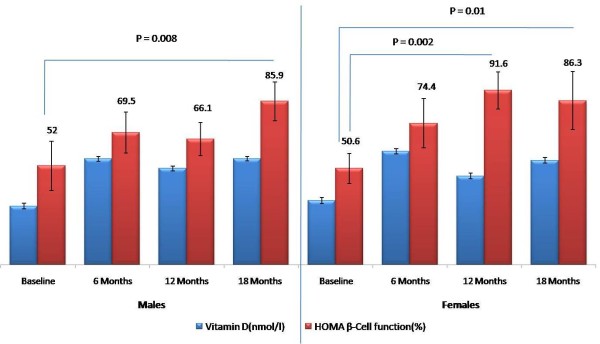
In all subjects there was a significant increase in mean 25-hydroxyvitamin D levels from baseline (32.2 ± 1.5 nmol/L) to 18 months (54.7 ± 1.5 nmol/L; p < 0.001), as well as serum calcium (baseline = 2.3 ± 0.23 mmol/L vs. 18 months = 2.6 ± 0.1 mmol/L; p = 0.003). A significant decrease in LDL- (baseline = 4.4 ± 0.8 mmol/L vs. 18 months = 3.6 ± 0.8 mmol/L, p < 0.001] and total cholesterol (baseline = 5.4 ± 0.2 mmol/L vs. 18 months = 4.9 ± 0.3 mmol/L, p < 0.001) were noted, as well as a significant improvement in HOMA-β function (p = 0.002). Majority of the improvements elicited were more prominent in women than men.
In the Saudi T2DM population receiving oral Vitamin D3 supplementation (2000 IU/day), circulating 25-hydroxyvitamin D levels remained below normal 18 months after the onset of treatment. Yet, this "suboptimal" supplementation significantly improved lipid profile with a favorable change in HDL/LDL ratio, and HOMA-β function, which were more pronounced in T2DM females.
维生素 D 缺乏与人类胰岛素功能受损有关,这表明其在 2 型糖尿病(T2DM)发病机制中发挥作用。在这项前瞻性干预研究中,我们调查了维生素 D3 补充剂对沙特 T2DM 患者代谢谱的影响,这些患者在接受维生素 D 补充剂治疗 18 个月前后的代谢谱都发生了变化。
招募了 T2DM 沙特患者(男性,N=34:年龄:56.6±8.7 岁,BMI:29.1±3.3kg/m2;女性,N=58:年龄:51.2±10.6 岁,BMI:34.3±4.9kg/m2),并给予 2000IU 维生素 D3 每天补充 18 个月。收集人体测量学和空腹血液(0、6、12、18 个月),使用特定的 ELISA 监测血清 25-羟基维生素 D 水平,并使用标准方法确定代谢谱。
所有患者的平均 25-羟基维生素 D 水平从基线(32.2±1.5nmol/L)增加到 18 个月(54.7±1.5nmol/L;p<0.001),血清钙也从基线(2.3±0.23mmol/L)增加到 18 个月(2.6±0.1mmol/L;p=0.003)。LDL-(基线=4.4±0.8mmol/L 与 18 个月=3.6±0.8mmol/L,p<0.001)和总胆固醇(基线=5.4±0.2mmol/L 与 18 个月=4.9±0.3mmol/L,p<0.001)显著下降,HOMA-β功能显著改善(p=0.002)。这些改善中,大多数在女性中比男性更为显著。
在接受口服维生素 D3 补充剂(2000IU/天)的沙特 T2DM 人群中,治疗开始 18 个月后,循环 25-羟基维生素 D 水平仍低于正常水平。然而,这种“亚最佳”补充显著改善了血脂谱,使 HDL/LDL 比值和 HOMA-β 功能更有利,在 T2DM 女性中更为明显。