Department of Internal Medicine, Diabetology and Clinical Pharmacology, Medical University in Lodz; 251Pomorska Street, 92-213 Lodz, Poland.
Department of Nucleic Acid Biochemistry, Medical University of Lodz, 251 Pomorska Street, 92-213 Lodz, Poland.
Int J Mol Sci. 2019 Jun 13;20(12):2891. doi: 10.3390/ijms20122891.
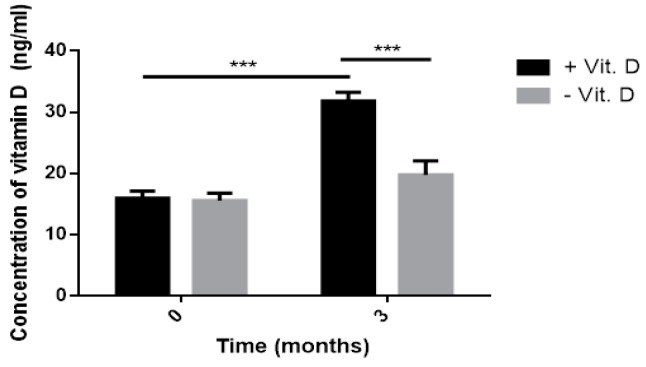
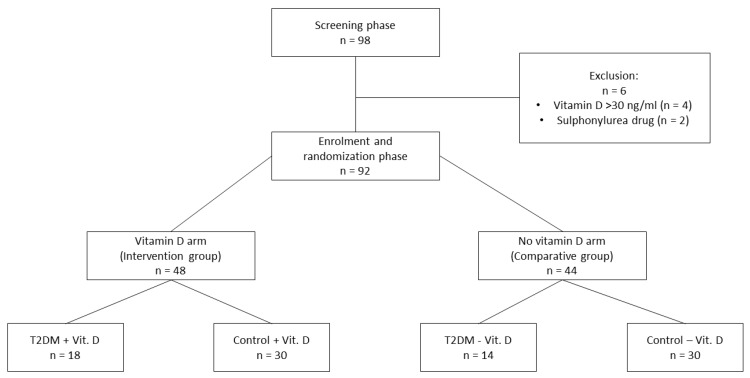
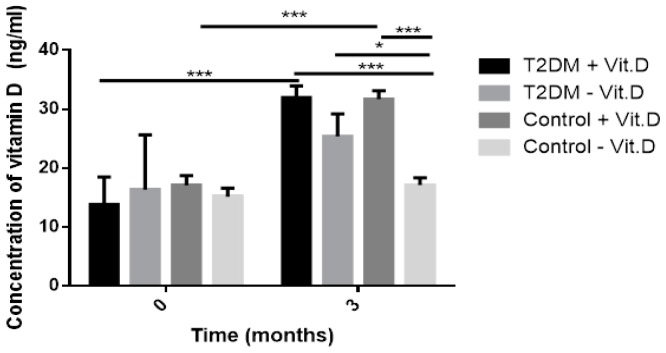
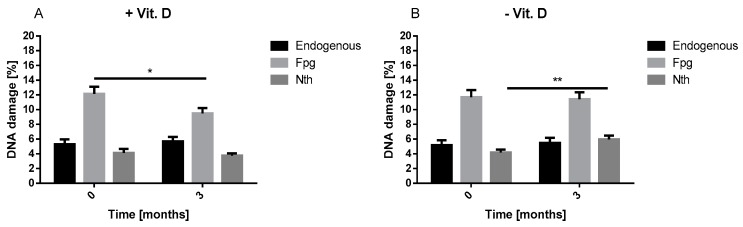
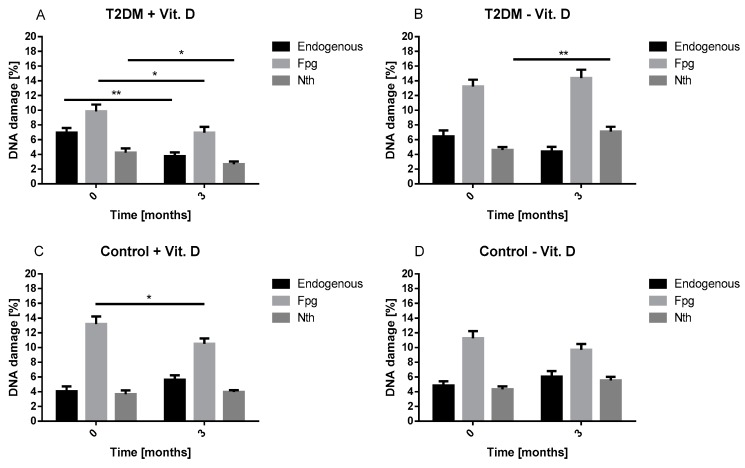
Research evidence indicates that vitamin D deficiency is involved in the pathogenesis of insulin resistance (IR) and associated metabolic disorders including hyperglycemia and dyslipidemia. It also suggested that vitamin D deficiency is associated with elevated levels of oxidative stress and its complications. Therefore, the aim of our study was to determine the effect of vitamin D supplementation on DNA damage and metabolic parameters in vitamin D deficient individuals aged >45 with metabolic disorders. Of 98 initially screened participants, 92 subjects deficient in vitamin D were included in the study. They were randomly assigned to the following group: with vitamin D supplementation (intervention group, 48) and without supplementation (comparative group, 44). The patients from both groups were divided into two subgroups according to the presence or absence of type 2 diabetes (T2DM). The intervention group was treated with 2000 International Unit (IU) cholecalciferol/day between October and March for three months. At baseline and after three-month supplementation vitamin D concentration (25-OH)D3 and endogenous and oxidative DNA damage were determined. In addition, fast plasma glucose (FPG), fasting insulin, HbA1c and lipid fraction (total cholesterol (TC), low-density lipoprotein cholesterol (LDL), high-density lipoprotein cholesterol (HDL), triglyceride (TG)), as well as anthropometric measurements (weight, height) were gathered. The following IR-related parameters were calculated Homeostatic Model Assesment - Insulin Resistance (HOMA-IR) and TG/HDL ratio. Three-month vitamin D supplementation increased the mean vitamin D concentration to generally accepted physiological level independently of T2DM presence. Importantly, vitamin D exposure decreased the level of oxidative DNA damage in lymphocytes of patients of intervention group. Among studied metabolic parameters, vitamin D markedly increased HDL level, decreased HOMA-IR, TG/HDL ratio. Furthermore, we found that HbA1c percentage diminished about 0.5% in T2DM patients supplemented with vitamin D. The current study demonstrated that daily 2000I U intake of vitamin D for three months decreased the level of oxidative DNA damage, a marker of oxidative stress, independently on T2DM presence. Furthermore, vitamin D reduced metabolic parameters connected with IR and improved glucose and lipid metabolism. Therefore, our results support the assertion that vitamin D, by reducing oxidative stress and improving of metabolic profile, may decrease IR and related diseases.
研究证据表明,维生素 D 缺乏与胰岛素抵抗(IR)和相关代谢紊乱有关,包括高血糖和血脂异常。它还表明,维生素 D 缺乏与氧化应激水平升高及其并发症有关。因此,我们的研究目的是确定补充维生素 D 对患有代谢紊乱的>45 岁维生素 D 缺乏个体的 DNA 损伤和代谢参数的影响。在最初筛选的 98 名参与者中,有 92 名维生素 D 缺乏的受试者被纳入研究。他们被随机分配到以下组:补充维生素 D(干预组,48 人)和不补充(对照组,44 人)。根据是否存在 2 型糖尿病(T2DM),两组患者又分为两组。干预组在 10 月至 3 月期间每天服用 2000 国际单位(IU)胆钙化醇。在基线和三个月补充维生素 D 后,测定维生素 D 浓度(25-羟)D3 和内源性和氧化 DNA 损伤。此外,还测定了快速血浆葡萄糖(FPG)、空腹胰岛素、HbA1c 和脂质成分(总胆固醇(TC)、低密度脂蛋白胆固醇(LDL)、高密度脂蛋白胆固醇(HDL)、甘油三酯(TG)),以及人体测量学测量(体重、身高)。计算了与胰岛素抵抗相关的以下参数:稳态模型评估-胰岛素抵抗(HOMA-IR)和 TG/HDL 比值。三个月的维生素 D 补充使维生素 D 浓度平均增加到公认的生理水平,与 T2DM 的存在无关。重要的是,维生素 D 暴露降低了干预组患者淋巴细胞中氧化 DNA 损伤的水平。在研究的代谢参数中,维生素 D 显著增加了 HDL 水平,降低了 HOMA-IR、TG/HDL 比值。此外,我们发现,补充维生素 D 的 T2DM 患者的 HbA1c 百分比下降了约 0.5%。本研究表明,每天摄入 2000IU 维生素 D 持续三个月可降低氧化 DNA 损伤水平,这是氧化应激的标志物,与 T2DM 的存在无关。此外,维生素 D 降低了与 IR 相关的代谢参数,并改善了葡萄糖和脂质代谢。因此,我们的结果支持以下观点,即维生素 D 通过降低氧化应激和改善代谢谱,可能降低 IR 及其相关疾病的风险。