Center of Excellence in Genomics, International Crops Research Institute for the Semi-Arid Tropics (ICRISAT), Patancheru, India.
PLoS One. 2012;7(7):e41213. doi: 10.1371/journal.pone.0041213. Epub 2012 Jul 18.
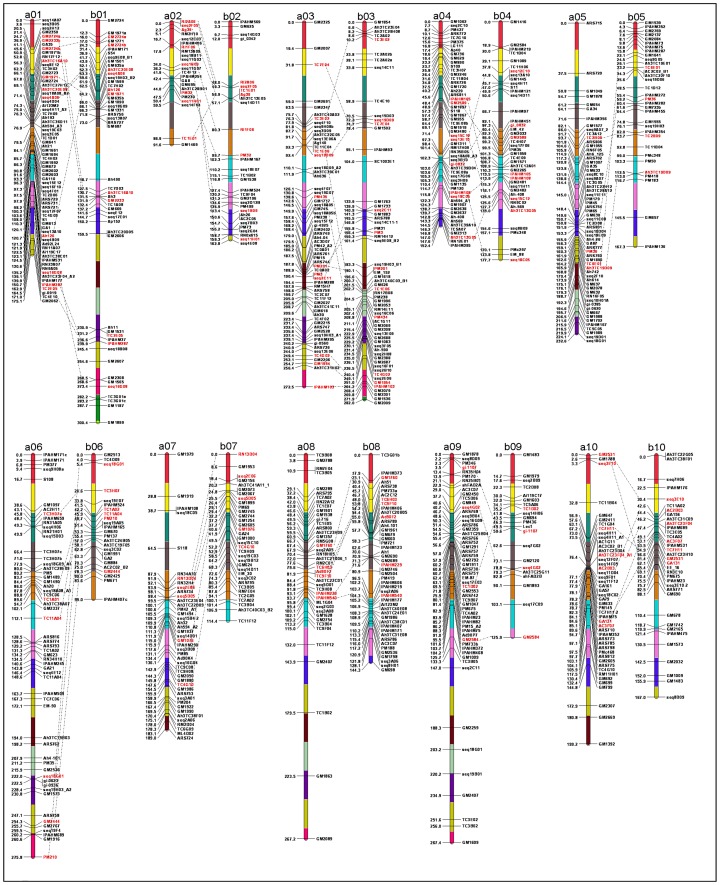
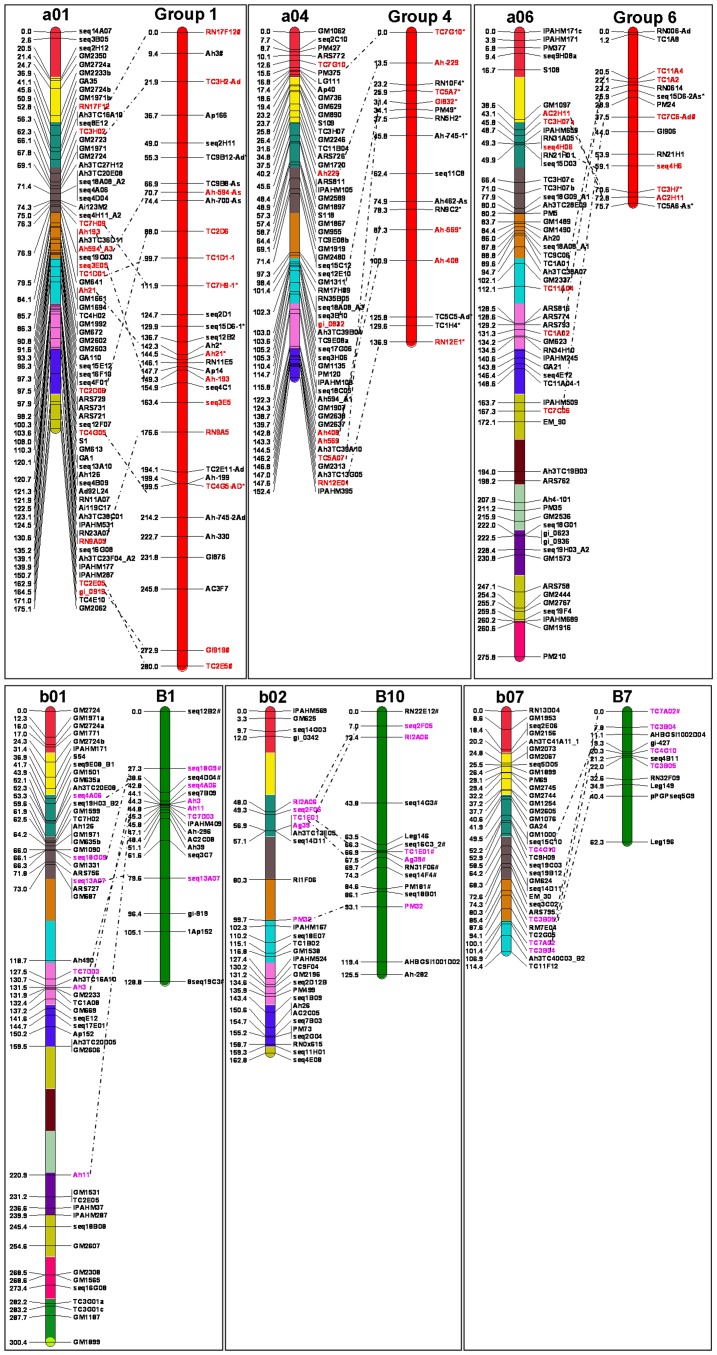
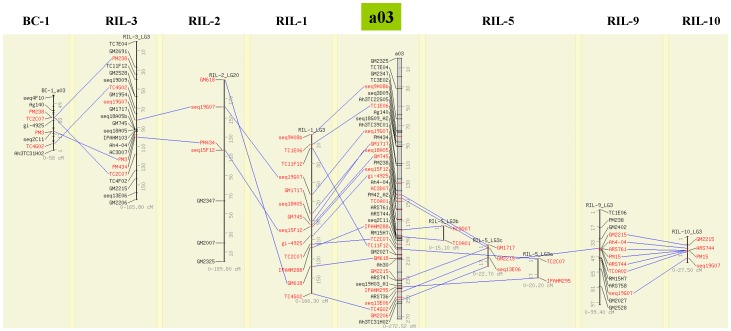
Only a few genetic maps based on recombinant inbred line (RIL) and backcross (BC) populations have been developed for tetraploid groundnut. The marker density, however, is not very satisfactory especially in the context of large genome size (2800 Mb/1C) and 20 linkage groups (LGs). Therefore, using marker segregation data for 10 RILs and one BC population from the international groundnut community, with the help of common markers across different populations, a reference consensus genetic map has been developed. This map is comprised of 897 marker loci including 895 simple sequence repeat (SSR) and 2 cleaved amplified polymorphic sequence (CAPS) loci distributed on 20 LGs (a01-a10 and b01-b10) spanning a map distance of 3, 863.6 cM with an average map density of 4.4 cM. The highest numbers of markers (70) were integrated on a01 and the least number of markers (21) on b09. The marker density, however, was lowest (6.4 cM) on a08 and highest (2.5 cM) on a01. The reference consensus map has been divided into 20 cM long 203 BINs. These BINs carry 1 (a10_02, a10_08 and a10_09) to 20 (a10_04) loci with an average of 4 marker loci per BIN. Although the polymorphism information content (PIC) value was available for 526 markers in 190 BINs, 36 and 111 BINs have at least one marker with >0.70 and >0.50 PIC values, respectively. This information will be useful for selecting highly informative and uniformly distributed markers for developing new genetic maps, background selection and diversity analysis. Most importantly, this reference consensus map will serve as a reliable reference for aligning new genetic and physical maps, performing QTL analysis in a multi-populations design, evaluating the genetic background effect on QTL expression, and serving other genetic and molecular breeding activities in groundnut.
仅有少数基于重组自交系(RIL)和回交(BC)群体的四倍体落花生遗传图谱被开发出来。然而,标记密度并不是很令人满意,特别是在基因组大小较大(2800Mb/1C)和 20 个连锁群(LGs)的情况下。因此,利用国际落花生社区的 10 个 RIL 和 1 个 BC 群体的标记分离数据,并借助不同群体共有的标记,开发了一个参考共识遗传图谱。该图谱包含 897 个标记位点,包括 895 个简单序列重复(SSR)和 2 个切割扩增多态性序列(CAPS)位点,分布在 20 个 LGs(a01-a10 和 b01-b10)上,图谱距离为 3863.6cM,平均图谱密度为 4.4cM。标记数量最多的是 a01(70 个),标记数量最少的是 b09(21 个)。然而,标记密度最低的是 a08(6.4cM),最高的是 a01(2.5cM)。参考共识图谱已被划分为 203 个 20CM 长的 BINs。这些 BINs携带 1(a10_02、a10_08 和 a10_09)至 20(a10_04)个位点,每个 BIN 平均有 4 个标记位点。虽然在 190 个 BIN 中的 526 个标记具有多态性信息含量(PIC)值,但分别有 36 和 111 个 BIN 至少有一个标记的 PIC 值大于 0.70 和大于 0.50。这些信息将有助于选择信息量高且分布均匀的标记来开发新的遗传图谱、背景选择和多样性分析。最重要的是,这个参考共识图谱将作为一个可靠的参考,用于对齐新的遗传和物理图谱、在多群体设计中进行 QTL 分析、评估 QTL 表达的遗传背景效应,以及为落花生的其他遗传和分子育种活动提供服务。