Gautami B, Pandey M K, Vadez V, Nigam S N, Ratnakumar P, Krishnamurthy L, Radhakrishnan T, Gowda M V C, Narasu M L, Hoisington D A, Knapp S J, Varshney R K
Mol Breed. 2012 Aug;30(2):757-772. doi: 10.1007/s11032-011-9660-0. Epub 2011 Nov 22.
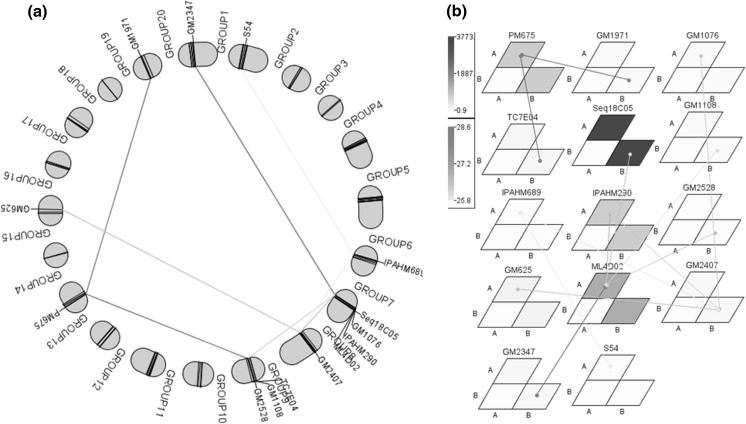
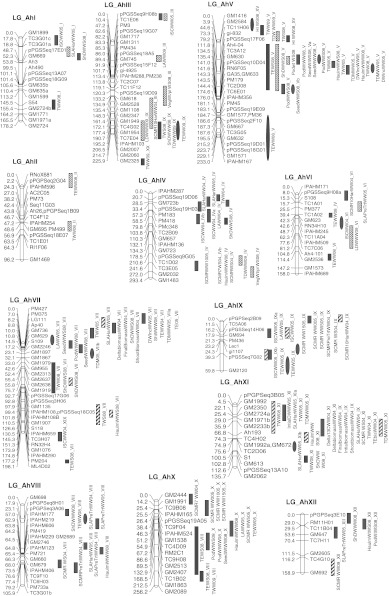
Groundnut (Arachis hypogaea L.) is an important food and cash crop grown mainly in semi-arid tropics (SAT) regions of the world where drought is the major constraint on productivity. With the aim of understanding the genetic basis and identification of quantitative trait loci (QTL) for drought tolerance, two new recombinant inbred line (RIL) mapping populations, namely ICGS 76 × CSMG 84-1 (RIL-2) and ICGS 44 × ICGS 76 (RIL-3), were used. After screening of 3,215 simple sequence repeat (SSR) markers on the parental genotypes of these populations, two new genetic maps were developed with 119 (RIL-2) and 82 (RIL-3) SSR loci. Together with these maps and the reference map with 191 SSR loci based on TAG 24 × ICGV 86031 (RIL-1), a consensus map was constructed with 293 SSR loci distributed over 20 linkage groups, spanning 2,840.8 cM. As all these three populations segregate for drought-tolerance-related traits, a comprehensive QTL analysis identified 153 main effect QTL (M-QTL) and 25 epistatic QTL (E-QTL) for drought-tolerance-related traits. Localization of these QTL on the consensus map provided 16 genomic regions that contained 125 QTL. A few key genomic regions were selected on the basis of the QTL identified in each region, and their expected role in drought adaptation is also discussed. Given that no major QTL for drought adaptation were identified, novel breeding approaches such as marker-assisted recurrent selection (MARS) and genomic selection (GS) approaches are likely to be the preferred approaches for introgression of a larger number of QTL in order to breed drought-tolerant groundnut genotypes. ELECTRONIC SUPPLEMENTARY MATERIAL: The online version of this article (doi:10.1007/s11032-011-9660-0) contains supplementary material, which is available to authorized users.
花生(Arachis hypogaea L.)是一种重要的粮食和经济作物,主要生长在世界半干旱热带(SAT)地区,干旱是该地区生产力的主要限制因素。为了了解耐旱性的遗传基础并鉴定数量性状位点(QTL),使用了两个新的重组自交系(RIL)作图群体,即ICGS 76×CSMG 84-1(RIL-2)和ICGS 44×ICGS 76(RIL-3)。在对这些群体的亲本基因型筛选了3215个简单序列重复(SSR)标记后,构建了两个新的遗传图谱,分别包含119个(RIL-2)和82个(RIL-3)SSR位点。结合这些图谱以及基于TAG 24×ICGV 86031(RIL-1)的包含191个SSR位点的参考图谱,构建了一个共有图谱,该图谱有293个SSR位点分布在20个连锁群上,跨度为2840.8 cM。由于这三个群体都因耐旱相关性状而分离,全面的QTL分析鉴定出了153个与耐旱相关性状的主效QTL(M-QTL)和25个上位性QTL(E-QTL)。这些QTL在共有图谱上的定位提供了16个包含125个QTL的基因组区域。根据每个区域鉴定出的QTL选择了一些关键基因组区域,并讨论了它们在干旱适应中的预期作用。鉴于未鉴定出主要的干旱适应QTL,标记辅助轮回选择(MARS)和基因组选择(GS)等新的育种方法可能是导入大量QTL以培育耐旱花生基因型的首选方法。电子补充材料:本文的在线版本(doi:10.1007/s11032-011-9660-0)包含补充材料,授权用户可获取。