Department of Musculoskeletal Biology and Magnetic Resonance and Image Analysis Research Centre, University of Liverpool, Liverpool, UK.
Diabetes. 2012 Aug;61(8):1927-34. doi: 10.2337/db11-1725.
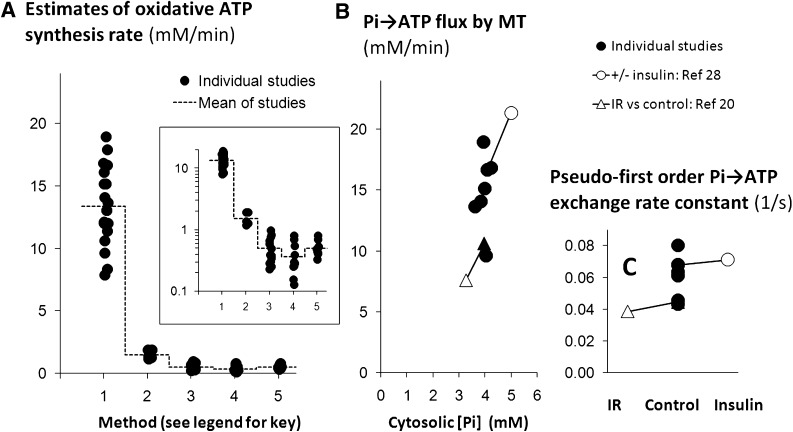
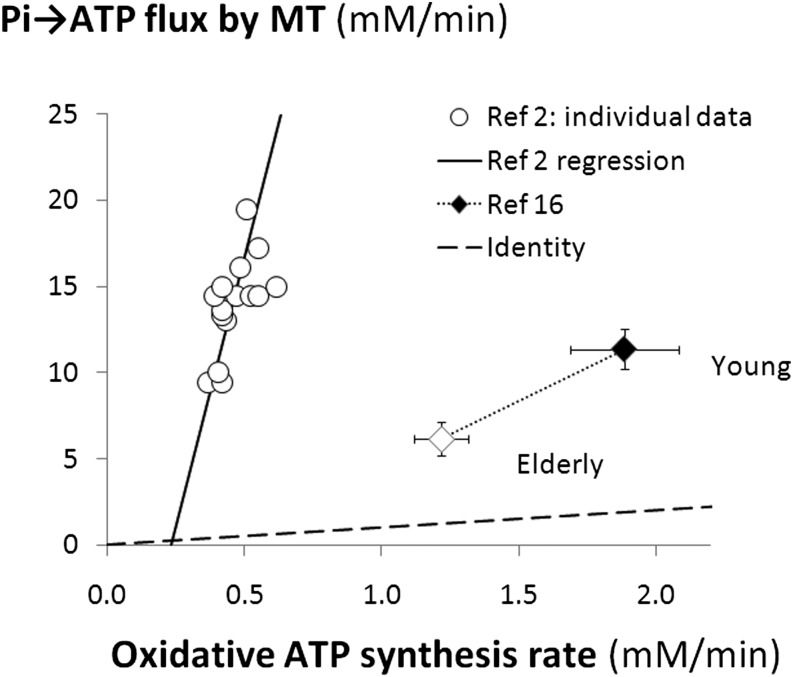
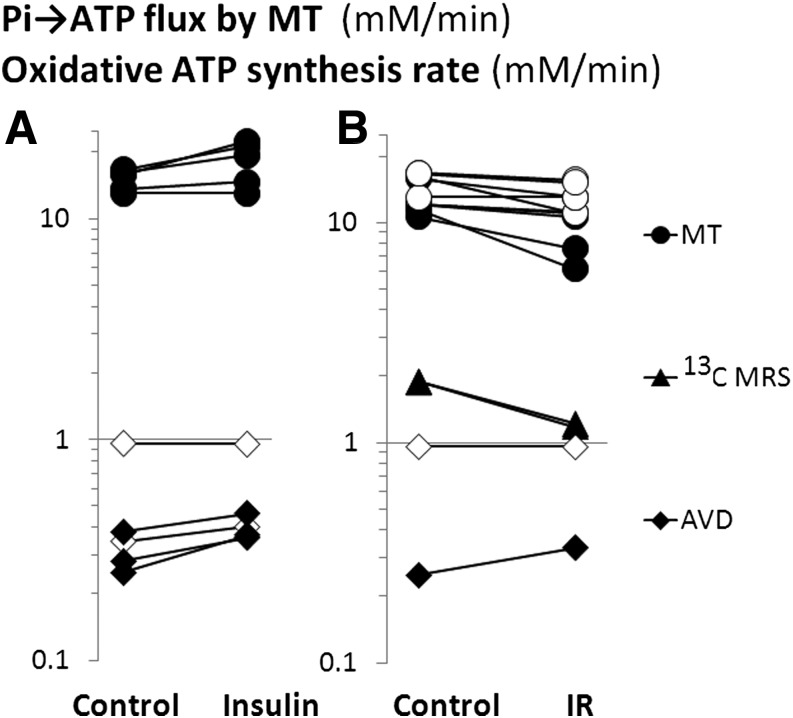
Magnetic resonance spectroscopy (MRS) methods offer a potentially valuable window into cellular metabolism. Measurement of flux between inorganic phosphate (Pi) and ATP using (31)P MRS magnetization transfer has been used in resting muscle to assess what is claimed to be mitochondrial ATP synthesis and has been particularly popular in the study of insulin effects and insulin resistance. However, the measured Pi→ATP flux in resting skeletal muscle is far higher than the true rate of oxidative ATP synthesis, being dominated by a glycolytically mediated Pi↔ATP exchange reaction that is unrelated to mitochondrial function. Furthermore, even if measured accurately, the ATP production rate in resting muscle has no simple relationship to mitochondrial capacity as measured either ex vivo or in vivo. We summarize the published measurements of Pi→ATP flux, concentrating on work relevant to diabetes and insulin, relate it to current understanding of the physiology of mitochondrial ATP synthesis and glycolytic Pi↔ATP exchange, and discuss some possible implications of recently reported correlations between Pi→ATP flux and other physiological measures.
磁共振波谱(MRS)方法为细胞代谢提供了一个有价值的潜在窗口。使用(31)P MRS 磁化转移测量无机磷(Pi)和 ATP 之间的通量,已用于静息肌肉中评估据称是线粒体 ATP 合成的情况,并且在胰岛素作用和胰岛素抵抗的研究中特别受欢迎。然而,在静息骨骼肌中测量的 Pi→ATP 通量远远高于氧化 ATP 合成的真实速率,主要由与线粒体功能无关的糖酵解介导的 Pi↔ATP 交换反应主导。此外,即使测量准确,静息肌肉中的 ATP 产生速率与体外或体内测量的线粒体容量也没有简单的关系。我们总结了 Pi→ATP 通量的已发表测量值,重点关注与糖尿病和胰岛素相关的工作,将其与目前对线粒体 ATP 合成和糖酵解 Pi↔ATP 交换生理学的理解联系起来,并讨论了最近报道的 Pi→ATP 通量与其他生理测量之间的相关性的一些可能影响。