Neuroimaging Laboratory, Department of Child and Adolescent Psychiatry, Rudolf Magnus Institute of Neuroscience, University Medical Center Utrecht, Utrecht, The Netherlands.
Transl Psychiatry. 2012 Mar 6;2(3):e84. doi: 10.1038/tp.2012.12.
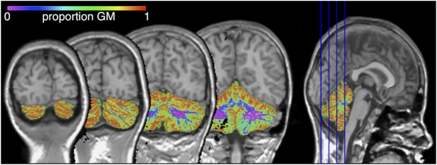
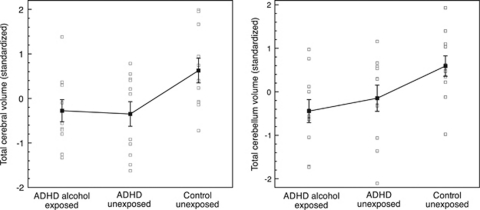
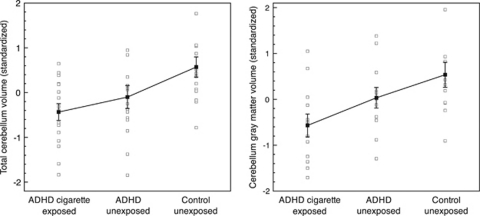
Prenatal exposure to teratogenic substances, such as nicotine or alcohol, increases the risk of developing attention-deficit/hyperactivity disorder (ADHD). To date, studies examining this relationship have used symptom scales as outcome measures to assess the effect of prenatal exposure, and have not investigated the neurobiological pathways involved. This study explores the effect of prenatal exposure to cigarettes or alcohol on brain volume in children with ADHD and typically developing controls. Children with ADHD who had been exposed prenatally to either substance were individually matched to children with and without ADHD who had not been. Controls who had been exposed prenatally were also individually matched to controls who had not been. For prenatal exposure to both smoking and alcohol, we found a pattern where subjects with ADHD who had been exposed had the smallest brain volumes and unexposed controls had the largest, with intermediate volumes for unexposed subjects with ADHD. This effect was most pronounced for cerebellum. A similar reduction fell short of significance for controls who had been exposed to cigarettes, but not alcohol. Our results are consistent with an additive effect of prenatal exposure and ADHD on brain volume, with the effects most pronounced for cerebellum.
产前暴露于致畸物质,如尼古丁或酒精,会增加患注意缺陷多动障碍(ADHD)的风险。迄今为止,研究该关系的研究使用症状量表作为结果测量来评估产前暴露的影响,而没有研究涉及的神经生物学途径。本研究探讨了产前暴露于香烟或酒精对 ADHD 儿童和正常发育对照者脑容量的影响。将产前暴露于任何一种物质的 ADHD 儿童与未暴露于 ADHD 儿童进行个体匹配。将产前暴露于任何一种物质的对照组与未暴露于对照组进行个体匹配。对于吸烟和酒精的产前暴露,我们发现 ADHD 暴露组的受试者脑容量最小,未暴露对照组的受试者脑容量最大,而未暴露 ADHD 受试者的脑容量居中。这种影响在小脑最为明显。对于暴露于香烟的对照组,这种减少虽然没有达到显著水平,但却很接近。我们的结果与产前暴露和 ADHD 对脑容量的累加效应一致,小脑的影响最为明显。