Faculty of Medicine, Department of Clinical Sciences Lund, Oncology and Pathology, Lund University, Lund, Sweden.
Department of Haematology, Oncology and Radiation Physics ,Skåne University Hospital, Lund, Sweden.
Breast Cancer Res. 2018 Jul 4;20(1):64. doi: 10.1186/s13058-018-0978-y.
Adjuvant radiotherapy is the standard of care after breast-conserving surgery for primary breast cancer, despite a majority of patients being over- or under-treated. In contrast to adjuvant endocrine therapy and chemotherapy, no diagnostic tests are in clinical use that can stratify patients for adjuvant radiotherapy. This study presents the development and validation of a targeted gene expression assay to predict the risk of ipsilateral breast tumor recurrence and response to adjuvant radiotherapy after breast-conserving surgery in primary breast cancer.
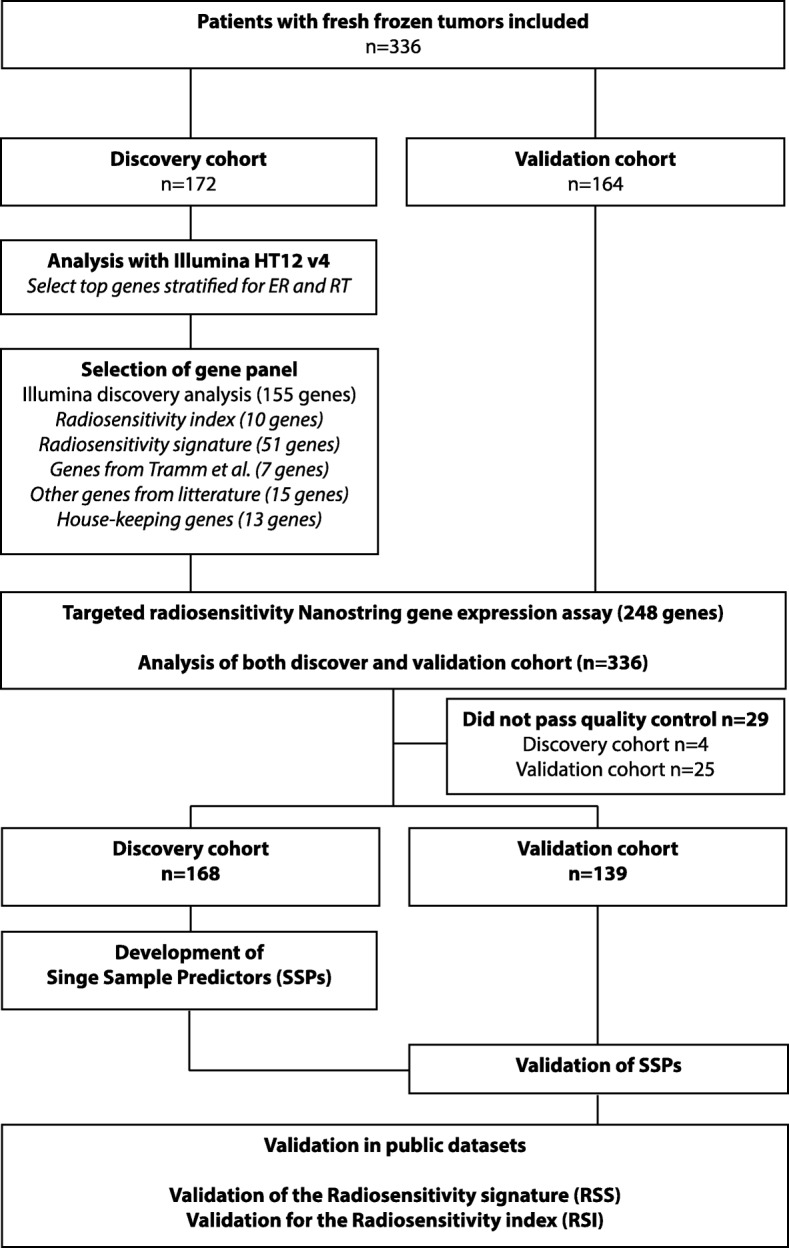
Fresh-frozen primary tumors from 336 patients radically (clear margins) operated on with breast-conserving surgery with or without radiotherapy were collected. Patients were split into a discovery cohort (N = 172) and a validation cohort (N = 164). Genes predicting ipsilateral breast tumor recurrence in an Illumina HT12 v4 whole transcriptome analysis were combined with genes identified in the literature (248 genes in total) to develop a targeted radiosensitivity assay on the Nanostring nCounter platform. Single-sample predictors for ipsilateral breast tumor recurrence based on a k-top scoring pairs algorithm were trained, stratified for estrogen receptor (ER) status and radiotherapy. Two previously published profiles, the radiosensitivity signature of Speers et al., and the 10-gene signature of Eschrich et al., were also included in the targeted panel.
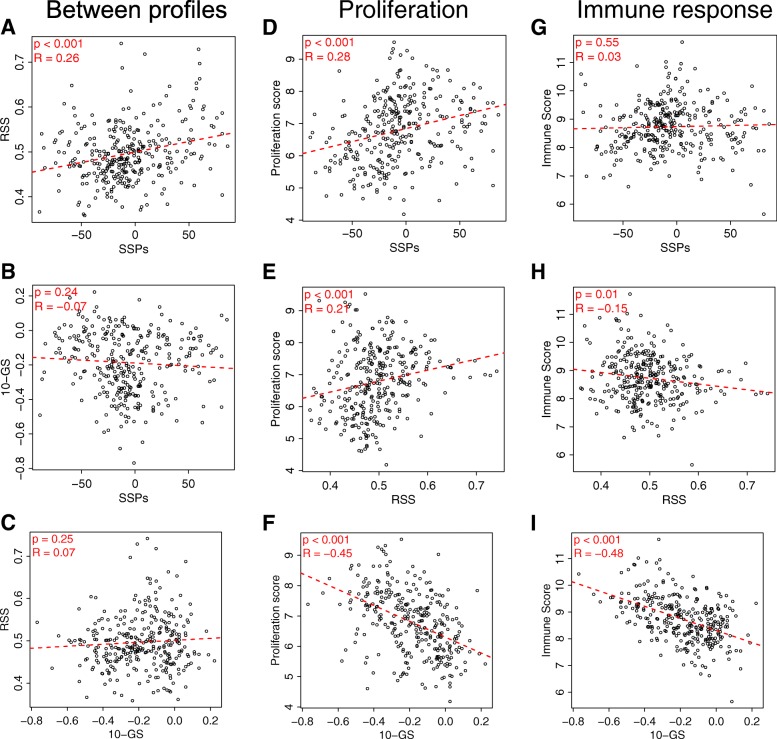
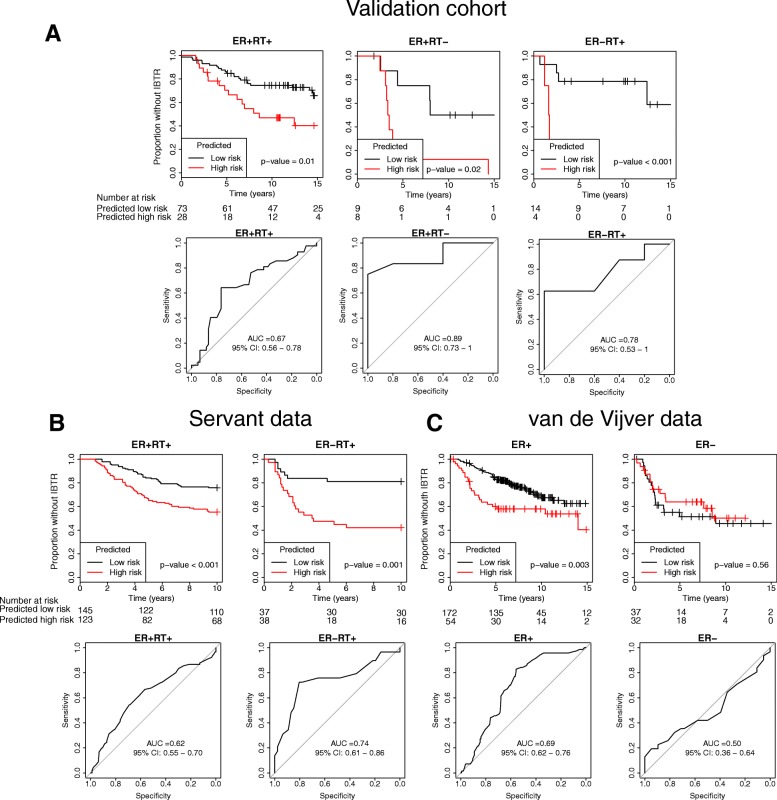
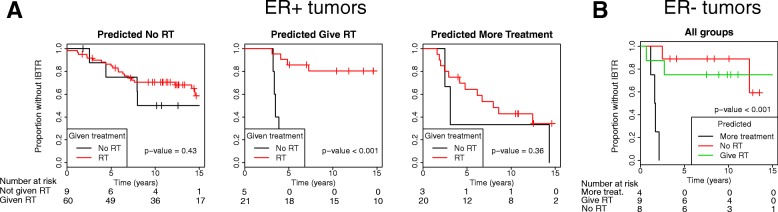
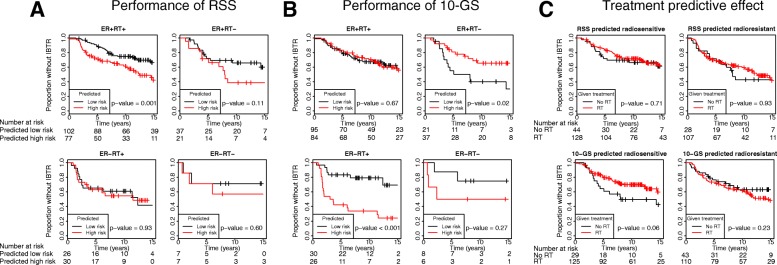
Derived single-sample predictors were prognostic for ipsilateral breast tumor recurrence in radiotherapy-treated ER+ patients (AUC 0.67, p = 0.01), ER+ patients without radiotherapy (AUC = 0.89, p = 0.02), and radiotherapy-treated ER- patients (AUC = 0.78, p < 0.001). Among ER+ patients, radiotherapy had an excellent effect on tumors classified as radiosensitive (p < 0.001), while radiotherapy had no effect on tumors classified as radioresistant (p = 0.36) and there was a high risk of ipsilateral breast tumor recurrence (55% at 10 years). Our single-sample predictors developed in ER+ tumors and the radiosensitivity signature correlated with proliferation, while single-sample predictors developed in ER- tumors correlated with immune response. The 10-gene signature negatively correlated with both proliferation and immune response.
Our targeted single-sample predictors were prognostic for ipsilateral breast tumor recurrence and have the potential to stratify patients for adjuvant radiotherapy. The correlation of models with biology may explain the different performance in subgroups of breast cancer.
尽管大多数患者接受了过度或不足的治疗,但辅助放疗仍是原发性乳腺癌保乳手术后的标准治疗方法。与辅助内分泌治疗和化疗不同,目前没有可用于分层接受辅助放疗的患者的诊断测试。本研究提出了一种靶向基因表达检测方法的开发和验证,以预测原发性乳腺癌保乳手术后同侧乳房肿瘤复发和对辅助放疗的反应风险。
从 336 例接受保乳手术(切缘清晰)联合或不联合放疗的根治性手术的患者中采集新鲜冷冻的原发性肿瘤。患者分为发现队列(n=172)和验证队列(n=164)。在 Illumina HT12 v4 全转录组分析中预测同侧乳房肿瘤复发的基因与文献中确定的基因(共 248 个基因)相结合,在 Nanostring nCounter 平台上开发靶向放射敏感性检测。基于 k-最佳评分对算法为雌激素受体(ER)状态和放疗分层训练了基于单个样本的同侧乳房肿瘤复发预测因子。还包括 Speers 等人的放射敏感性特征和 Eschrich 等人的 10 基因特征两个先前发表的特征。
衍生的单个样本预测因子对接受放疗的 ER+患者(AUC 0.67,p=0.01)、未接受放疗的 ER+患者(AUC=0.89,p=0.02)和接受放疗的 ER-患者的同侧乳房肿瘤复发具有预后意义(AUC=0.78,p<0.001)。在 ER+患者中,对于被归类为放射敏感的肿瘤,放疗效果极佳(p<0.001),而对于被归类为放射抵抗的肿瘤,放疗没有效果(p=0.36),并且同侧乳房肿瘤复发的风险很高(10 年内为 55%)。我们在 ER+肿瘤中开发的单个样本预测因子与增殖相关,而在 ER-肿瘤中开发的预测因子与免疫反应相关。10 基因特征与增殖和免疫反应均呈负相关。
我们的靶向单样本预测因子对同侧乳房肿瘤复发具有预后意义,并有可能为辅助放疗分层患者。模型与生物学的相关性可能解释了乳腺癌亚组中表现不同的原因。