Umeå Centre for Global Health Research, Division of Epidemiology and Global Health, Department of Public Health and Clinical Medicine, Umeå University, Sweden.
Glob Health Action. 2012;5. doi: 10.3402/gha.v5i0.8488. Epub 2012 Jul 23.
National surveys in low-income countries increasingly rely on self-reported measures of health. The ease, speed, and economy of collecting self-reports of health make such collection attractive for rapid appraisals. However, the interpretation of these measures is complicated since different cultures understand and respond to the same question in different ways.
The aim of this pilot study was to develop a culturally sensitive tool to study the self-reported health (SRH) of the local adult population in Burkina Faso.
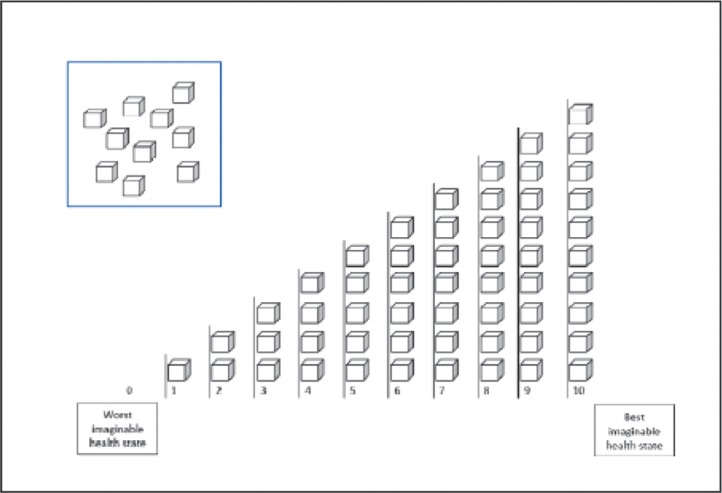
The study was carried out in the 2009 rainy season. The sample included 27 men and 25 women aged 18 or older who live in semi-urban Nouna, Burkina Faso. Three culturally adapted instruments were tested: a SRH question, a wooden visual analogue scale (VAS), and a drawn VAS. Respondents were asked to explain their answers to each instrument. The narratives were analyzed with the content analysis technique, and the prevalence of poor SRH was estimated from the quantitative data by stratification for respondent background variables (sex, age, literacy, education, marital status, ethnicity, chronic diseases). The correlation between the instruments was tested with Spearman's correlation test.
The SRH question showed a 38.5% prevalence of poor SRH and 44.2% prevalence with both VAS. The correlation between the VAS was 0.89, whereas the correlation between the VAS and the SRH question was 0.60-0.64. Nevertheless, the question used as the basis of each instrument was culturally sensitive and clear to all respondents. Analysis of the narratives shows that respondents clearly differentiated between the various health statuses.
In this pilot, we developed and tested a new version of the SRH question that may be more culturally sensitive than its non-adapted equivalents. Additional insight into this population's understanding and reporting of health was also obtained. A larger sample is needed to further study the validity and reliability of the SRH question and the VAS and understand which instrument is best suited to study SRH in the low-income setting of semi-rural Burkina Faso.
在低收入国家,越来越多的全国性调查依赖于自我报告的健康衡量标准。自我报告健康数据的收集既简单又快速,还经济实惠,这使得这种收集方法对于快速评估非常有吸引力。然而,由于不同文化以不同的方式理解和回应同一个问题,因此这些衡量标准的解释变得复杂。
本试点研究旨在开发一种文化敏感的工具,以研究布基纳法索当地成年人口的自我报告健康(SRH)。
该研究于 2009 年雨季进行。样本包括 27 名年龄在 18 岁及以上的男性和 25 名女性,他们居住在布基纳法索的半城市努纳。测试了三种文化适应性工具:一个 SRH 问题、一个木制视觉模拟量表(VAS)和一个绘制的 VAS。要求受访者解释他们对每个工具的答案。使用内容分析技术对这些叙述进行分析,并根据受访者的背景变量(性别、年龄、文化程度、教育程度、婚姻状况、种族、慢性疾病)进行分层,从定量数据中估计 SRH 不良的流行率。使用 Spearman 相关检验测试了这些工具之间的相关性。
SRH 问题显示 SRH 不良的流行率为 38.5%,两个 VAS 的流行率为 44.2%。VAS 之间的相关性为 0.89,而 VAS 与 SRH 问题之间的相关性为 0.60-0.64。然而,用作每个工具基础的问题对所有受访者来说都是有文化敏感性的且清晰易懂。对叙述的分析表明,受访者清楚地区分了各种健康状况。
在本试点研究中,我们开发并测试了一个新版本的 SRH 问题,它可能比未经调整的同类问题更具文化敏感性。此外,我们还进一步了解了该人群对健康的理解和报告。需要更大的样本量来进一步研究 SRH 问题和 VAS 的有效性和可靠性,并了解哪种工具最适合研究布基纳法索半农村地区的低收入人群的 SRH。