Qian Ting, Jaeger T Florian, Aslin Richard N
Department of Brain and Cognitive Sciences, University of Rochester Rochester, NY, USA.
Front Psychol. 2012 Jul 20;3:228. doi: 10.3389/fpsyg.2012.00228. eCollection 2012.
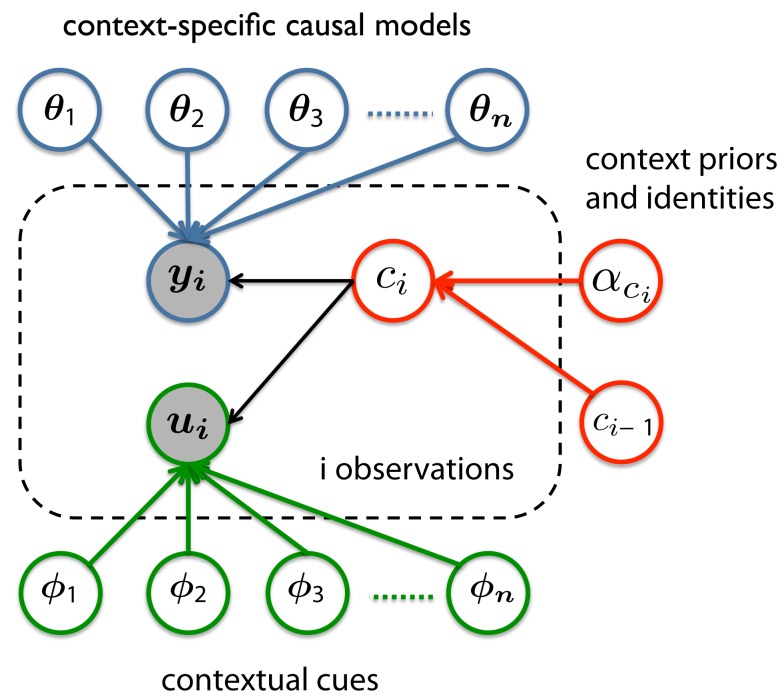
Learning an accurate representation of the environment is a difficult task for both animals and humans, because the causal structures of the environment are unobservable and must be inferred from the observable input. In this article, we argue that this difficulty is further increased by the multi-context nature of realistic learning environments. When the environment undergoes a change in context without explicit cueing, the learner must detect the change and employ a new causal model to predict upcoming observations correctly. We discuss the problems and strategies that a rational learner might adopt and existing findings that support such strategies. We advocate hierarchical models as an optimal structure for retaining causal models learned in past contexts, thereby avoiding relearning familiar contexts in the future.
对动物和人类而言,学习环境的准确表征都是一项艰巨的任务,因为环境的因果结构不可观测,必须从可观测的输入中进行推断。在本文中,我们认为现实学习环境的多上下文性质进一步加剧了这一困难。当环境在没有明确提示的情况下发生上下文变化时,学习者必须检测到这种变化并采用新的因果模型来正确预测即将出现的观察结果。我们讨论了理性学习者可能采用的问题和策略,以及支持这些策略的现有研究结果。我们主张将分层模型作为保留在过去上下文中学习到的因果模型的最佳结构,从而避免在未来重新学习熟悉的上下文。