Department of Cognitive Science and Education, University of Trento, Trento, Italy.
Res Dev Disabil. 2012 Nov-Dec;33(6):2255-64. doi: 10.1016/j.ridd.2012.06.011. Epub 2012 Jul 24.
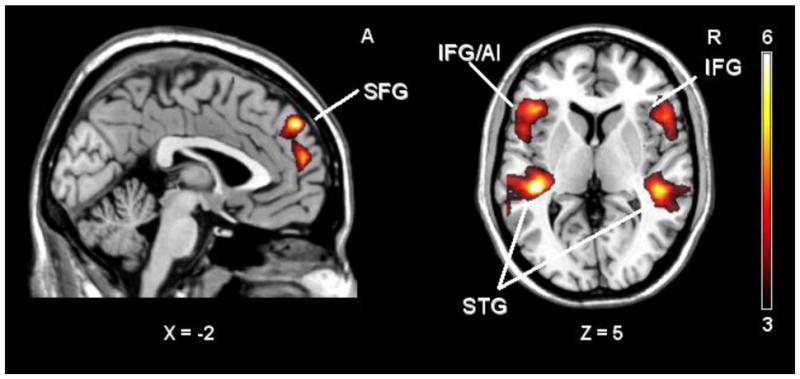
This study used fMRI to measure brain activity during adult processing of cries of infants with autistic disorder (AD) compared to cries of typically developing (TD) infants. Using whole brain analysis, we found that cries of infants with AD compared to those of TD infants elicited enhanced activity in brain regions associated with verbal and prosodic processing, perhaps because altered acoustic patterns of AD cries render them especially difficult to interpret, and increased activity in brain regions associated with emotional processing, indicating that AD cries also elicit more negative feelings and may be perceived as more aversive and/or arousing. Perceived distress engendered by AD cries related to increased activation in brain regions associated with emotional processing. This study supports the hypothesis that cry is an early and meaningful anomaly displayed by children with AD. It could be that cries associated with AD alter parent-child interactions much earlier than the time that reliable AD diagnosis normally occurs.
本研究使用 fMRI 技术测量了成年人处理自闭症谱系障碍(AD)婴儿哭声与正常发育(TD)婴儿哭声时的大脑活动。通过全脑分析,我们发现与 TD 婴儿的哭声相比,AD 婴儿的哭声会引起与语言和韵律处理相关的大脑区域的活动增强,这可能是因为 AD 婴儿的哭声的声学模式发生了改变,使得它们特别难以解读,并且与情绪处理相关的大脑区域的活动也增加了,这表明 AD 婴儿的哭声也会引起更强烈的负面情绪,可能被认为更令人不快和/或令人兴奋。AD 婴儿哭声引起的感知痛苦与与情绪处理相关的大脑区域的激活增加有关。这项研究支持了这样一种假设,即哭声是 AD 儿童早期出现的一种有意义的异常表现。可能是与 AD 相关的哭声比通常可靠的 AD 诊断时间更早地改变了亲子互动。