ReproGen – Animal Bioscience Group, Faculty of Veterinary Science, University of Sydney, Camden, NSW 2570, Australia.
Genet Sel Evol. 2012 Jul 27;44(1):22. doi: 10.1186/1297-9686-44-22.
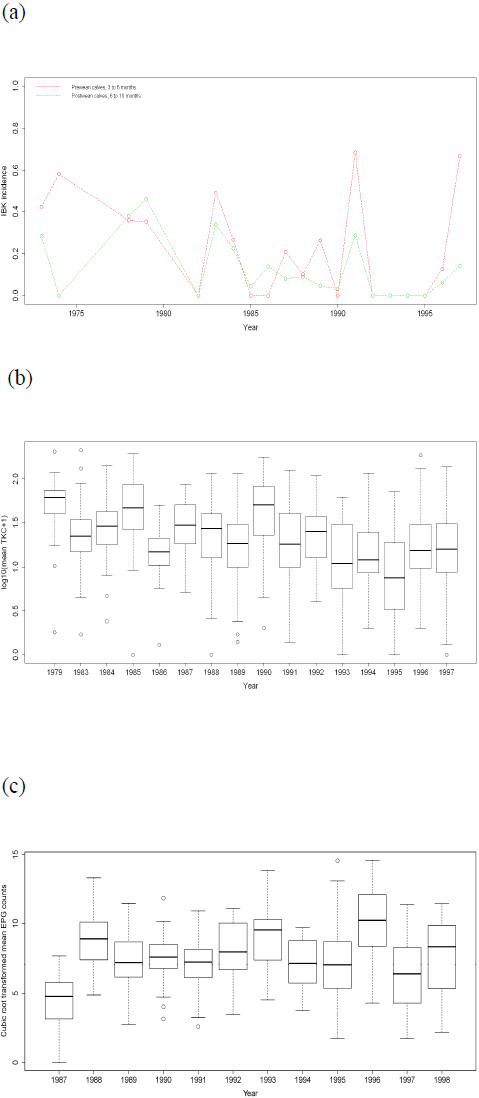
Infectious bovine keratoconjunctivitis (IBK) or 'pinkeye' is an economically important ocular disease that significantly impacts animal performance. Genetic parameters for IBK infection and its genetic and phenotypic correlations with cattle tick counts, number of helminth (unspecified species) eggs per gram of faeces and growth traits in Australian tropically adapted Bos taurus cattle were estimated.
Animals were clinically examined for the presence of IBK infection before and after weaning when the calves were 3 to 6 months and 15 to 18 months old, respectively and were also recorded for tick counts, helminth eggs counts as an indicator of intestinal parasites and live weights at several ages including 18 months.
Negative genetic correlations were estimated between IBK incidence and weight traits for animals in pre-weaning and post-weaning datasets. Genetic correlations among weight measurements were positive, with moderate to high values. Genetic correlations of IBK incidence with tick counts were positive for the pre-weaning and negative for the post-weaning datasets but negative with helminth eggs counts for the pre-weaning dataset and slightly positive for the post-weaning dataset. Genetic correlations between tick and helminth eggs counts were moderate and positive for both datasets. Phenotypic correlations of IBK incidence with helminth eggs per gram of faeces were moderate and positive for both datasets, but were close to zero for both datasets with tick counts.
Our results suggest that genetic selection against IBK incidence in tropical cattle is feasible and that calves genetically prone to acquire IBK infection could also be genetically prone to have a slower growth. The positive genetic correlations among weight traits and between tick and helminth eggs counts suggest that they are controlled by common genes (with pleiotropic effects). Genetic correlations between IBK incidence and tick and helminth egg counts were moderate and opposite between pre-weaning and post-weaning datasets, suggesting that the environmental and (or) maternal effects differ between these two growth phases. This preliminary study provides estimated genetic parameters for IBK incidence, which could be used to design selection and breeding programs for tropical adaptation in beef cattle.
传染性牛角膜结膜炎(IBK)或“红眼病”是一种具有重要经济意义的眼部疾病,它会显著影响动物的生产性能。本研究旨在估计澳大利亚热带适应性瘤牛的 IBK 感染的遗传参数及其与牛蜱计数、每克粪便中未特指种类的寄生虫卵数和生长性状的遗传和表型相关性。
在犊牛 3 至 6 月龄和 15 至 18 月龄时断奶前后,对牛进行临床检查以确定 IBK 感染的存在,并记录蜱计数、寄生虫卵计数(作为肠道寄生虫的指标)和几个年龄段(包括 18 月龄)的活体体重。
在断奶前和断奶后数据集,IBK 发病率与体重性状之间估计存在负遗传相关性。体重测量值之间的遗传相关性为正,具有中等至高度值。IBK 发病率与蜱计数的遗传相关性在断奶前数据集为正,在断奶后数据集为负,但在断奶前数据集与寄生虫卵计数呈负相关,在断奶后数据集呈轻微正相关。在两个数据集,蜱和寄生虫卵计数之间的遗传相关性为中等且为正。在两个数据集,IBK 发病率与每克粪便中寄生虫卵数的表型相关性均为中等且为正,但在两个数据集与蜱计数的表型相关性接近零。
我们的结果表明,对热带牛的 IBK 发病率进行遗传选择是可行的,并且遗传上易感染 IBK 感染的犊牛也可能遗传上生长缓慢。体重性状之间以及蜱和寄生虫卵计数之间的遗传相关性为正,表明它们受共同基因(具有多效性)控制。IBK 发病率与蜱和寄生虫卵计数之间的遗传相关性在断奶前和断奶后数据集之间为中等且相反,表明这两个生长阶段的环境和(或)母体效应不同。这项初步研究提供了 IBK 发病率的遗传参数估计值,可用于设计热带适应性肉牛的选择和繁殖计划。