Nagarajan Rajakumar, Sarma Manoj K, Thames April D, Castellon Steven A, Hinkin Charles H, Thomas M Albert
Department of Radiological Sciences, David Geffen School of Medicine, University of California, Los Angeles, CA 90095-1721, USA.
Int J Hepatol. 2012;2012:179365. doi: 10.1155/2012/179365. Epub 2012 Jul 12.
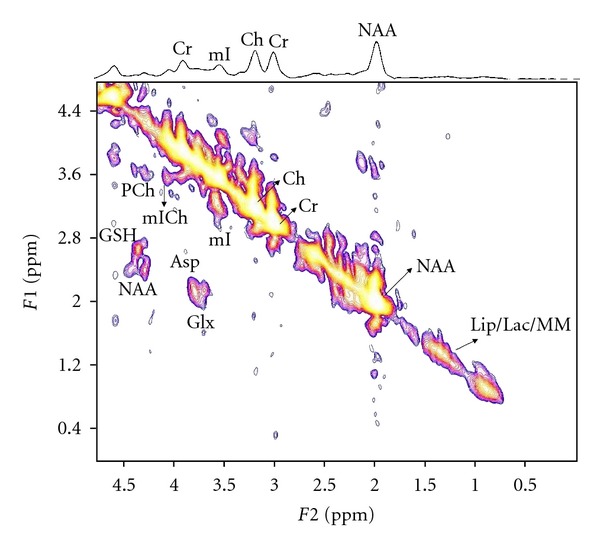
There is an evidence of neurocognitive dysfunction even in the absence of advanced liver disease in chronic hepatitis C virus (HCV) infection. Brain metabolism has been investigated non-invasively using one-dimensional (1D) in vivo Magnetic Resonance Spectroscopy (MRS) over three decades. Even though highly concentrated cerebral metabolites (N-acetylaspartate, creatine, choline, glutamate/glutamine, myo-inositol) have been detected using MRS, other metabolites at low concentrations (~1-3 mM or less) including glutathione, aspartate and GABA are quite difficult to observe using 1D MRS. In order to resolve overlapping resonances from a number of metabolites, a remedy is to add a second spectral dimension to the existing 1D MRS. Localized two-dimensional correlated spectroscopy (L-COSY) has been developed over the last decade to enhance the spectral dispersion by using the second spectral dimension. We have evaluated this L-COSY technique in the frontal white/gray matter regions of 14 HCV+ (mean age of 56.2 years) and 14 HCV- (mean age of 46.6 years) subjects. Our preliminary results showed significantly increased myo-inositol and glutathione in the HCV+ compared to the HCV- subjects. Hence, glutathione and myo-inositol should be considered along with other metabolites as important markers of inflammation.
即使在慢性丙型肝炎病毒(HCV)感染且无晚期肝病的情况下,也存在神经认知功能障碍的证据。三十多年来,一直使用一维(1D)活体磁共振波谱(MRS)对脑代谢进行非侵入性研究。尽管使用MRS已检测到高浓度的脑代谢物(N-乙酰天门冬氨酸、肌酸、胆碱、谷氨酸/谷氨酰胺、肌醇),但使用1D MRS很难观察到低浓度(约1-3 mM或更低)的其他代谢物,包括谷胱甘肽、天冬氨酸和γ-氨基丁酸。为了解决多种代谢物的重叠共振问题,一种解决方法是在现有的1D MRS上增加第二个光谱维度。在过去十年中开发了局部二维相关光谱(L-COSY),以通过使用第二个光谱维度来增强光谱分散。我们在14名HCV阳性(平均年龄56.2岁)和14名HCV阴性(平均年龄46.6岁)受试者的额叶白质/灰质区域评估了这种L-COSY技术。我们的初步结果显示,与HCV阴性受试者相比,HCV阳性受试者的肌醇和谷胱甘肽显著增加。因此,谷胱甘肽和肌醇应与其他代谢物一起被视为炎症的重要标志物。