David Geffen School of Medicine (A.D.T., S.A.C., E.J.S., R.N., M.K.S., N.S.T., M.A.T., C.H.H.), University of California, Los Angeles; Greater Los Angeles VA Healthcare System (S.A.C., J.S., D.S., C.H.H.); and Department of Infectious Disease (J.H.T.), Kaiser Permanente Antelope Valley, Lancaster, CA.
Neurol Neuroimmunol Neuroinflamm. 2015 Jan 14;2(1):e59. doi: 10.1212/NXI.0000000000000059. eCollection 2015 Feb.
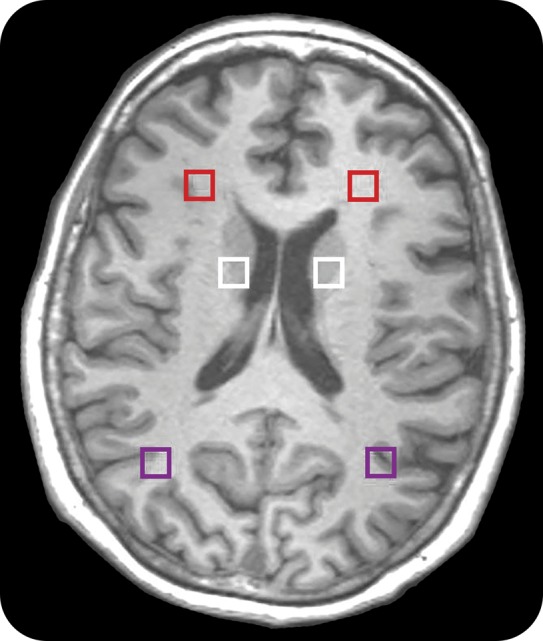
This study examined neurologic abnormalities (as measured by proton magnetic resonance spectroscopy imaging and diffusion tensor imaging), neurocognitive performance, and fatigue among a sample of adults with hepatitis C virus (HCV). We hypothesized that HCV+ individuals would demonstrate structural brain abnormalities and neurocognitive compromise consistent with frontostriatal dysfunction as well as increased fatigue compared to controls.
Participants were 76 individuals diagnosed with HCV and 20 controls who underwent a comprehensive neurocognitive evaluation and clinical assessments. A subset of the HCV+ participants (n = 29) and all controls underwent MRI.
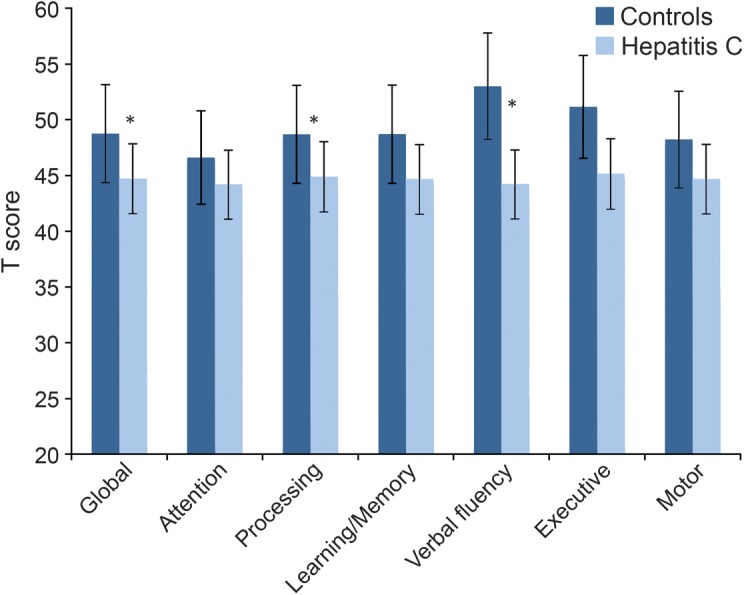
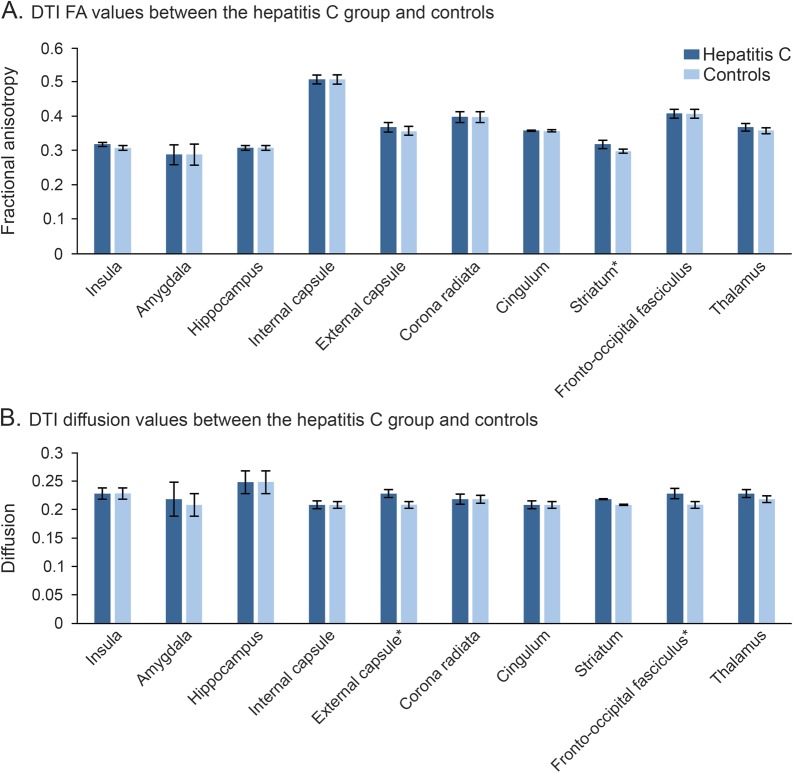
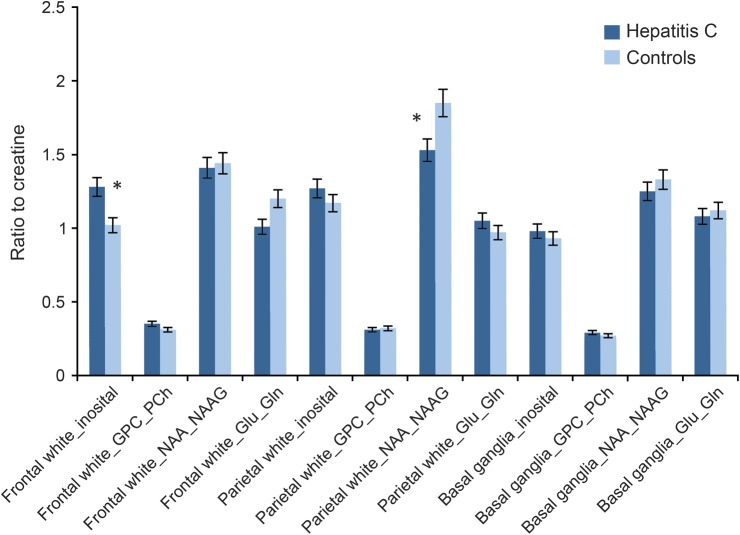
Individuals diagnosed with chronic HCV infection demonstrated greater fractional anisotropy in the striatum as well as greater mean diffusivity in the fronto-occiptal fasciculus and external capsule compared to HCV- controls. HCV+ participants also demonstrated lower levels of N-acetylaspartate in bilateral parietal white matter and elevations in myo-inosital (mI) in bilateral frontal white matter compared to HCV- controls (all p values < 0.05). HCV+ participants also demonstrated significantly poorer neuropsychological performance, particularly in processing speed and verbal fluency. HCV+ patients reported higher levels of fatigue than controls, and fatigue was significantly correlated with diffusivity in the superior fronto-occipital fasciculus, elevations in mI in frontal white matter, and overall cognitive performance.
Our results suggest that HCV-associated neurologic complications disrupt frontostriatal structures, which may result in increased fatigue and poorer cognitive performance, particularly in those cognitive domains regulated by frontostriatal regions.
本研究检测了丙型肝炎病毒(HCV)感染者的神经异常(通过质子磁共振波谱成像和弥散张量成像测量)、神经认知表现和疲劳。我们假设 HCV+个体将表现出与额-纹状体功能障碍一致的结构性脑异常和神经认知损伤,以及与对照组相比更高的疲劳感。
参与者包括 76 名被诊断为 HCV 的个体和 20 名对照组,他们接受了全面的神经认知评估和临床评估。一部分 HCV+参与者(n=29)和所有对照组都接受了 MRI 检查。
与 HCV-对照组相比,慢性 HCV 感染者的纹状体部分各向异性分数更高,额-枕束和外囊的平均弥散度更高。HCV+参与者还显示双侧顶叶白质中的 N-乙酰天门冬氨酸水平降低,双侧额叶白质中的肌肌醇(mI)升高(所有 p 值<0.05)。与 HCV-对照组相比,HCV+参与者的神经心理学表现也明显较差,尤其是在处理速度和语言流畅性方面。HCV+患者报告的疲劳水平高于对照组,且疲劳与上额枕束的弥散度、额叶白质中 mI 的升高以及整体认知表现显著相关。
我们的结果表明,HCV 相关的神经并发症会破坏额-纹状体结构,这可能导致疲劳感增加和认知表现下降,尤其是在那些由额-纹状体区域调节的认知领域。