Department of Clinical Epidemiology and Biostatistics, McMaster University, Hamilton, Ontario, Canada.
PLoS One. 2012;7(7):e39471. doi: 10.1371/journal.pone.0039471. Epub 2012 Jul 25.
Assessment of heterogeneity is essential in systematic reviews and meta-analyses of clinical trials. The most commonly used heterogeneity measure, I(2), provides an estimate of the proportion of variability in a meta-analysis that is explained by differences between the included trials rather than by sampling error. Recent studies have raised concerns about the reliability of I(2) estimates, due to their dependence on the precision of included trials and time-dependent biases. Authors have also advocated use of 95% confidence intervals (CIs) to express the uncertainty associated with I(2) estimates. However, no previous studies have explored how many trials and events are required to ensure stable and reliable I(2) estimates, or how 95% CIs perform as evidence accumulates.
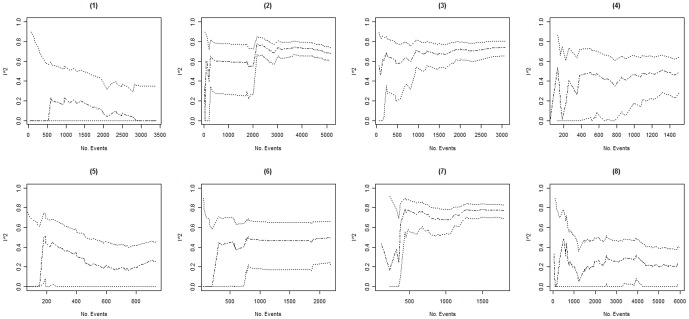
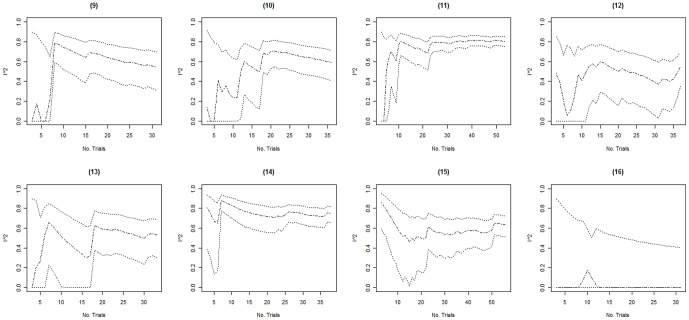
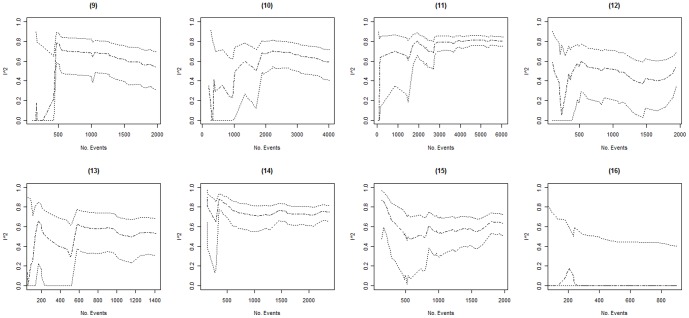
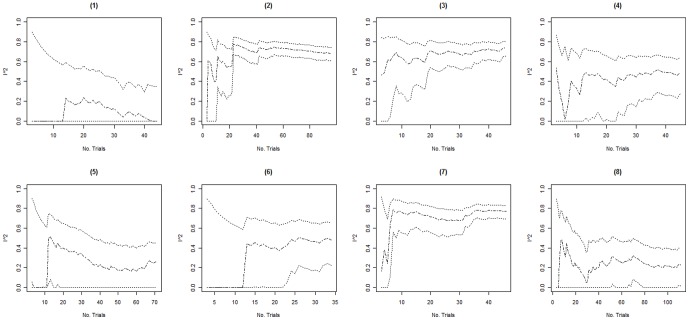
METHODOLOGY/PRINCIPAL FINDINGS: To assess the stability and reliability of I(2) estimates and their 95% CIs, in relation to the cumulative number of trials and events in meta-analysis, we looked at 16 large Cochrane meta-analyses--each including a sufficient number of trials and events to reliably estimate I(2)--and monitored the I(2) estimates and their 95% CIs for each year of publication. In 10 of the 16 meta-analyses, the I(2) estimates fluctuated more than 40% over time. The median number of events and trials required before the cumulative I(2) estimates stayed within +/-20% of the final I(2) estimate was 467 and 11. No major fluctuations were observed after 500 events and 14 trials. The 95% confidence intervals provided good coverage over time.
CONCLUSIONS/SIGNIFICANCE: I(2) estimates need to be interpreted with caution when the meta-analysis only includes a limited number of events or trials. Confidence intervals for I(2) estimates provide good coverage as evidence accumulates, and are thus valuable for reflecting the uncertainty associated with estimating I(2).
在临床试验的系统评价和荟萃分析中,评估异质性至关重要。最常用的异质性衡量指标 I(2) 提供了一种估计,即荟萃分析中因纳入试验之间的差异而导致的变异性比例,而不是由抽样误差引起的。由于其依赖于纳入试验的精度和时变偏倚,最近的研究对 I(2) 估计的可靠性提出了担忧。作者还主张使用 95%置信区间 (CI) 来表达与 I(2) 估计相关的不确定性。然而,以前的研究尚未探讨需要多少个试验和事件才能确保 I(2) 估计的稳定和可靠,也没有探讨 95%CI 随着证据的积累如何表现。
方法/主要发现:为了评估 I(2) 估计及其 95%CI 在荟萃分析中与试验和事件数量的累积关系的稳定性和可靠性,我们研究了 16 项大型 Cochrane 荟萃分析——每项分析都包含足够的试验和事件来可靠地估计 I(2)——并监测了每年发表的每个分析的 I(2) 估计及其 95%CI。在 16 项荟萃分析中的 10 项中,I(2) 估计值随时间波动超过 40%。在累积 I(2) 估计值保持在最终 I(2) 估计值的 +/-20%内之前,所需的中位数事件和试验数量为 467 和 11。在达到 500 个事件和 14 个试验后,没有观察到重大波动。95%置信区间随着时间的推移提供了良好的覆盖。
结论/意义:当荟萃分析仅包含有限数量的事件或试验时,需要谨慎解释 I(2) 估计。随着证据的积累,I(2) 估计的置信区间提供了良好的覆盖范围,因此对于反映估计 I(2) 相关的不确定性很有价值。