Department of Anthropology, Hunter College, New York, New York, United States of America.
PLoS One. 2012;7(7):e40503. doi: 10.1371/journal.pone.0040503. Epub 2012 Jul 25.
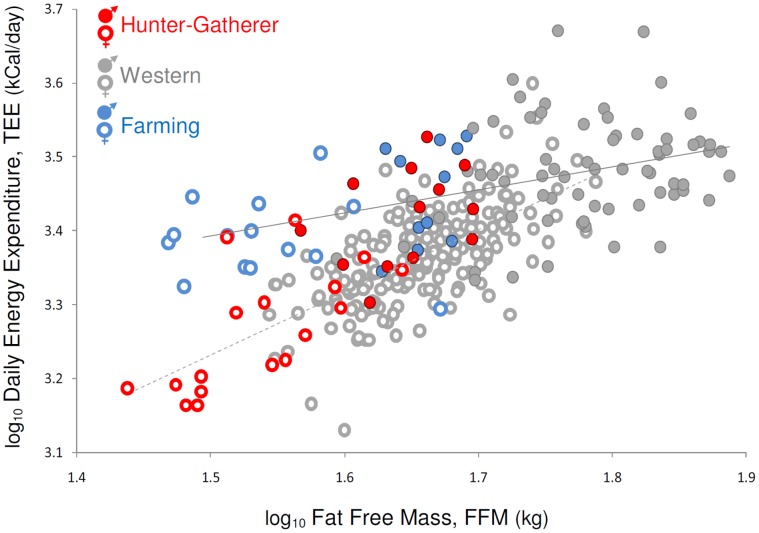
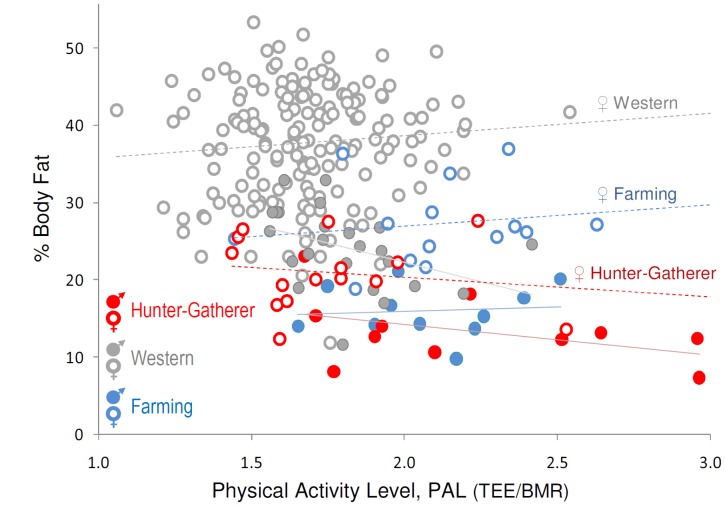
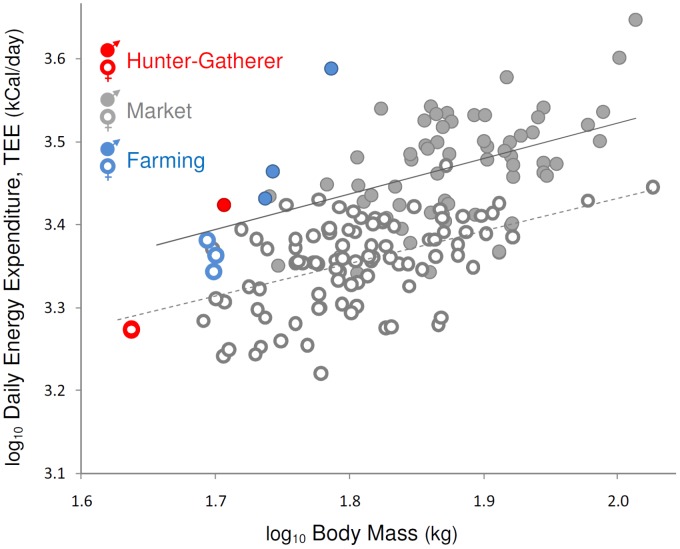
Western lifestyles differ markedly from those of our hunter-gatherer ancestors, and these differences in diet and activity level are often implicated in the global obesity pandemic. However, few physiological data for hunter-gatherer populations are available to test these models of obesity. In this study, we used the doubly-labeled water method to measure total daily energy expenditure (kCal/day) in Hadza hunter-gatherers to test whether foragers expend more energy each day than their Western counterparts. As expected, physical activity level, PAL, was greater among Hadza foragers than among Westerners. Nonetheless, average daily energy expenditure of traditional Hadza foragers was no different than that of Westerners after controlling for body size. The metabolic cost of walking (kcal kg(-1) m(-1)) and resting (kcal kg(-1) s(-1)) were also similar among Hadza and Western groups. The similarity in metabolic rates across a broad range of cultures challenges current models of obesity suggesting that Western lifestyles lead to decreased energy expenditure. We hypothesize that human daily energy expenditure may be an evolved physiological trait largely independent of cultural differences.
西方生活方式与我们的狩猎采集者祖先有显著的不同,而这些在饮食和活动水平上的差异往往与全球肥胖流行有关。然而,几乎没有狩猎采集人群的生理数据来验证这些肥胖模型。在这项研究中,我们使用双标记水法测量了哈扎狩猎采集者的总日能量消耗(千卡/天),以测试觅食者每天消耗的能量是否比他们的西方同行多。正如预期的那样,哈扎觅食者的体力活动水平(PAL)高于西方人。然而,在控制身体大小后,传统哈扎觅食者的平均日能量消耗与西方人没有不同。哈扎和西方人群的步行(千卡/千克/米)和休息(千卡/千克/秒)的代谢成本也相似。在广泛的文化中,代谢率的相似性挑战了当前的肥胖模型,表明西方的生活方式导致能量消耗减少。我们假设人类的日能量消耗可能是一种进化的生理特征,在很大程度上独立于文化差异。