Department of Anthropology, Northwestern University, Evanston, Illinois, United States of America.
PLoS One. 2012;7(7):e40905. doi: 10.1371/journal.pone.0040905. Epub 2012 Jul 27.
Birth weight (BW) predicts many health outcomes, but the relative contributions of genes and environmental factors to BW remain uncertain. Some studies report stronger mother-offspring than father-offspring BW correlations, with attenuated father-offspring BW correlations when the mother is stunted. These findings have been interpreted as evidence that maternal genetic or environmental factors play an important role in determining birth size, with small maternal size constraining paternal genetic contributions to offspring BW. Here we evaluate mother-offspring and father-offspring birth weight (BW) associations and evaluate whether maternal stunting constrains genetic contributions to offspring birth size.
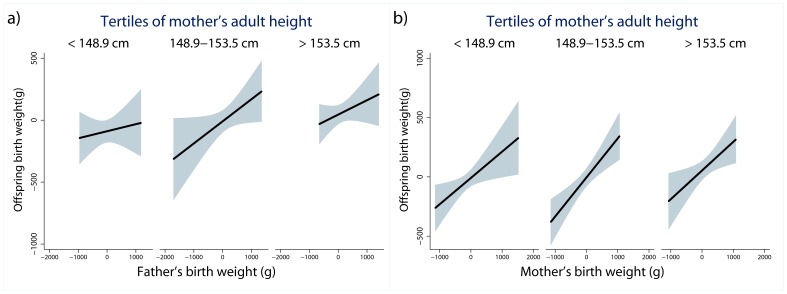
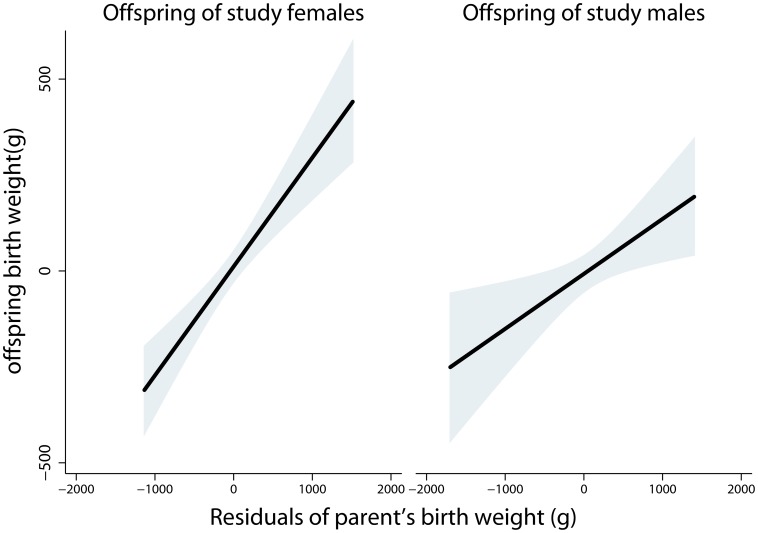
METHODS/PRINCIPAL FINDINGS: Data include BW of offspring (n = 1,101) born to female members (n = 382) and spouses of male members (n = 275) of a birth cohort (born 1983-84) in Metropolitan Cebu, Philippines. Regression was used to relate parental and offspring BW adjusting for confounders. Resampling testing was used to evaluate whether false paternity could explain any evidence for excess matrilineal inheritance. In a pooled model adjusting for maternal height and confounders, parental BW was a borderline-significantly stronger predictor of offspring BW in mothers compared to fathers (sex of parent interaction p = 0.068). In separate multivariate models, each kg in mother's and father's BW predicted a 271±53 g (p<0.00001) and 132±55 g (p = 0.017) increase in offspring BW, respectively. Resampling statistics suggested that false paternity rates of >25% and likely 50% would be needed to explain these differences. There was no interaction between maternal stature and maternal BW (interaction p = 0.520) or paternal BW (p = 0.545).
CONCLUSIONS/SIGNIFICANCE: Each kg change in mother's BW predicted twice the change in offspring BW as predicted by a change in father's BW, consistent with an intergenerational maternal effect on offspring BW. Evidence for excess matrilineal BW heritability at all levels of maternal stature points to indirect genetic, mitochondrial, or epigenetic maternal contributions to offspring fetal growth.
出生体重 (BW) 可预测许多健康结果,但基因和环境因素对 BW 的相对贡献仍不确定。一些研究报告称,母亲与子女 BW 的相关性强于父亲与子女 BW 的相关性,而当母亲身材矮小(stunted)时,父亲与子女 BW 的相关性减弱。这些发现被解释为母亲的遗传或环境因素在决定出生体重方面起着重要作用的证据,即母亲身材矮小限制了父亲遗传对子女 BW 的贡献。在这里,我们评估了母子和父女 BW 的关联,并评估了母亲身材矮小是否限制了遗传对后代出生大小的贡献。
方法/主要发现:数据包括菲律宾宿雾大都会出生队列(1983-84 年出生)中女性成员(n=382)及其配偶所生子女(n=1101)的 BW。使用回归分析来调整混杂因素后,父母和子女 BW 之间的关系。重新抽样检验用于评估是否有假父本可以解释母系遗传过度的任何证据。在调整母亲身高和混杂因素的汇总模型中,与父亲相比,父母 BW 对子女 BW 的预测力在母亲中具有边缘显著意义(父母性别交互作用 p=0.068)。在单独的多元模型中,母亲和父亲 BW 每增加 1 公斤,分别预测子女 BW 增加 271±53 克(p<0.00001)和 132±55 克(p=0.017)。重新抽样统计数据表明,需要假父本率超过 25%且可能达到 50%才能解释这些差异。母亲身高与母亲 BW(交互作用 p=0.520)或父亲 BW(p=0.545)之间没有相互作用。
结论/意义:母亲 BW 的每 1 公斤变化预测子女 BW 的变化是父亲 BW 变化的两倍,这与母亲对子女 BW 的代际影响一致。在所有母亲身高水平上,母系 BW 遗传力都存在过度的证据,这表明遗传、线粒体或母体印迹对后代胎儿生长有间接贡献。