Department of Anesthesiology, University Hospital Aachen, Aachen, Germany.
PLoS One. 2012;7(7):e41758. doi: 10.1371/journal.pone.0041758. Epub 2012 Jul 27.
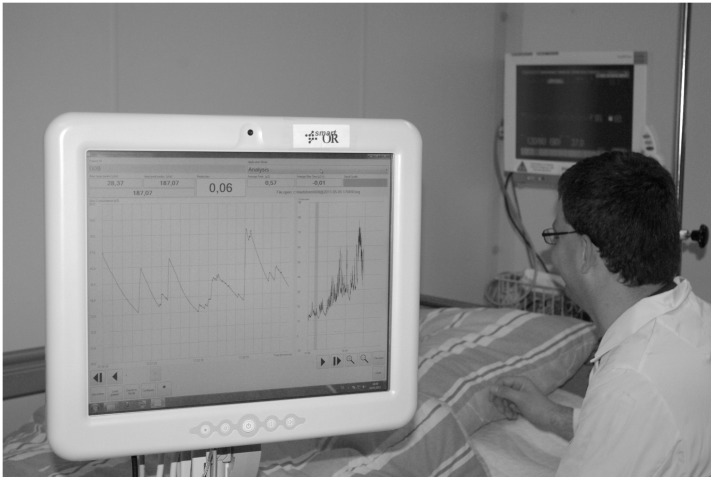
After surgery, effective and well-directed acute pain therapy is a necessary and integral part of the overall treatment plan. Generally, the assessment of pain intensity depends on a patient's self-evaluation using scoring systems such as numeric rating scales (NRS, 0 to 10). Recently, a "Pain Monitor" was commercially provided which is based on measurements of fluctuations of skin conductance (NFSC). In this randomized, controlled, single-blind trial, possible benefits of this certain device were studied.
Postoperative patients (n = 44) were randomly assigned to a test or a control group during their stay in the postanesthesia care unit (PACU). All patients were treated and monitored according to internal hospital standards. Whereas all patients systematically evaluated their pain each 15 min, test group patients were additionally addressed when NFSC exceeded a predefined level. In cases of NRS≥5 during a routine elevation or in between, pain relief was achieved by standard procedures irrespective of group allocation.
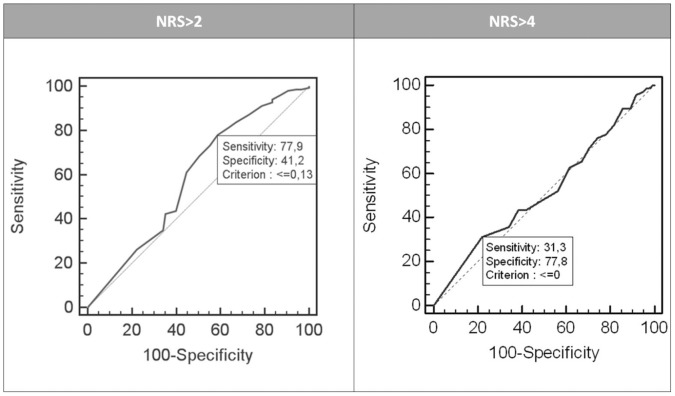
During their stay in PACU, both test and control groups experienced a significant decrease in NRS as a consequence of pain therapy. No significant differences in mean NRS or in NFSC values were found between the test and control groups. No correlation was observed between NRS and NFSC.
Postoperative patients experience diverse stressors, such as anxiety, disorientation, shivering, sickness and pain. Although the application of continuous pain monitoring would be meaningful in this clinical setting, the tested device failed to distinguish pain from other stressors in postoperative adult patients.
German Clinical Trials Register DRKS00000755.
手术后,有效的、有针对性的急性疼痛治疗是整体治疗计划的必要组成部分。通常,疼痛强度的评估取决于患者使用评分系统(如数字评分量表(NRS,0-10))进行的自我评估。最近,一种基于皮肤电导波动(NFSC)测量的“疼痛监测仪”已商业化提供。在这项随机、对照、单盲试验中,研究了该特定设备的可能益处。
术后患者(n=44)在麻醉后监护病房(PACU)期间随机分配到测试组或对照组。所有患者均按照院内标准进行治疗和监测。尽管所有患者都系统地每 15 分钟评估一次疼痛,但当 NFSC 超过预设水平时,测试组患者会得到额外的关注。在常规升高期间或在两者之间出现 NRS≥5 的情况下,无论分组如何,均通过标准程序缓解疼痛。
在 PACU 期间,测试组和对照组的 NRS 均因疼痛治疗而显著下降。测试组和对照组的平均 NRS 或 NFSC 值无显著差异。NRS 与 NFSC 之间未观察到相关性。
术后患者会经历多种应激源,如焦虑、迷失方向、颤抖、恶心和疼痛。尽管在这种临床环境中应用连续疼痛监测具有重要意义,但测试的设备未能区分术后成年患者的疼痛与其他应激源。
德国临床试验注册处 DRKS00000755。