Erel Varlik K, Özkan Heval Selman
Department of Anaesthesiology and Reanimation.
Department of Plastic Surgery, School of Medicine, Adnan Menderes University, Aydin, Turkey.
J Pain Res. 2017 Dec 14;10:2827-2832. doi: 10.2147/JPR.S151370. eCollection 2017.
Today, many subjective methods are used to measure pain. Wong Baker and Hicks Facial Pain Scale is one of the most commonly used method. Clinicians grade pain according to the facial mimetic reaction of the patient. Unfortunately, there is no objective measure for monitoring pain. By using the same principle of the Wong Baker and Hicks Facial Pain Scale, in this study, we aimed to objectively measure pain by using a thermal camera to detect instant facial temperature changes.
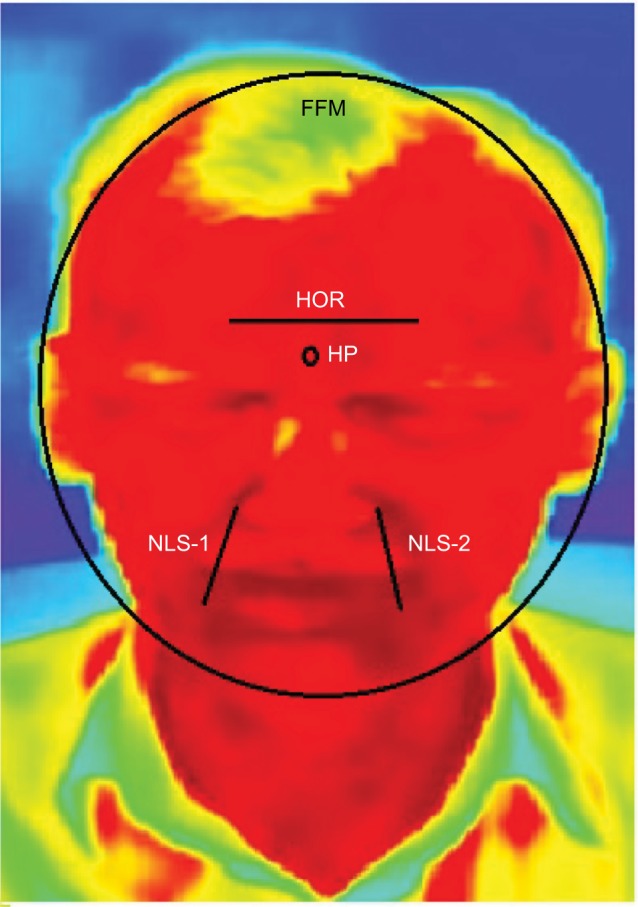
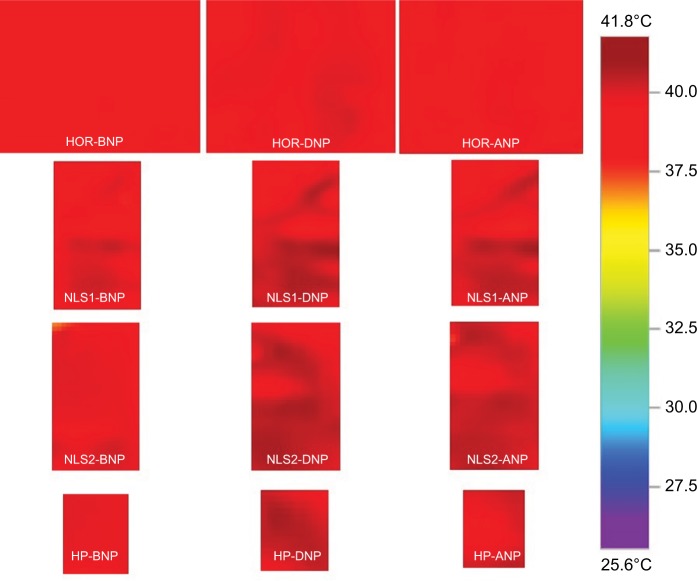
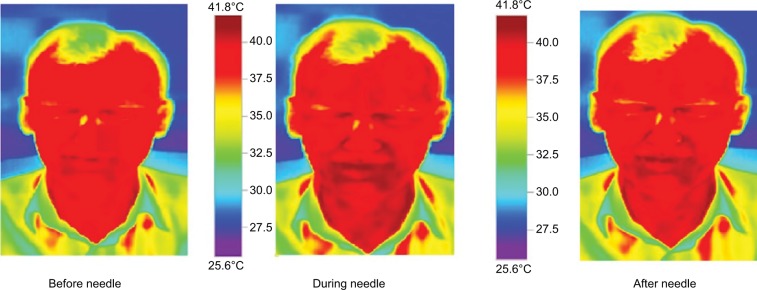
Thirty volunteers who attended blood collection unit were subjected to facial thermal monitoring and measurements were obtained 5 minutes before needle puncture (BNP), during needle puncture (DNP), and after needle puncture (ANP). Data were processed with TestoIRSoft 3.8 software program and mean temperatures of the whole face (FFM) and highest temperature points (HP), horizontal line (HOR) between two pupils and first glabellar wrinkle, and bilateral lines starting from the nasolabial sulcus to oral commissure (NLS-1 at right, NLS-2 at left) were evaluated. All data were statistically analyzed with paired sample -test.
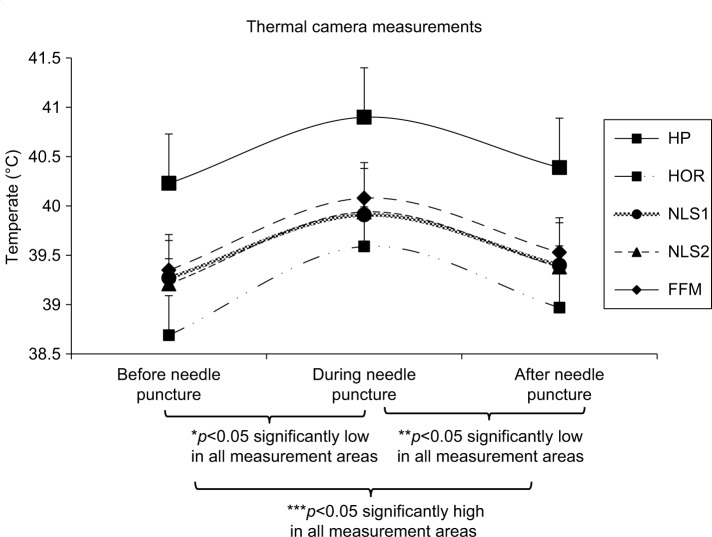
Statistically, temperature measurements of HOR, NLS-1, NLS-2, HP, and FFM were significantly higher between BNP and DNP, significantly lower between ANP and DNP, and significantly higher between BNP and ANP (<0.05). The most interesting result in our analysis was that the HP point was between the two eyebrows in 26 of the 30 volunteers.
Our results suggest that a thermal camera can be used to objectively monitor pain and in follow-up. However, further studies involving non-healthy volunteers (especially high-fever patients, children, immunosuppressive patients, and cancer and intensive care patients) should be performed.
如今,有许多主观方法用于测量疼痛。 Wong Baker面部表情疼痛量表和希克斯面部疼痛量表是最常用的方法之一。临床医生根据患者的面部模仿反应对疼痛进行分级。不幸的是,目前尚无用于监测疼痛的客观方法。本研究基于与Wong Baker面部表情疼痛量表和希克斯面部疼痛量表相同的原理,旨在通过使用热成像仪检测面部即时温度变化来客观地测量疼痛。
30名到采血室的志愿者接受面部热监测,在针刺前5分钟(BNP)、针刺期间(DNP)和针刺后(ANP)进行测量。数据用TestoIRSoft 3.8软件程序处理,并评估整个面部的平均温度(FFM)、最高温度点(HP)、两瞳孔之间的水平线(HOR)和眉间第一道皱纹,以及从鼻唇沟到口角的双侧线(右侧为NLS-1,左侧为NLS-2)。所有数据采用配对样本检验进行统计学分析。
统计学上,HOR、NLS-1、NLS-2、HP和FFM的温度测量值在BNP和DNP之间显著升高,在ANP和DNP之间显著降低,在BNP和ANP之间显著升高(<0.05)。我们分析中最有趣的结果是,30名志愿者中有26名的HP点位于两眉之间。
我们的结果表明,热成像仪可用于客观监测疼痛及后续随访。然而,应开展涉及非健康志愿者(尤其是高热患者、儿童、免疫抑制患者以及癌症和重症监护患者)的进一步研究。