Division of Malaria and Parasitic Diseases, Korea Centers for Disease Controland Prevention, Osong 363-951, Republic of Korea.
Malar J. 2012 Aug 1;11:257. doi: 10.1186/1475-2875-11-257.
Plasmodium vivax re-emerged in 1993 and has now become a major public health problem during the summer season in South Korea. The aim of this study was to interpret and understand the meaning of seroepidemiological studies for developing the best malaria control programme in South Korea.
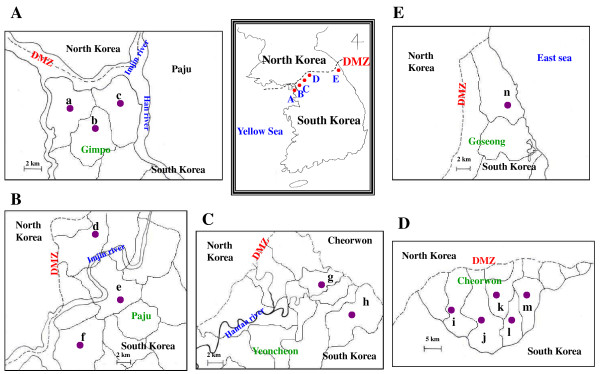
Blood samples were collected in Gimpo city, Paju city, Yeoncheon County, Cheorwon County and Goseong County of high risk area in South Korea. Microscopy was performed to identify patients infected with P. vivax. Antibody detection for P. vivax was performed using indirect fluorescent antibody test (IFAT).
A total of 1,574 blood samples was collected from participants in the study areas and evaluated against three parameters: IFAT positive rate, annual antibody positive index (AAPI), and annual parasite index (API). The IFAT positive rate was 7.24% (n = 114). Of the five study areas, Gimpo had the highest IFAT positive rate (13.68%) and AAPI (4.63). Yeongcheon had the highest API in 2005 (2.06) while Gimpo had the highest API in 2006 (5.00). No correlation was observed between any of the three parameters and study sites' distance from the demilitarized zone (DMZ).
These results showed that P. vivax antibody levels could provide useful information about the prevalence of malaria in endemic areas. Furthermore, AAPI results for each year showed a closer relationship to API the following year than the API of the same year and thus could be helpful in predicting malaria transmission risks.
间日疟原虫于 1993 年再次出现,现已成为韩国夏季的一个主要公共卫生问题。本研究旨在解释和理解血清流行病学研究的意义,以制定韩国最佳的疟疾控制方案。
在韩国高风险地区的金浦市、坡州市、涟川县、城川郡和高城郡采集血样。通过显微镜检查鉴定感染间日疟原虫的患者。使用间接荧光抗体试验(IFAT)检测间日疟原虫抗体。
共采集研究地区 1574 份血样,评估三个参数:IFAT 阳性率、年度抗体阳性指数(AAPI)和年度寄生虫指数(API)。IFAT 阳性率为 7.24%(n=114)。五个研究地区中,金浦的 IFAT 阳性率(13.68%)和 AAPI(4.63)最高。2005 年,永川的 API 最高(2.06),而 2006 年金浦的 API 最高(5.00)。这三个参数与研究地点距非军事区(DMZ)的距离之间没有相关性。
这些结果表明,间日疟原虫抗体水平可以为流行地区疟疾的流行情况提供有用信息。此外,每年的 AAPI 结果与次年的 API 更为密切,而与当年的 API 相关性较低,因此有助于预测疟疾传播风险。