Lee Hyeong-Woo, Kang Yoon-Joong, Cho Shin-Hyeong, Na Byoung-Kuk, Pak Jhang Ho, Nam Ho-Woo, Park Yun-Kyu, Sohn Youngjoo, Kim Tong-Soo
Department of Pathology, Immunology, and Laboratory Medicine, College of Medicine, University of Florida, FL 32610, USA.
Department of Biomedical Science, Jungwon University, Goesan, Chungbuk 367-805, Korea.
Korean J Parasitol. 2015 Apr;53(2):169-75. doi: 10.3347/kjp.2015.53.2.169. Epub 2015 Apr 22.
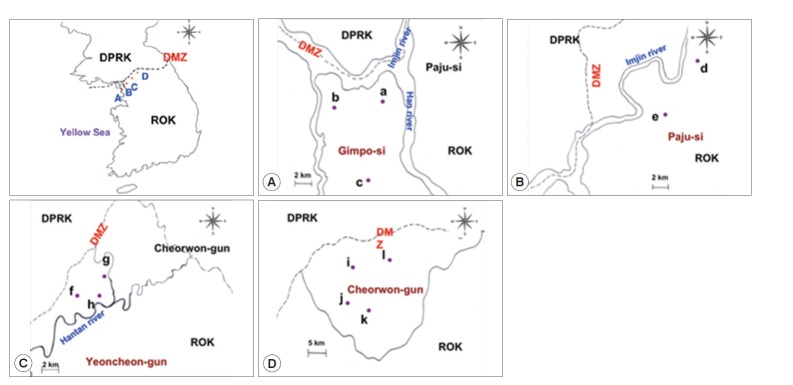
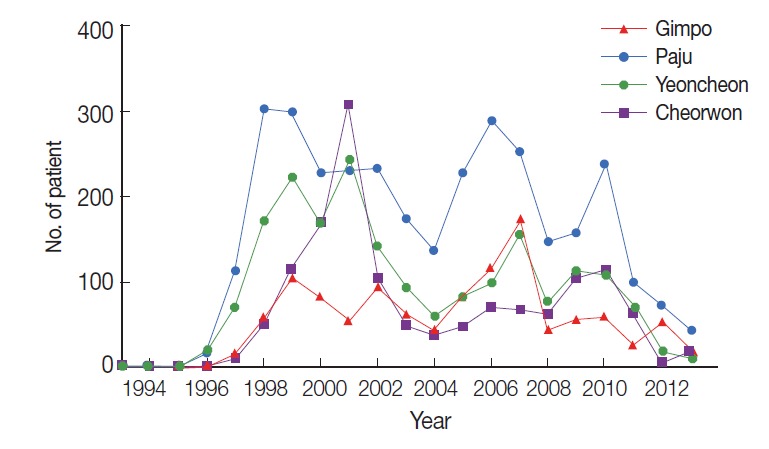
The relationship between anti- Plasmodium vivax circumsporozoite protein (CSP) antibody levels and the prevalence of malaria in epidemic areas of South Korea was evaluated. Blood samples were collected from inhabitants of Gimpo-si (city), Paju-si, and Yeoncheon-gun (county) in Gyeonggi-do (province), as well as Cheorwon-gun in Gangwon-do from November to December 2004. Microscopic examinations were used to identify malaria parasites. ELISA was used to quantitate anti-circumsporozoite protein (CSP) antibodies against P. vivax. A total of 1,774 blood samples were collected. The overall CSP-ELISA-positive rate was 7.7% (n=139). The annual parasite incidences (APIs) in these areas gradually decreased from 2004 to 2005 (1.09 and 0.80, respectively). The positive rate in Gimpo (10.4%, 44/425) was the highest identified by CSP-ELISA. The highest API was found in Yeoncheon, followed by Cheorwon, Paju, and Gimpo in both years. The positive rates of CSP-ELISA were closely related to the APIs in the study areas. These results suggest that seroepidemiological studies based on CSP may be helpful in estimating the malaria prevalence in certain areas. In addition, this assay can be used to establish and evaluate malaria control and eradication programs in affected areas.
评估了韩国流行地区抗间日疟原虫环子孢子蛋白(CSP)抗体水平与疟疾流行率之间的关系。2004年11月至12月,从京畿道金浦市、坡州市和涟川郡以及江原道铁原郡的居民中采集血样。使用显微镜检查来鉴定疟原虫。采用酶联免疫吸附测定(ELISA)法对间日疟原虫的抗环子孢子蛋白(CSP)抗体进行定量。共采集了1774份血样。CSP-ELISA总体阳性率为7.7%(n = 139)。这些地区的年寄生虫发病率(API)从2004年到2005年逐渐下降(分别为1.09和0.80)。金浦市的阳性率(10.4%,44/425)在CSP-ELISA检测中为最高。两年中,涟川的API最高,其次是铁原、坡州和金浦。CSP-ELISA的阳性率与研究地区的API密切相关。这些结果表明,基于CSP的血清流行病学研究可能有助于估计某些地区的疟疾流行情况。此外,该检测方法可用于制定和评估受影响地区的疟疾控制及根除计划。