Departments of Parasitology, Inha University School of Medicine, Incheon 400-712, Republic of Korea.
Malar J. 2013 Dec 13;12:448. doi: 10.1186/1475-2875-12-448.
Plasmodium vivax re-emerged in 1993. Although the number of infections has been steadily decreasing, it is likely to continue to affect public health until it is eradicated. The aim of this study is to measure anti-circumsporozoite protein (CSP) antibody and compare malaria prevalence. As to understand the prevalence, an epidemiology study has to be conducted in the Republic of Korea.
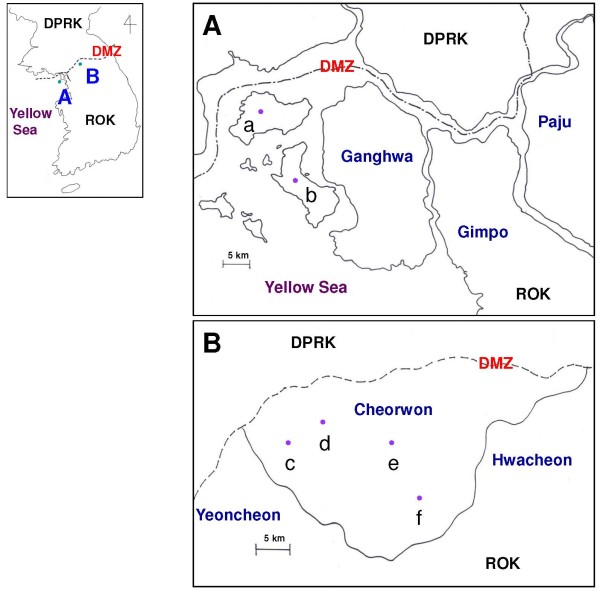
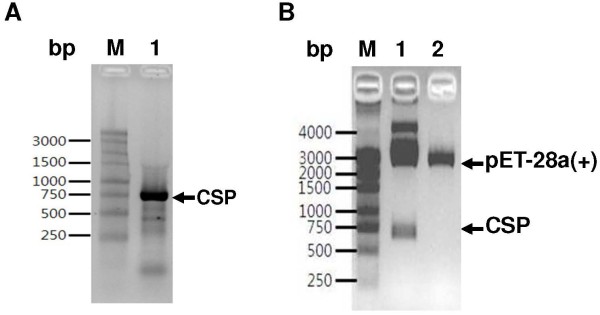
A total of 1,825 and 1,959 blood samples were collected in 2010 and 2011, respectively, from the inhabitants of Ganghwa and Cheorwon counties. The antibody titers of the inhabitants were measured by enzyme-linked immunosorbent assay (ELISA) using recombinant protein purified from Escherichia coli transformed with a CSP gene-inserted pET-28a(+) expression vector. Microscopic examination was performed to identify malaria parasites.
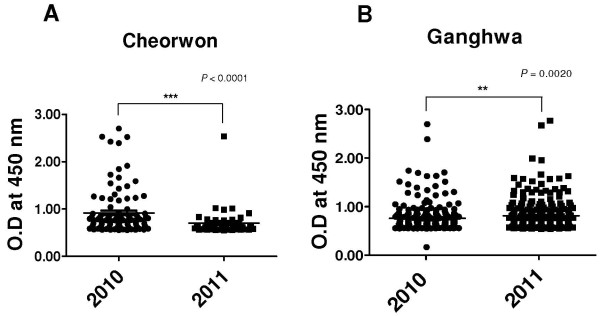
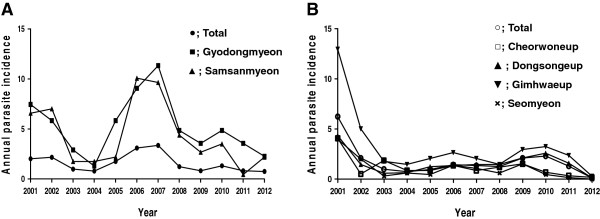
The annual parasite incidence (API) in Ganghwa decreased from 4.28 in 2010 to 2.23 in 2011, and that in Cheorwon decreased from 1.88 in 2010 to 1.15 in 2011. The antibody-positive CSP rate in these areas also decreased from 18.14% (331/1825) in 2010 to 15.36% (301/1959) in 2011. Pearson analysis showed a strong correlation between the API and the antibody-positive CSP rate in these areas (r = 1.000, P < 0.01). The intensity of the immune responses of the inhabitants of Cheorwon, as measured by the mean optical density, decreased from 0.9186 ± 0.0472 in 2010 to 0.7035 ± 0.0457 in 2011 (P = 0.034), but increased in Ganghwa from 0.7649 ± 0.0192 in 2010 to 0.8237 ± 0.1970 in 2011 (P = 0.006). The immune response increased according to age (r = 0.686, P = 0.041).
The positive CSP-ELISA rate was closely related to the API in the study areas. This suggests that seroepidemiological studies based on CSP-ELISA may be helpful in estimating the malaria prevalence. Moreover, such studies can be used to establish and evaluate malaria control and eradication programmes in high-risk areas in Korea.
间日疟原虫于 1993 年再次出现。尽管感染人数一直在稳步下降,但在其被消灭之前,它仍有可能继续影响公众健康。本研究旨在测量抗环子孢子蛋白(CSP)抗体并比较疟疾的流行率。为了了解流行率,必须在大韩民国开展一项流行病学研究。
2010 年和 2011 年分别从江华和城川郡居民中采集了 1825 份和 1959 份血样。采用酶联免疫吸附试验(ELISA)法,用大肠杆菌转化的含 CSP 基因插入的 pET-28a(+)表达载体中纯化的重组蛋白测量居民的抗体滴度。进行显微镜检查以鉴定疟原虫。
江华的年寄生虫发病率(API)从 2010 年的 4.28 降至 2011 年的 2.23,而城川的 API 从 2010 年的 1.88 降至 2011 年的 1.15。这些地区的 CSP 阳性抗体率也从 2010 年的 18.14%(331/1825)下降到 2011 年的 15.36%(301/1959)。Pearson 分析显示,这些地区的 API 与 CSP 阳性抗体率之间存在很强的相关性(r=1.000,P<0.01)。Cheorwon 居民的免疫反应强度(以平均光密度表示)从 2010 年的 0.9186±0.0472 降至 2011 年的 0.7035±0.0457(P=0.034),而江华则从 2010 年的 0.7649±0.0192 增加到 2011 年的 0.8237±0.1970(P=0.006)。免疫反应随年龄增长而增加(r=0.686,P=0.041)。
CSP-ELISA 的阳性率与研究地区的 API 密切相关。这表明,基于 CSP-ELISA 的血清流行病学研究可能有助于估计疟疾的流行率。此外,此类研究可用于在韩国高风险地区建立和评估疟疾控制和消除规划。