Drugs for Neglected Diseases Initiative (DNDi), Geneva, Switzerland.
Malar J. 2012 Aug 2;11:260. doi: 10.1186/1475-2875-11-260.
The widespread use of artesunate-amodiaquine (ASAQ) for treating uncomplicated malaria makes it important to gather and analyse information on its tolerability.
An individual-patient tolerability analysis was conducted using data from eight randomized controlled clinical trials conducted at 17 sites in nine sub-Saharan countries comparing ASAQ to other anti-malarial treatments. All patients who received at least one dose of the study drug were included in the analysis. Differences in adverse event (AE) and treatment emergent adverse event (TEAE) were analysed by Day 28.
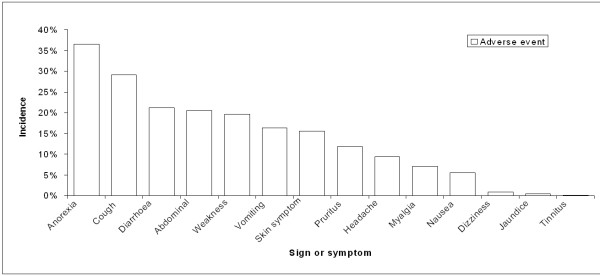
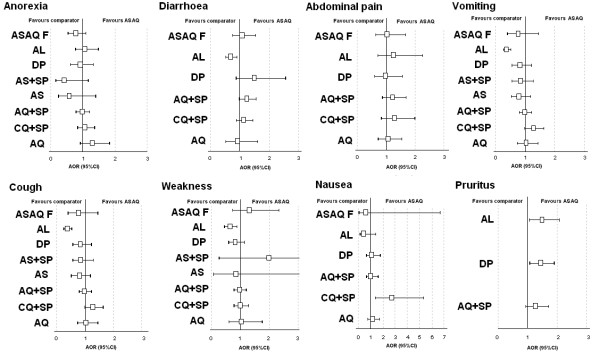
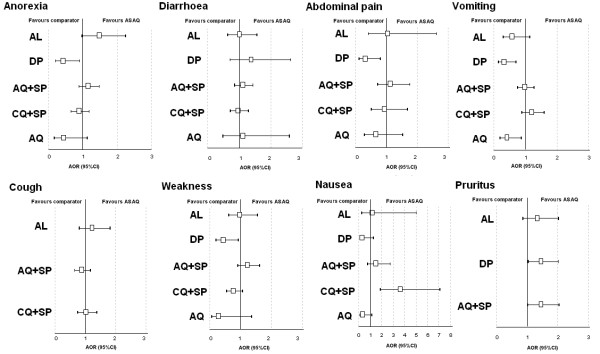
Of the 6,179 patients enrolled (74% <5 years of age), 50% (n = 3,113) received ASAQ, 20% (n = 1,217) another ACT, and 30% (n = 1,849) a non-ACT (combination or single-agent) treatment. Overall, 8,542 AEs were recorded. The proportion of patients experiencing at least one gastro-intestinal AE on ASAQ was 43% (and higher than that with artemether-lumefantrine and dihydroartemisinin-piperaquine at two sites), and was 23% for any other AEs (not different from other treatments). Specifically, the risk of diarrhoea, vomiting, cough and weakness was lower with artemether-lumefantrine; artemether-lumefantrine and dihydroartemisinin-piperaquine carried a higher risk of pruritus, chloroquine-SP had a higher risk of nausea. Parasitological recurrence increased the risk of occurrence of any AE. No other difference was detected. Comparing AE to TEAE in patients who had pre-treatment occurrence and grades of intensity recorded, AEs were significantly more related to the pre-treatment prevalence of the symptom (p = 0.001, Fisher test); AEs overestimated TEAEs by a factor ranging from none to five-fold. The overall incidence of serious AEs (SAEs) with ASAQ was nine per 1,000 (29/3,113) and mortality was one per 1,000 (three deaths, none drug-related); both were similar to other treatments.
ASAQ was comparatively well-tolerated. Safety information is important, and must be collected and analysed in a standardized way. TEAEs are a more objective measure of treatment-induced toxicity.
青蒿琥酯-阿莫地喹(ASAQ)被广泛用于治疗无并发症疟疾,因此收集和分析其耐受性信息非常重要。
对在撒哈拉以南 9 个国家的 17 个地点进行的 8 项随机对照临床试验的数据进行了个体患者耐受性分析,比较了 ASAQ 与其他抗疟治疗药物。所有至少接受过一次研究药物治疗的患者均纳入分析。在第 28 天比较不良反应(AE)和治疗中出现的不良反应(TEAE)的差异。
在纳入的 6179 名患者中(<5 岁患者占 74%),50%(n=3113)接受 ASAQ 治疗,20%(n=1217)接受另一种 ACT 治疗,30%(n=1849)接受非 ACT(联合或单一药物)治疗。共记录了 8542 例不良事件。在 ASAQ 治疗组中,至少发生 1 例胃肠道不良事件的患者比例为 43%(在两个地点高于青蒿琥酯-氨酚喹啉),任何其他不良事件的比例为 23%(与其他治疗无差异)。具体而言,腹泻、呕吐、咳嗽和乏力的风险较低;瘙痒的风险较高,氯喹-SP 恶心的风险较高。寄生虫学复发增加了任何不良事件发生的风险。未发现其他差异。在比较记录了治疗前发生和严重程度的 AE 与 TEAE 时,AE 与症状的治疗前流行率显著相关(p=0.001,Fisher 检验);AE 较 TEAE 高估了 1 至 5 倍。ASAQ 总体严重不良事件(SAE)发生率为每 1000 例 9 例(3113 例中的 29 例),死亡率为每 1000 例 1 例(3 例死亡,均与药物无关);与其他治疗方法相似。
ASAQ 耐受性良好。安全性信息很重要,必须以标准化的方式收集和分析。TEAE 是治疗相关毒性的更客观衡量标准。