Electrical Engineering and Computer Science, University of Michigan, Ann Arbor, Michigan, United States of America.
PLoS One. 2012;7(7):e41019. doi: 10.1371/journal.pone.0041019. Epub 2012 Jul 31.
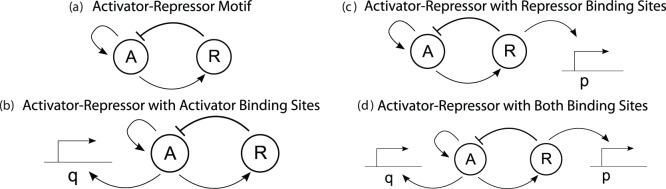
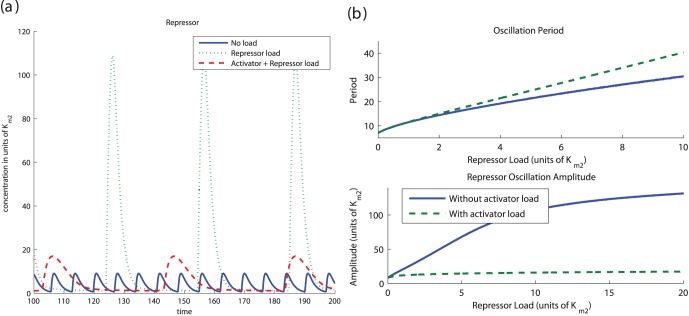
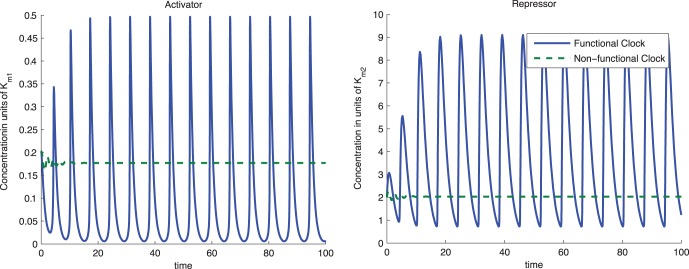
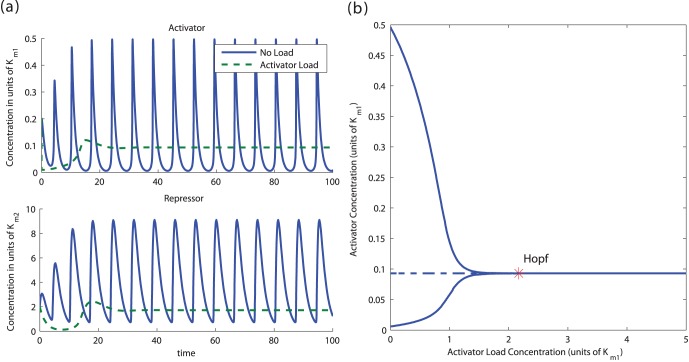
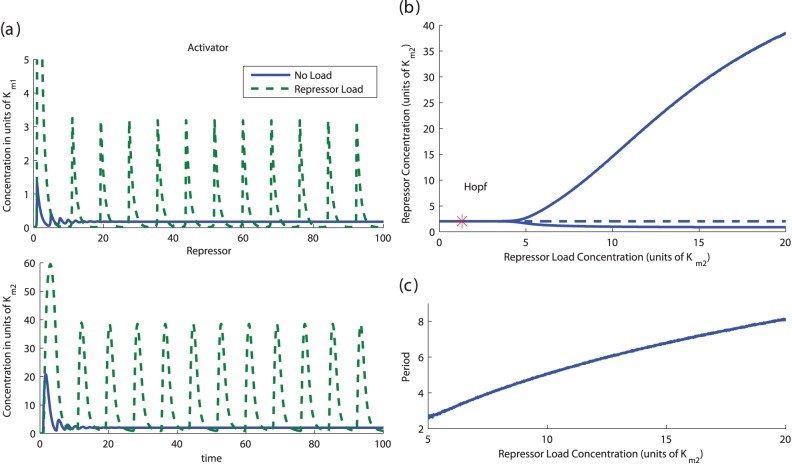
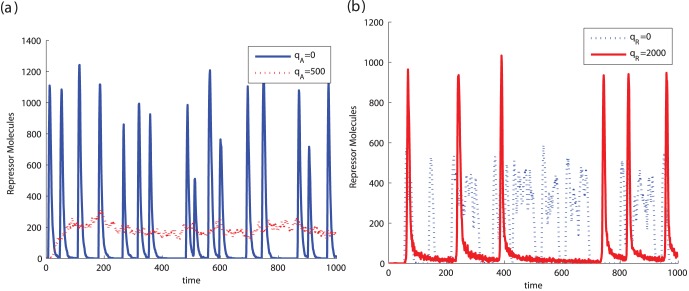
Periodic oscillations play a key role in cell physiology from the cell cycle to circadian clocks. The interplay of positive and negative feedback loops among genes and proteins is ubiquitous in these networks. Often, delays in a negative feedback loop and/or degradation rates are a crucial mechanism to obtain sustained oscillations. How does nature control delays and kinetic rates in feedback networks? Known mechanisms include proper selection of the number of steps composing a feedback loop and alteration of protease activity, respectively. Here, we show that a remarkably simple means to control both delays and effective kinetic rates is the employment of DNA binding sites. We illustrate this design principle on a widely studied activator-repressor clock motif, which is ubiquitous in natural systems. By suitably employing DNA target sites for the activator and/or the repressor, one can switch the clock "on" and "off" and precisely tune its period to a desired value. Our study reveals a design principle to engineer dynamic behavior in biomolecular networks, which may be largely exploited by natural systems and employed for the rational design of synthetic circuits.
周期性振荡在细胞生理学中起着关键作用,从细胞周期到生物钟。基因和蛋白质之间的正反馈和负反馈回路的相互作用在这些网络中无处不在。通常,负反馈回路中的延迟和降解速率是获得持续振荡的关键机制。大自然如何控制反馈网络中的延迟和动力学速率?已知的机制包括适当选择组成反馈回路的步骤数和改变蛋白酶活性。在这里,我们展示了一种控制延迟和有效动力学速率的非常简单的方法,即使用 DNA 结合位点。我们在广泛研究的激活剂-抑制剂时钟基序上说明了这个设计原则,该基序在自然系统中无处不在。通过适当地为激活剂和/或抑制剂使用 DNA 靶标,可以打开和关闭时钟,并将其周期精确地调整到所需的值。我们的研究揭示了一种在生物分子网络中设计动态行为的设计原则,这可能被自然系统广泛利用,并被用于合成电路的合理设计。