Pennington Biomedical Research Center, Baton Rouge, LA 70808, USA.
Obes Rev. 2012 Nov;13(11):1001-14. doi: 10.1111/j.1467-789X.2012.01019.x. Epub 2012 Aug 2.
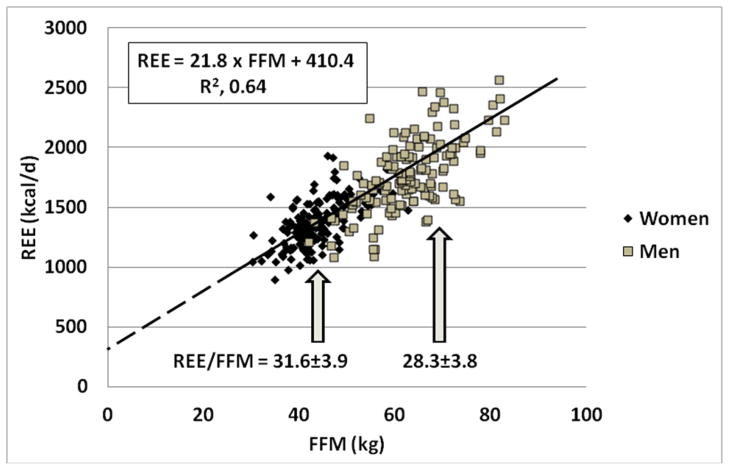
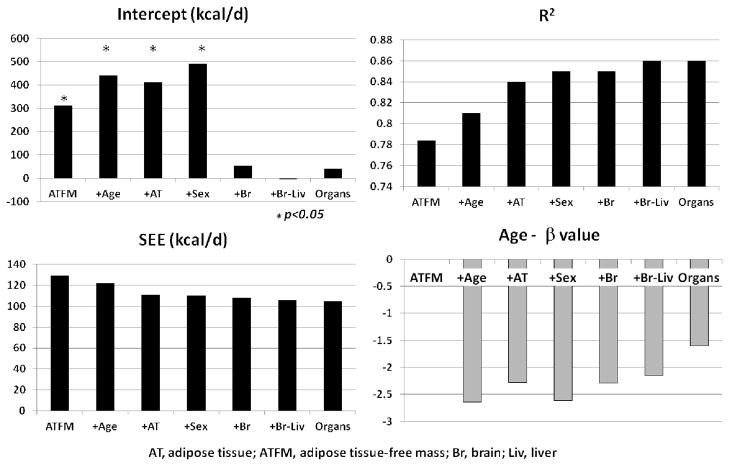
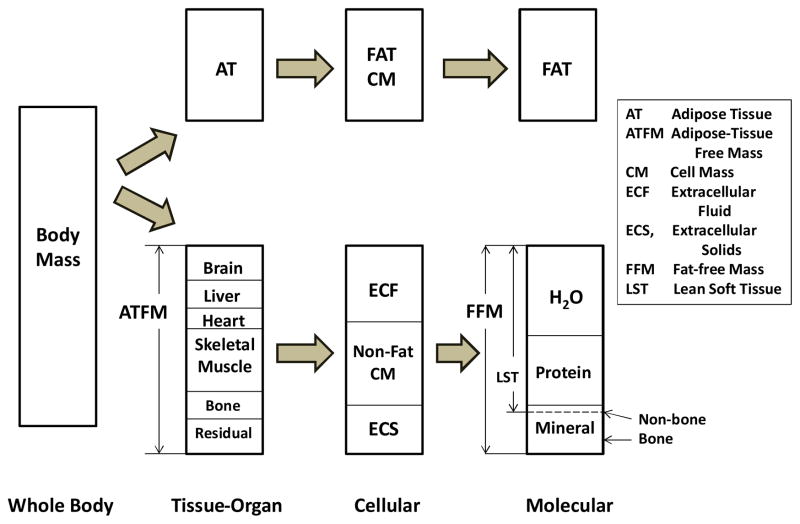
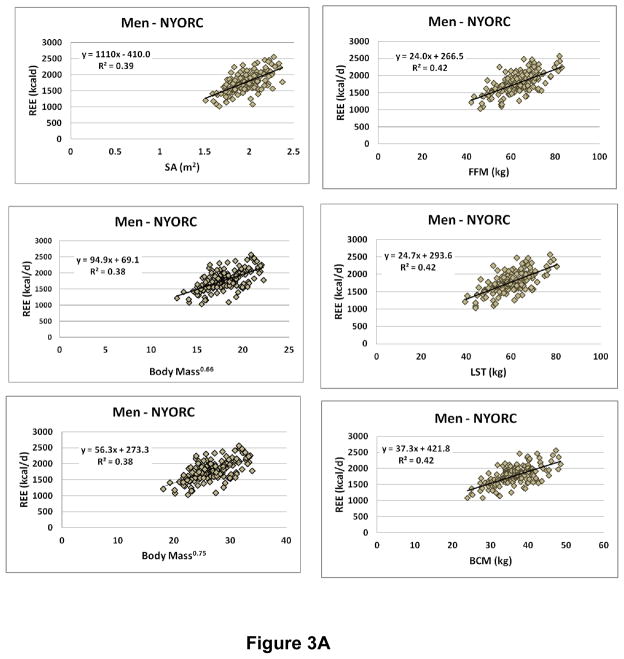
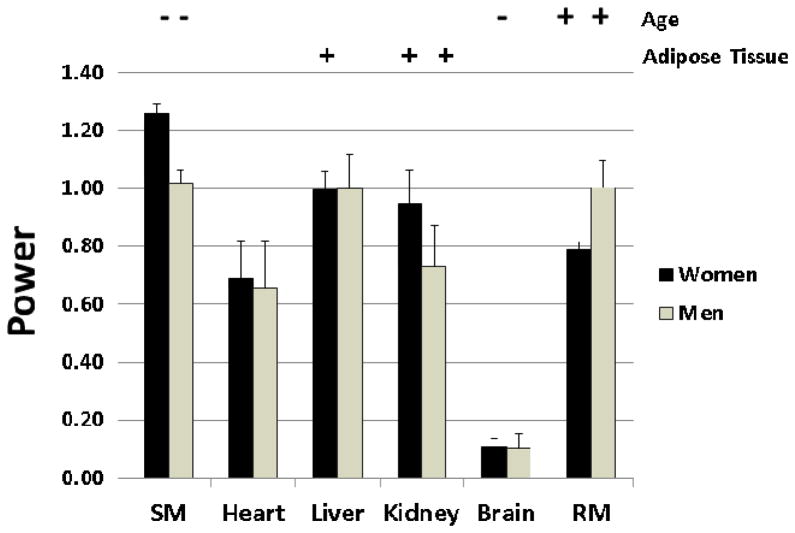
Establishing if an adult's resting energy expenditure (REE) is high or low for their body size is a pervasive question in nutrition research. Early workers applied body mass and height as size measures and formulated the Surface Law and Kleiber's Law, although each has limitations when adjusting REE. Body composition methods introduced during the mid-20th century provided a new opportunity to identify metabolically homogeneous 'active' compartments. These compartments all show improved correlations with REE estimates over body mass-height approaches, but collectively share a common limitation: REE-body composition ratios are not 'constant' but vary across men and women and with race, age and body size. The now-accepted alternative to ratio-based norms is to adjust for predictors by applying regression models to calculate 'residuals' that establish if an REE is relatively high or low. The distinguishing feature of statistical REE-body composition models is a 'non-zero' intercept of unknown origin. The recent introduction of imaging methods has allowed development of physiological tissue-organ-based REE prediction models. Herein, we apply these imaging methods to provide a mechanistic explanation, supported by experimental data, for the non-zero intercept phenomenon and, in that context, propose future research directions for establishing between-subject differences in relative energy metabolism.
确定成年人的静息能量消耗 (REE) 是否与其体型大小相匹配,这是营养研究中普遍存在的问题。早期的研究人员将体重和身高作为体型指标,提出了体表定律和克莱伯定律,但在调整 REE 时,每种方法都有其局限性。20 世纪中叶引入的身体成分方法提供了一个新的机会,可以识别代谢上同质的“活跃”区室。这些区室与 REE 估计值的相关性均优于体重-身高方法,但它们共同存在一个共同的局限性:REE-身体成分比不是“恒定的”,而是因性别、种族、年龄和体型而异。现在,替代基于比例的标准的方法是通过应用回归模型来调整预测因子,计算“残差”,以确定 REE 是否相对较高或较低。统计 REE-身体成分模型的区别特征是未知来源的“非零”截距。最近引入的成像方法允许基于生理组织器官的 REE 预测模型的开发。在此,我们应用这些成像方法,根据实验数据,对非零截距现象提供一种机制解释,并在此背景下,为确定相对能量代谢的个体间差异提出未来的研究方向。