Department of Internal Medicine, Yale University School of Medicine, New Haven, CT 06510, USA.
Dis Model Mech. 2012 Sep;5(5):681-5. doi: 10.1242/dmm.009035. Epub 2012 Aug 3.
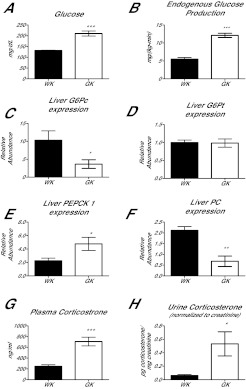
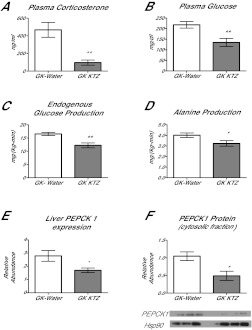
The Goto-Kakizaki (GK) rat is an inbred model of type 2 diabetes (T2D); GK rats are lean but have hyperglycemia and increased gluconeogenesis. However, fasting hyperglycemia in other commonly used rodent models of T2D is associated with increased corticosterone, and thus the underlying mechanism for hyperglycemia differs significantly from T2D in humans. Information regarding corticosterone in the GK rat is not readily available. We studied 14- to 16-week-old GK rats in comparison with age-matched control Wistar-Kyoto (WK) rats. GK rats had lower body weights (WK: 343±10 g vs GK: 286±9 g, P<0.01), but higher plasma glucose concentrations (WK: 132±1.5 mg/dl vs GK: 210±11.7 mg/dl, P<0.01). This was associated with an ∼twofold increase in PEPCK1 expression (P<0.05). However, these findings were also associated with elevations in plasma corticosterone and urinary corticosterone excretion. Ketoconazole (KTZ) treatment in GK rats reduced plasma corticosterone, fasting glucose (GK: 218±15 mg/dl vs GK-KTZ: 135±19 mg/dl, P<0.01) and rates of glucose production [GK: 16.5±0.6 mg/(kg-minute) vs GK-KTZ: 12.2±0.9 mg/(kg-minute), P<0.01]. This was associated with an ∼40% reduction in hepatic PEPCK1 expression as well as a 20% reduction in alanine turnover. Thus, hypercorticosteronemia might contribute to the diabetic phenotype of GK rats and should be considered as a potential confounder in rodent models of T2D.
Goto-Kakizaki(GK)大鼠是 2 型糖尿病(T2D)的近交系模型;GK 大鼠体型偏瘦,但存在高血糖和糖异生增加。然而,其他常用的 T2D 啮齿动物模型中的空腹高血糖与皮质酮增加有关,因此高血糖的潜在机制与人类 T2D 有很大的不同。关于 GK 大鼠皮质酮的信息并不容易获得。我们研究了 14-16 周龄的 GK 大鼠与年龄匹配的对照 Wistar-Kyoto(WK)大鼠进行比较。GK 大鼠的体重较低(WK:343±10g 与 GK:286±9g,P<0.01),但血糖浓度较高(WK:132±1.5mg/dl 与 GK:210±11.7mg/dl,P<0.01)。这与 PEPCK1 表达增加约两倍有关(P<0.05)。然而,这些发现也与血浆皮质酮和尿皮质酮排泄增加有关。酮康唑(KTZ)治疗 GK 大鼠可降低血浆皮质酮、空腹血糖(GK:218±15mg/dl 与 GK-KTZ:135±19mg/dl,P<0.01)和葡萄糖生成率[GK:16.5±0.6mg/(kg·min)与 GK-KTZ:12.2±0.9mg/(kg·min),P<0.01]。这与肝 PEPCK1 表达降低约 40%以及丙氨酸周转率降低 20%有关。因此,高皮质酮血症可能导致 GK 大鼠的糖尿病表型,应被视为 T2D 啮齿动物模型中的一个潜在混杂因素。