School of Electrical Engineering, Korea Advanced Institute of Science and Technology (KAIST), Daejeon 34141, Republic of Korea.
Digestive Disease Research Center, Department of Internal Medicine, University of Ulsan College of Medicine, Asan Medical Center, Seoul 05505, Republic of Korea.
Sci Adv. 2023 Sep;9(35):eadh8619. doi: 10.1126/sciadv.adh8619. Epub 2023 Sep 1.
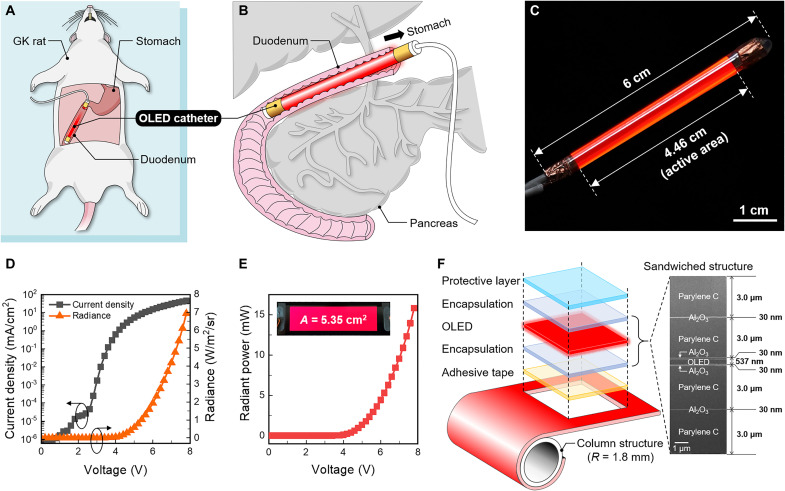
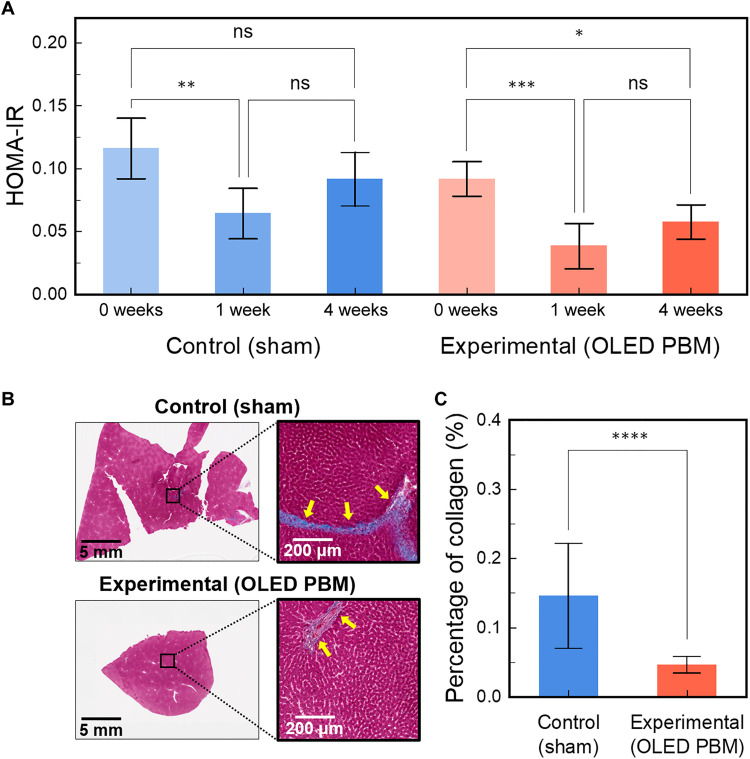
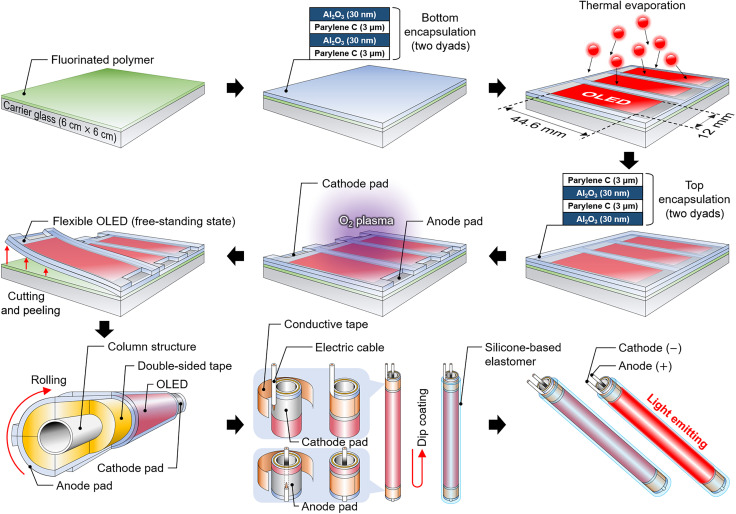
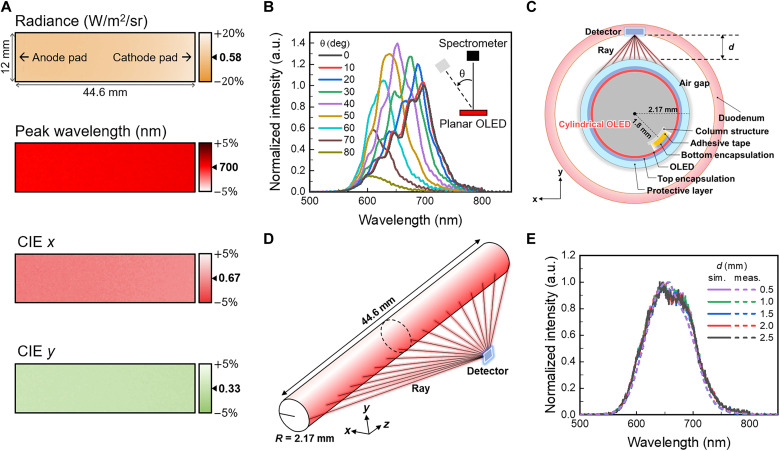
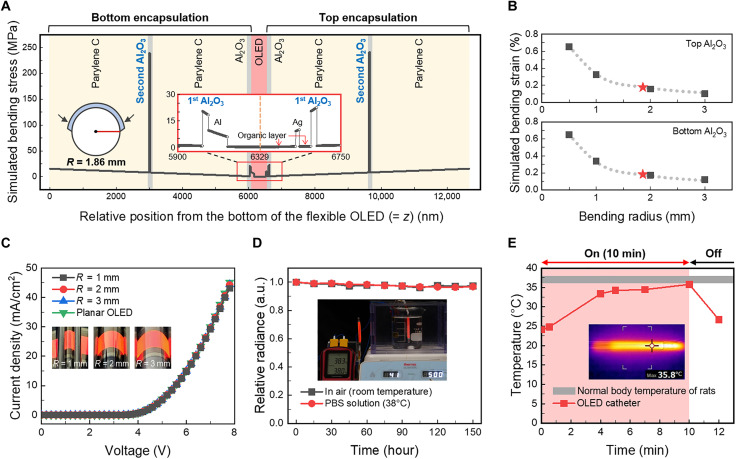
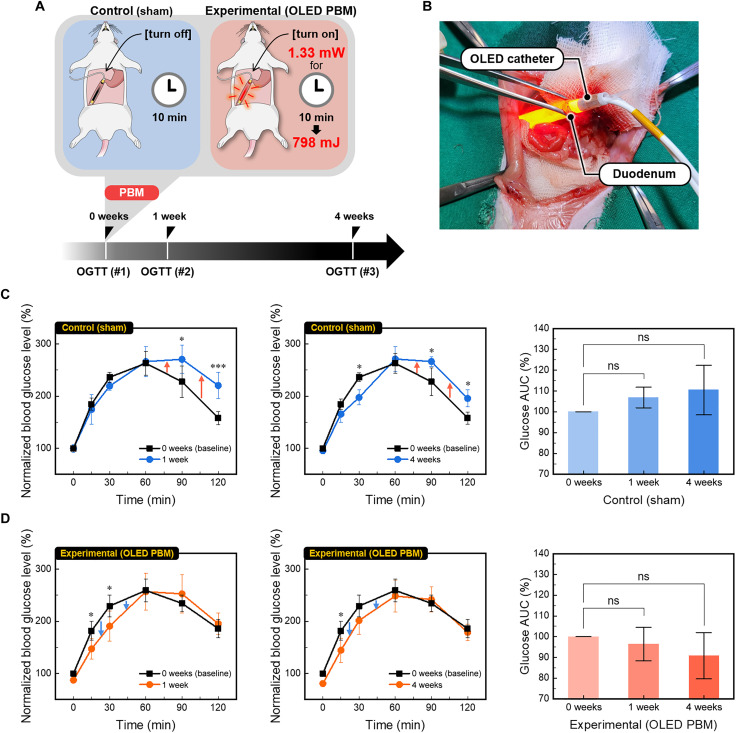
Phototherapeutics has shown promise in treating various diseases without surgical or drug interventions. However, it is challenging to use it in inner-body applications due to the limited light penetration depth through the skin. Therefore, we propose an organic light-emitting diode (OLED) catheter as an effective photobiomodulation (PBM) platform useful for tubular organs such as duodenums. A fully encapsulated highly flexible OLED is mounted over a round columnar structure, producing axially uniform illumination without local hotspots. The biocompatible and airtight OLED catheter can operate in aqueous environments for extended periods, meeting the essential requirements for inner-body medical applications. In a diabetic Goto-Kakizaki (GK) rat model, the red OLED catheter delivering 798 mJ of energy is shown to reduce hyperglycemia and insulin resistance compared to the sham group. Results are further supported by the subdued liver fibrosis, illustrating the immense potential of the OLED-catheter-based internal PBM for the treatment of type 2 diabetes and other diseases yet to be identified.
光疗在治疗各种疾病方面显示出了希望,无需手术或药物干预。然而,由于皮肤的光穿透深度有限,在内体应用中使用它具有挑战性。因此,我们提出了一种有机发光二极管(OLED)导管,作为一种有效的光生物调节(PBM)平台,可用于十二指肠等管状器官。一个完全封装的高柔性 OLED 安装在一个圆形柱状结构上,产生轴向均匀的照明,没有局部热点。这种生物相容性和密封的 OLED 导管可以在水介质中长时间运行,满足内体医学应用的基本要求。在糖尿病 Goto-Kakizaki(GK)大鼠模型中,与假手术组相比,输送 798mJ 能量的红色 OLED 导管可降低高血糖和胰岛素抵抗。结果进一步得到了肝脏纤维化程度降低的支持,这说明了基于 OLED 导管的内部 PBM 在治疗 2 型糖尿病和其他尚未确定的疾病方面具有巨大的潜力。