College of Horticulture, Northwest A&F University, Yangling, Shaanxi 712100, China.
Molecules. 2012 Aug 3;17(8):9361-78. doi: 10.3390/molecules17089361.
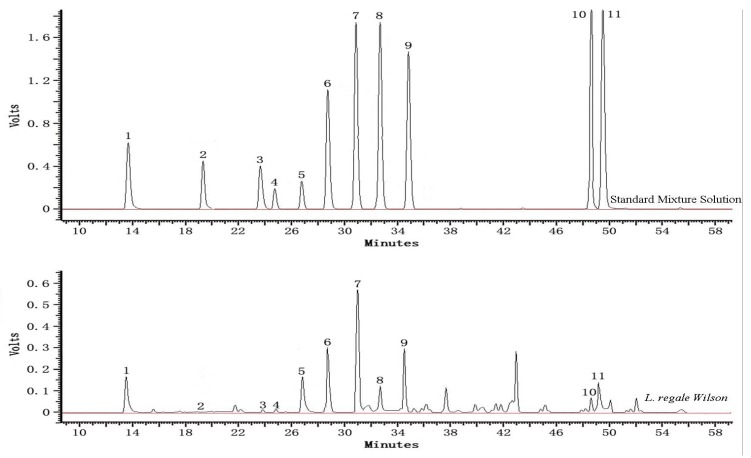
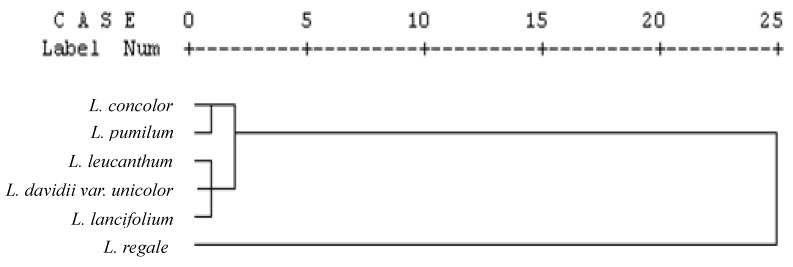
Lily (Lilium) is used as an important edible and medical plant species with a vague taxonomic classification and a long history in China. Bulbs of six Lilium species (L. regale, L. concolor, L. pumilum, L. leucanthum, L. davidii var. unicolor and L. lancifolium) native to China were investigated with a view to their exploitation as a potential source of natural antioxidants due to their phenolic composition and dietary antioxidant potential. The results showed that all bulb extracts exhibited strong antioxidant activities, which generally correlated positively with the total phenolic contents (r = 0.68 to 0.94), total flavonoid contents (r = 0.51 to 0.89) and total flavanol contents (r = 0.54 to 0.95). High-performance liquid chromatography (HPLC) analysis revealed that rutin and kaempferol were the major phenolic components in the extracts. Hierarchical cluster analysis showed that L. regale belonged to the group with high phenolic content and strong antioxidant power. L. concolor and L. pumilum were arranged in one group characterized by moderate phenolic content and antioxidant capacity, while L. leucanthum, L. davidii var. unicolor and L. lancifolium were clustered in the third group with low phenolic content and weak antioxidant activity. These strongly suggest that lily bulbs may serve as a potential source of natural antioxidant for food and pharmaceutical applications.
百合(Lilium)作为一种重要的食用和药用植物,在中国具有模糊的分类学和悠久的历史。本研究对原产于中国的 6 种百合(L. regale、L. concolor、L. pumilum、L. leucanthum、L. davidii var. unicolor 和 L. lancifolium)的鳞茎进行了研究,以期将其开发为天然抗氧化剂的潜在来源,因为它们具有酚类成分和膳食抗氧化潜力。结果表明,所有鳞茎提取物均表现出较强的抗氧化活性,这通常与总酚含量(r = 0.68 至 0.94)、总黄酮含量(r = 0.51 至 0.89)和总黄烷醇含量(r = 0.54 至 0.95)呈正相关。高效液相色谱(HPLC)分析表明,芦丁和山柰酚是提取物中的主要酚类成分。层次聚类分析表明,L. regale 属于酚类含量高、抗氧化能力强的组。L. concolor 和 L. pumilum 排列在一个组中,其特点是酚类含量和抗氧化能力适中,而 L. leucanthum、L. davidii var. unicolor 和 L. lancifolium 则聚类在第三个组中,其酚类含量低,抗氧化活性弱。这些结果强烈表明,百合鳞茎可能是食品和医药应用中天然抗氧化剂的潜在来源。