Department of Biology, University of Crete, Voutes University Campus, Heraklion, Crete, Greece.
PLoS One. 2012;7(7):e41979. doi: 10.1371/journal.pone.0041979. Epub 2012 Jul 27.
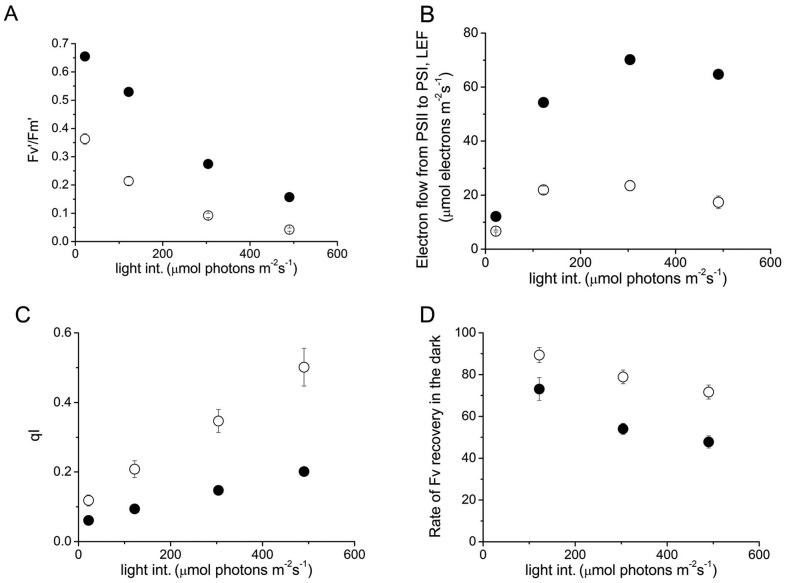
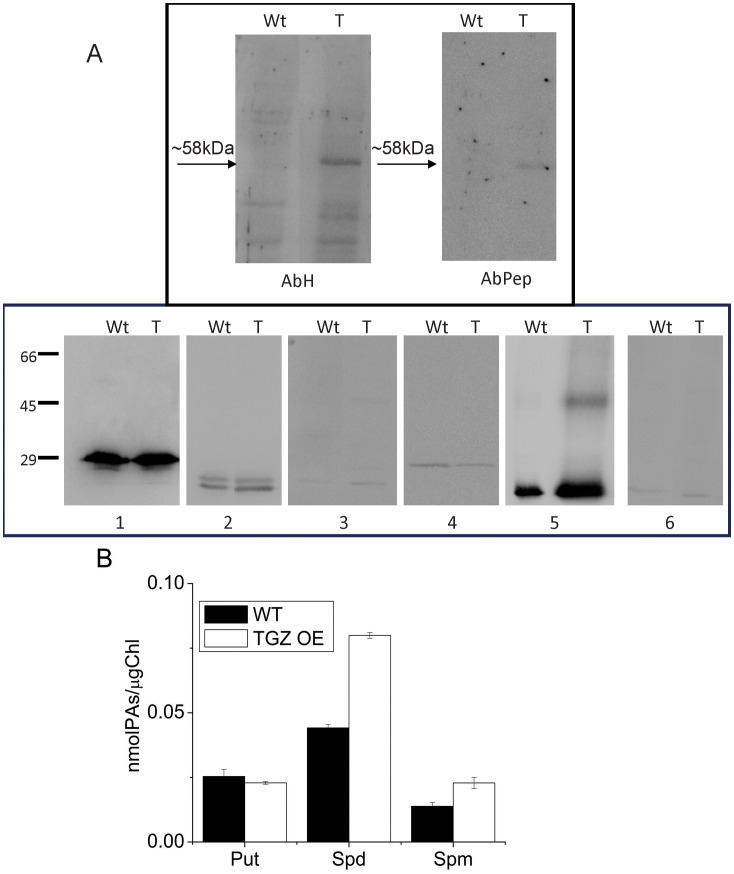
Transglutaminases function as biological glues in animal cells, plant cells and microbes. In energy producing organelles such as chloroplasts the presence of transglutaminases was recently confirmed. Furthermore, a plastidial transglutaminase has been cloned from maize and the first plants overexpressing tgz are available (Nicotiana tabacum TGZ OE). Our hypothesis is that the overexpression of plastidal transglutaminase will alter photosynthesis via increased polyamination of the antenna of photosystem II. We have used standard analytical tools to separate the antenna from photosystem II in wild type and modified plants, 6 specific antibodies against LHCbs to confirm their presence and sensitive HPLC method to quantify the polyamination level of these proteins. We report that bound spermidine and spermine were significantly increased (∼80%) in overexpressors. Moreover, we used recent advances in in vivo probing to study simultaneously the proton and electron circuit of thylakoids. Under physiological conditions overexpressors show a 3-fold higher sensitivity of the antenna down regulation loop (qE) to the elicitor (luminal protons) which is estimated as the ΔpH component of thylakoidal proton motive force. In addition, photosystem (hyper-PSIIα) with an exceptionally high antenna (large absorption cross section), accumulate in transglutaminase over expressers doubling the rate constant of light energy utilization (Kα) and promoting thylakoid membrane stacking. Polyamination of antenna proteins is a previously unrecognized mechanism for the modulation of the size (antenna absorption cross section) and sensitivity of photosystem II to down regulation. Future research will reveal which peptides and which residues of the antenna are responsible for such effects.
转谷氨酰胺酶在动物细胞、植物细胞和微生物中充当着生物胶的作用。在产能细胞器如叶绿体中,最近也证实了转谷氨酰胺酶的存在。此外,已经从玉米中克隆了一种质体转谷氨酰胺酶,并且第一批过表达 tgz 的植物(烟草 TGZ OE)也已问世。我们的假设是,通过增加光合系统 II 天线的多聚胺化,过表达质体转谷氨酰胺酶将改变光合作用。我们使用标准分析工具将天线与野生型和改良植物中的光合系统 II 分离,使用 6 种针对 LHCbs 的特异性抗体来确认它们的存在,并使用灵敏的 HPLC 方法来定量这些蛋白质的多聚胺化水平。我们报告说,结合的亚精胺和精胺在过表达体中显著增加(约 80%)。此外,我们利用最近在体内探测方面的进展,同时研究了类囊体的质子和电子回路。在生理条件下,过表达体对天线下调环(qE)对激发子(腔质子)的敏感性提高了 3 倍,这可以估计为类囊体质子动力势的ΔpH 分量。此外,具有异常高天线(大吸收截面)的光系统(超 PSIIα)在转谷氨酰胺酶过表达体中积累,使光能利用的速率常数(Kα)增加了一倍,并促进了类囊体膜的堆叠。天线蛋白的多聚胺化是调节光系统 II 大小(天线吸收截面)和对下调敏感性的一种以前未被认识的机制。未来的研究将揭示哪些肽和天线的哪些残基负责这种效应。