Al-Khayyat Arwa Ishaq, Al-Anazi Mohammed, Warsy Arjumand, Vazquez-Tello Alejandro, Alamri Abdullah Mohammed, Halwani Rabih, Alangari Abdullah, Al-Frayh Abdurrahman, Hamid Qutayba, Al-Muhsen Saleh
Department of Biochemistry, College of Science, King Saud University, Riyadh, Saudi Arabia.
Ann Saudi Med. 2012 Sep-Oct;32(5):479-86. doi: 10.5144/0256-4947.2012.479.
Genetic association studies have demonstrated that over 100 variants in target genes (including ADAM33) are associated with airway remodeling and hyper-responsiveness in different ethnic groups; however, this has never been evaluated in Arabic populations. The objective of this study was to determine whether ADAM33 polymorphisms that are associated with asthma in a population of asthmatic children from Saudi Arabia.
A cross-sectional pilot study comparing the polymorphisms of normal subjects and asthmatic patients from Saudi Arabia over a period of 1 year.
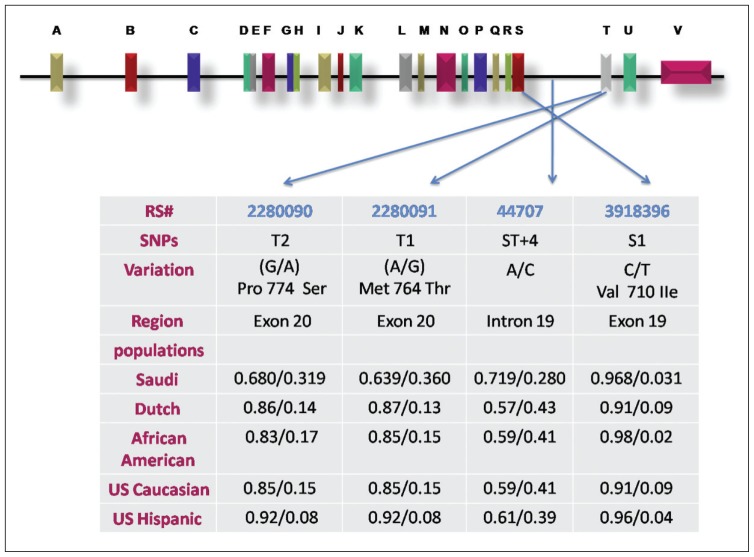
One hundred and seven Saudi asthmatic children and 87 healthy Saudi children of 3-12 years old were assessed for allelic association of ADAM33 T1 (rs2280091), T2 (rs2280090), ST+4 (rs44707) and S1 (rs3918396) SNPs to asthma. Genotyping was done by real-time PCR, multiplex ARMS and PCR-RFLP.
T1 and T2 SNP genotype frequencies in asthmatic children were significantly different compared to controls (P < .05), indicating allelic association with asthma. The T1 A/G and G/G and the T2 A/G and A/A genotypes (P=.0013 and P=.008, respectively) but not S1 and ST+4, increased the risk of asthma when using the best fit dominant model. Strong linkage disequilibrium between T1 (rs2280091) and T2 (rs2280090) was observed (r2=0.83; D'=0.95; P < .001). The haplotype G-A-A-C was significantly more frequent in asthmatics, thus supporting the association of T1 G-allele and T2 A-allele with increased predisposition to asthma (P=.007).
T1 A/G and T2 G/A ADAM33 polymorphisms, but not S1 or ST+4, were significantly associated with asthma development in Saudi children, like those reported for white and Hispanic populations in the United States.
基因关联研究表明,目标基因(包括ADAM33)中的100多个变异与不同种族群体的气道重塑和高反应性相关;然而,阿拉伯人群从未对此进行过评估。本研究的目的是确定在沙特阿拉伯哮喘儿童群体中,ADAM33基因多态性是否与哮喘相关。
一项横断面试点研究,在1年时间内比较沙特阿拉伯正常受试者和哮喘患者的基因多态性。
对107名3至12岁的沙特哮喘儿童和87名健康沙特儿童进行评估,以确定ADAM33 T1(rs2280091)、T2(rs2280090)、ST + 4(rs44707)和S1(rs3918396)单核苷酸多态性与哮喘的等位基因关联。通过实时PCR、多重扩增不应变突变系统(ARMS)和PCR - 限制性片段长度多态性(RFLP)进行基因分型。
与对照组相比,哮喘儿童中T1和T2单核苷酸多态性基因型频率有显著差异(P < 0.05),表明与哮喘存在等位基因关联。当使用最佳拟合显性模型时,T1 A/G和G/G以及T2 A/G和A/A基因型(分别为P = 0.0013和P = 0.008)而非S1和ST + 4,增加了哮喘风险。观察到T1(rs2280091)和T2(rs2280090)之间存在强连锁不平衡(r2 = 0.83;D' = 0.95;P < 0.001)。单倍型G - A - A - C在哮喘患者中显著更常见,因此支持T1 G等位基因和T2 A等位基因与哮喘易感性增加相关(P = 0.007)。
与美国白人和西班牙裔人群的报道一样,ADAM33基因的T1 A/G和T2 G/A多态性而非S1或ST + 4多态性与沙特儿童哮喘的发生显著相关。